A motorized chair for elderly parents means one of four very different things: a power wheelchair (joystick-driven, for people who cannot walk far), a power lift recliner (helps them stand up from sitting), a mobility scooter (for errands, requires good sitting balance), or a newer category of 3-in-1 electric rollator-wheelchairs. New power wheelchairs run roughly $900 to $5,900 in 2026, and Medicare Part B covers 80% of approved models — but only with a doctor’s order proving in-home medical need. This guide walks through which type actually fits your parent’s situation, what each honestly costs, and the cheaper alternatives that solve the real problem in many families.
Table of Contents
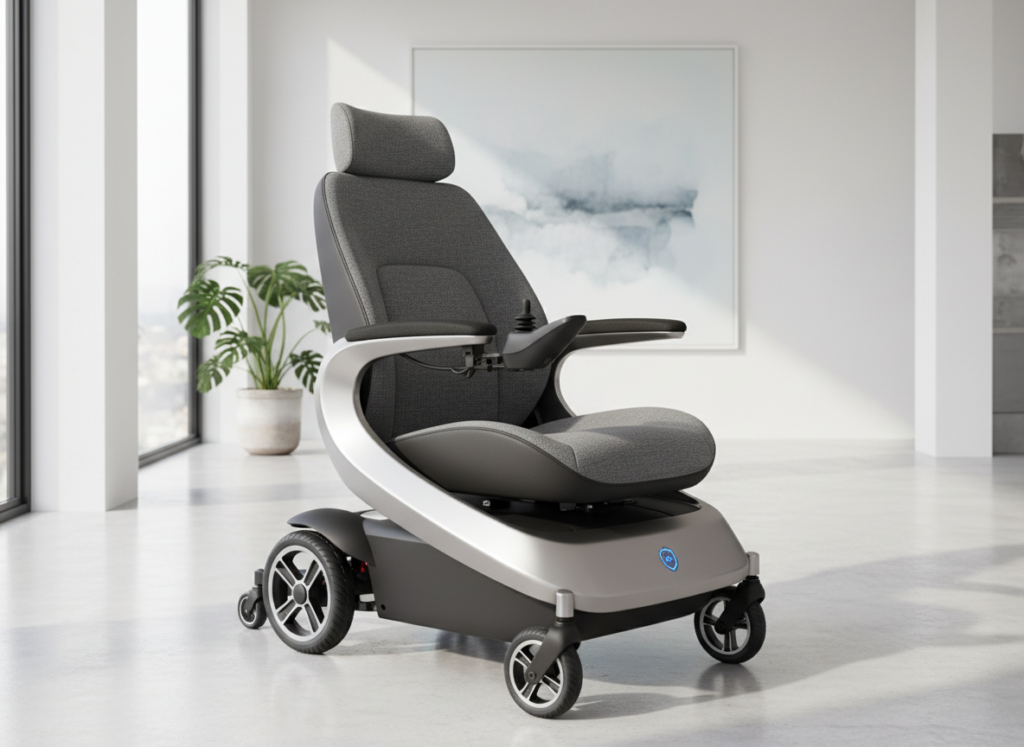
The four types of motorized chair for elderly users at a glance
| Type | Typical price | Best for | Key spec to check |
|---|---|---|---|
| Power wheelchair | $900–$5,900 | Cannot walk household distances, has hand control | Weight capacity (usually 300 lbs), battery range 8–16 miles |
| 3-in-1 electric rollator/wheelchair | Varies — check retailer | Can still walk some, tires on longer outings | Device weight (38–62 lbs), joystick + walker modes |
| Electric seat lift | $399.99 (Elenker JC35M3-1, verified July 2026) | Can walk, but struggles to stand from sitting | Lift height range, 300 lb capacity |
| Rollator walker (non-powered) | $149.99 (Elenker HFK-9210KDB, verified July 2026) | Steady enough to walk with support | Seat height, dual brakes, wheel size |
Quick pick: Not sure where to start? Most families researching a motorized chair for elderly parents are actually dealing with one specific moment — someone who struggles to stand up from a chair, not someone who can’t walk at all. For that scenario, the Elenker JC35M3-1 electric seat lift ($399.99) solves the problem directly, at a tenth of the cost of a mid-range power wheelchair, without taking away a single step of walking your parent still has.
What people actually mean by “motorized chair”
When adult children search for a motorized chair for elderly parents, they are usually reacting to one specific moment — Dad could not get out of his armchair without help, or Mum had to sit down twice walking to the mailbox. The right device depends entirely on which moment it was, because the four product categories solve four different problems.
A power wheelchair replaces walking. It is joystick-controlled, turns tightly indoors, and counts as a medical device in Medicare’s eyes. A mobility scooter replaces walking outdoors and in shops, but demands good trunk stability and two-handed steering — many seniors who need a power chair cannot safely use a scooter.
A power lift chair or seat assist tilts forward to help someone stand; it solves the standing-up problem, not the walking problem. And the 3-in-1 electric rollator is the newest category: a walker your parent pushes when they can walk, that converts to a joystick-driven electric wheelchair when they cannot.
Getting the category right matters more than the brand. A $4,000 power wheelchair is the wrong purchase for a parent whose real problem is standing up from the sofa — a $400 seat lift solves that one.
Does your parent actually need a motorized chair for elderly care?
A motorized chair introduced too early accelerates decline. Physical therapists are blunt about this: a senior who can still walk with a rollator, and stops walking because a power chair is easier, loses leg strength and balance faster — which raises fall risk everywhere the chair is not, the bathroom above all. If your parent is at that borderline stage, a walker plus a fall detection watch is often a safer combination than early wheels.
A motorized chair for elderly parents is genuinely the right call when walking itself has become unsafe or impossible: severe COPD where twenty steps means stopping for breath, advanced arthritis or neuropathy, heart failure with strict exertion limits, or a stroke that took one side’s strength. For a parent recovering from hip replacement surgery who needs six weeks of reduced weight-bearing, renting beats buying — most medical supply companies rent power chairs month to month.
One hard caution: for a parent with dementia, a motorized chair is usually the wrong answer even when their legs are weak. Joystick control requires judgment about speed, obstacles and edges that dementia steadily removes, and a powered chair can carry a confused senior a long way from home quickly. Families managing wandering risk should read our guide to GPS locator watches for seniors with dementia before putting anyone on powered wheels.

Power wheelchairs: what the market actually looks like in 2026
Power wheelchairs split into three tiers. Travel/portable chairs disassemble or fold for a car boot — the Pride Jazzy Go Chair MED is the best-known example, breaking down into lightweight components a caregiver can lift. Full-size chairs add bigger batteries, suspension and seating options for all-day users. Bariatric and heavy-duty chairs extend weight capacity beyond the standard 300 lbs.
Specs that matter more than brand marketing: battery range (look for 10–15 miles real-world — a chair that manages the house and the block, not just the house), turning radius for hallways and bathrooms, seat width against your parent’s build, and total chair weight if it must ever go in a car. Joystick sensitivity is adjustable on most 2026 models and worth setting up properly for arthritic hands.
We do not currently have an affiliate relationship with any power wheelchair manufacturer, so the names above are simply what our research found ranking well on merit. Prices vary widely by configuration — check Pride Mobility and large medical equipment retailers directly for current pricing, and get a written quote that includes the seat, batteries and delivery, which are quoted separately more often than you would expect.
The 3-in-1 electric rollator-wheelchair hybrids
The most interesting development for borderline walkers is the 3-in-1 electric rollator: walker, transport chair and joystick-driven electric wheelchair in one frame. Your parent walks behind it while they have the energy — keeping those leg muscles working — then sits and drives when they tire — a motorized chair for elderly users who can still walk part of the time. For a senior with heart failure who can manage the shops for twenty minutes but not the walk back to the car, this solves the exact problem.
Real models in this category as of July 2026: the Rollz Motion Electric (62 lbs, dual mode: assisted push or joystick), the Sinceborn 3-in-1 (38 lb carbon-fibre frame, 360° joystick, roughly 3.7 mph), the CARLIKE 3-in-1 (39 lbs, 500W motors, detachable footrests) and the Paiseec W3 (49.6 lbs, up to 16 miles per charge, 300 lb capacity). Prices in this category change frequently and vary by seller — check current pricing at the retailer before deciding, and confirm the return policy, because joystick comfort is impossible to judge from a listing.
One honest caveat: these hybrids are heavier than a standard rollator (a normal walker weighs 20–30 lbs; hybrids run 38–62 lbs). If your parent’s routine involves lifting the walker up porch steps or into a car boot themselves, a powered hybrid may be less independent, not more.
What Medicare will and won’t pay for
Medicare Part B treats a motorized chair for elderly users — a power wheelchair, in its terms — as durable medical equipment. The rules are stricter than most families expect. Your parent needs a face-to-face exam and a written order from a doctor stating they cannot use a cane, walker or manual wheelchair effectively inside the home — outdoor errands do not count in the assessment.
If approved, Medicare pays 80% of the approved amount after the Part B deductible, through a Medicare-enrolled supplier. Scooters face the same test; lift chairs are only partially covered (the lift mechanism, not the chair itself); and the 3-in-1 hybrids generally are not covered at all because they are not coded as wheelchairs.
If budget is the constraint, the same state programs and waivers that fund medical alert systems sometimes fund mobility equipment — our guide to free medical alert systems for seniors walks through Medicaid waivers, Area Agencies on Aging and veterans’ benefits that apply to both.
The alternatives most families should price first
In our experience helping families evaluate this purchase, a large share of “Dad needs a motorized chair” situations are actually one of two cheaper problems: he cannot stand up from sitting, or he cannot walk far without resting. Both have solutions under $400.
If standing up is the problem: Elenker JC35M3-1 electric seat lift — $399.99
The Elenker JC35M3-1 electric chair lift is a portable battery-powered lifting seat: it lowers to 2.3 inches, lifts to 19 inches, and raises a seated person most of the way to standing at the press of a hand control. It carries 300 lbs, weighs 24 lbs itself, runs about 10 lifts per 2.5-hour charge, and is IP68-rated, so it works in wet rooms. Unlike a lift recliner it moves around the house — same device at the armchair, the dining table and beside the bed. At $399.99 (price verified on Elenker’s site, July 2026) it costs a tenth of a mid-range power chair and directly solves the sit-to-stand problem — for many families researching a motorized chair for elderly parents, this is the device they actually needed.
If standing transfers need a helper: Elenker HFK-9405 stand assist — $319.99
For couples where one spouse physically pulls the other up, the Elenker HFK-9405 stand assist lift ($319.99, down from $479.99, verified August 2026) gives the standing person a stable frame to pull up on instead of a caregiver’s back. Caregiver back injuries are how home care arrangements collapse — this is cheap insurance against that.
If walking endurance is the problem: Elenker HFK-9210KDB rollator — $149.99
The Elenker HFK-9210KDB all-terrain rollator ($149.99, down from $249.99, verified July 2026) has 12-inch wheels that handle grass and gravel, dual brakes, and a padded seat for resting mid-walk. For a parent who can walk but needs guaranteed rest stops, a rollator with a seat preserves their strength and independence in a way a powered chair cannot.
Full comparison: every option side by side
| Product | Type | Price | Weight capacity | Device weight | Where to buy |
|---|---|---|---|---|---|
| Pride Jazzy Go Chair MED | Travel power wheelchair | Varies — check Pride Mobility | ~300 lbs | Disassembles into light components | Pride Mobility dealers |
| Rollz Motion Electric | 3-in-1 hybrid | Varies — check retailer | ~300 lbs | 62 lbs | Rollz retailers |
| Sinceborn 3-in-1 | 3-in-1 hybrid | Varies — check retailer | ~300 lbs | 38 lbs (carbon fibre) | Walmart |
| CARLIKE 3-in-1 | 3-in-1 hybrid | Varies — check retailer | ~300 lbs | 39 lbs | Amazon |
| Paiseec W3 | 3-in-1 hybrid | Varies — check retailer | 300 lbs | 49.6 lbs, 16-mile range | Paiseec |
| Elenker JC35M3-1 seat lift | Electric seat lift | $399.99 | 300 lbs | 24 lbs, IP68, 19″ lift | Elenker |
| Elenker HFK-9405 stand assist | Stand assist lift | $319.99 | 300 lbs | Frame lift, home care | Elenker |
| Elenker HFK-9210KDB rollator | Rollator with seat | $149.99 | 300 lbs | 12″ all-terrain wheels | Elenker |
Elenker prices verified on elenkerwalker.com in July 2026. Elenker discontinued its own DY-series electric wheelchairs, so for full power wheelchairs you will be buying from a dedicated mobility dealer — the Elenker options above are the walk-preserving and transfer-assist alternatives.
Frequently asked questions
Will Medicare pay for a motorized wheelchair for the elderly?
Medicare does pay for a motorized chair for elderly patients — but only with a doctor’s face-to-face exam and written order stating your parent cannot get around inside the home with a cane, walker or manual wheelchair. If approved, Part B pays 80% of the approved amount after the deductible, through a Medicare-enrolled supplier. Outdoor-only need does not qualify.
How much does a motorized chair for elderly adults cost?
New power wheelchairs run roughly $900 to $5,900 in 2026 depending on size, battery and features. Portable seat lifts like the Elenker JC35M3-1 cost $399.99, and 3-in-1 electric rollator hybrids sit between those — prices vary by seller, so check current listings.
What is the difference between a mobility scooter and a power wheelchair?
A scooter steers with a handlebar (tiller) and needs good sitting balance and two working hands; it suits outdoor errands. A power wheelchair steers with a one-hand joystick, turns much more tightly, and works indoors. Seniors with limited trunk strength or one weak side almost always need the wheelchair, not the scooter.
What is a 3-in-1 rollator walker/electric wheelchair?
A single frame that works as a pushed rollator walker, a caregiver-pushed transport chair, and a joystick-driven electric wheelchair. It suits seniors who can still walk short distances but tire quickly. Models include the Rollz Motion Electric, Sinceborn 3-in-1, CARLIKE 3-in-1 and Paiseec W3.
How far can an electric wheelchair go on a single charge?
Typically 8 to 16 miles depending on battery, rider weight and terrain. The Paiseec W3 hybrid claims up to 16 miles. Cold weather and hills cut real-world range meaningfully, so treat quoted figures as best-case.
Can seniors with dementia safely use a motorized wheelchair?
Usually not. Joystick driving requires ongoing judgment about speed, obstacles and drop-offs, and powered mobility increases wandering range. Talk to an occupational therapist first, and consider location safeguards like a GPS locator watch alongside any mobility decision.
What can I use instead of a motorized chair if my parent can still walk?
A rollator with a built-in seat (rest stops on demand), an electric seat lift if standing up is the struggle, or a stand assist frame for helped transfers. All three cost under $400 and preserve the walking your parent still has, which is the best fall prevention there is.
The bottom line
The right motorized chair for elderly parents depends on which problem you are solving. If your parent cannot walk safely inside the home, pursue a power wheelchair through their doctor and Medicare — the paperwork takes weeks, so start now. If they can walk but tire on outings, a 3-in-1 electric rollator hybrid keeps them walking while guaranteeing a ride home.
If the real struggle is getting up from a chair, the $399.99 Elenker JC35M3-1 seat lift solves that without taking away a single step of walking. And if they simply need rest breaks, a $149.99 rollator with a seat is the honest answer — the most expensive option is not the safest one, and keeping your parent on their feet as long as safely possible is the goal every one of these devices should serve.