It was 11pm when the phone rang.
In This Guide
- Overview
- Comparison
- Best Options
- Our Recommendation
Her mother had been gone for two hours before anyone noticed. The neighbours found her three streets away, confused, standing in someone else’s front garden in her nightgown. She had no idea how she got there.
The next morning, her daughter searched for a GPS locator watch for seniors with dementia. She needed something that would tell her the moment her mother left the house — not two hours later.
If you are at that moment — or if you want to be ready before it arrives — this guide is for you. It covers the best GPS locators for dementia wandering, the form factor decision that most caregivers get wrong, and the nighttime strategy that matters most.
Why Dementia Wandering Makes a GPS Locator Essential — GPS Locator Watch Seniors Dementia
Wandering is one of the most dangerous behaviours associated with dementia. According to the Alzheimer’s Association, 6 in 10 people with dementia will wander at some point. Without a GPS tracker for elderly parents, a wandering senior can travel miles from home before anyone realises they are missing. Caregivers evaluating GPS locator watch seniors dementia will find the key details in this section.
Sundowning — the pattern of increased confusion and agitation in the late afternoon and evening — means the highest-risk window is often between dusk and early morning. This is also when caregivers are most likely to be asleep.
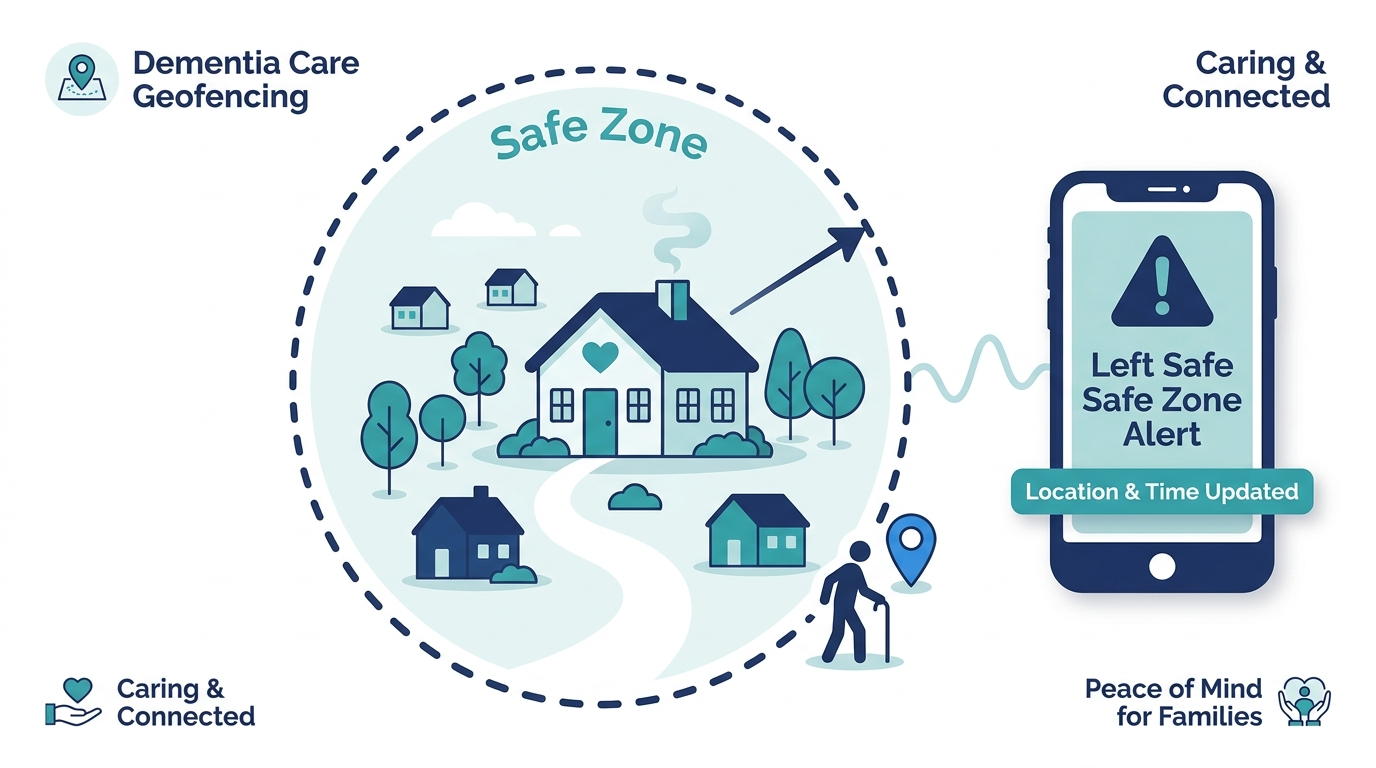
A GPS locator with geofencing solves this by sending an automatic alert to your phone the moment your parent crosses a boundary you have set — the front door, the garden gate, the end of the street. You do not need to check an app. You do not need to wait for a phone call. The alert comes to you.
The question is not whether your parent needs a GPS locator. The question is which form factor they will actually keep on their body.
The Most Important Decision — Watch or Clip-On?
This is the decision most GPS locator guides skip entirely — and it is the most important one for dementia. Caregivers evaluating GPS locator watch seniors dementia will find the key details in this section.
A GPS watch for seniors assumes your parent will:
- Accept wearing a watch every day
- Not remove it when confused or agitated
- Charge it daily or every other day
- Not lose it between charges
For many dementia seniors, none of these assumptions hold. A parent who would never have removed a watch before their diagnosis may become resistant to anything on their wrist as dementia progresses. A parent in moderate or advanced dementia may remove the watch repeatedly — not out of defiance, but because they have forgotten what it is or why it is there.
A clip-on GPS locator attaches to clothing — a collar, a belt loop, a pocket, a bra strap. It is small enough to go unnoticed. It does not feel like a medical device. For many dementia seniors who resist wrist-worn devices, a clip-on stays on simply because they forget it is there.
The form factor question is: will your parent keep a watch on their wrist every day, including at night? If the honest answer is yes — choose a watch. If the answer is maybe, sometimes, or no — choose a clip-on.
Quick Comparison: GPS Locators for Dementia Wandering
Battery life and geofencing are the two specs that matter most for dementia — a device with a short battery or no automatic boundary alert leaves the exact overnight window unprotected. This table pulls the verified specs from each review below so you can compare at a glance before reading further.
| Device | Form Factor | Monthly Cost | Battery Life | Geofencing | Fall Detection | Monitoring Centre |
|---|---|---|---|---|---|---|
| Jiobit | Clip-on | $14.99–$19.99 | 7–10 days | Yes | No | No |
| Medical Guardian Smart Watch | Watch | $44.95 | 24–48 hours | Yes | Yes | Yes (CSAA Five Diamond) |
| AngelSense | Clip-on, tamper-resistant | $32–$39 | 2–4 days | Yes | No | No — voice monitoring instead |
| Bay Alarm SOS Smart Watch | Watch | $24.95 | ~24 hours | Not specified by manufacturer | Optional add-on | Yes (Bay Alarm Medical) |
| Lively Jitterbug Smart3 | Watch | $19.99–$29.99 | 1–2 days | Not specified by manufacturer | Yes | Yes (Lively Urgent Response) |
Two devices in this table — Bay Alarm SOS Smart Watch and Lively Jitterbug Smart3 — do not publish an explicit geofencing feature the way Jiobit, Medical Guardian Smart Watch, and AngelSense do. If automatic boundary alerts are the deciding factor for your parent’s wandering risk, confirm geofencing directly with the provider before choosing either of those two.
Jiobit — Best Clip-On GPS Locator for Dementia Wandering
Jiobit is the best GPS locator for dementia seniors who will not reliably wear a watch — and the strongest overnight wandering solution available in 2026. Caregivers evaluating GPS locator watch seniors dementia will find the key details in this section.
The 7 to 10 day battery is the defining specification. For a dementia senior who cannot manage charging, a tracker that only needs to be charged once a week dramatically reduces the risk of a dead device during a wandering event. Compare this to GPS watches that require daily or every-other-day charging — every missed charge is a window of vulnerability.
Jiobit clips to a collar, belt loop, pocket, or bag via a small, secure clip. For overnight protection, clip it to your parent’s pyjama collar before bed. The device continues tracking through the night without any action from your parent.
Geofencing sends an automatic alert to your phone when your parent moves outside the designated safe zone — the home perimeter, the garden, a care facility boundary. Real-time location is visible on your phone app continuously.
Jiobit does not include fall detection or a professional monitoring centre. It is a location tracker only. For a parent who also needs a fall detection watch for seniors, pair Jiobit with a separate fall detection pendant — or choose Medical Guardian Smart Watch (below) if your parent will reliably wear a watch.
- Device: $99–$129
- Monthly: $14.99–$19.99
- GPS: Real-time, continuous
- Geofencing: Yes — automatic caregiver alerts
- Battery: 7–10 days
- Waterproof: Yes
- Fall detection: No
- Monitoring centre: No
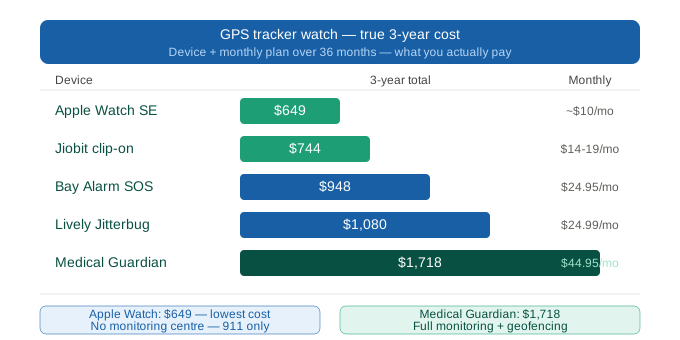
- Year 3 total: ~$639–$849
Best for: Dementia seniors who resist wrist-worn devices. Overnight wandering prevention — clip to pyjamas. Budget-conscious caregivers who need location tracking without monitoring subscription costs.
Medical Guardian Smart Watch — Best Watch-Form GPS Locator for Dementia
Medical Guardian Smart Watch is the best GPS locator in watch form for a dementia senior who will reliably wear a watch — combining real-time location tracking, geofencing, fall detection, and a professional monitoring centre in one device. Caregivers evaluating GPS locator watch seniors dementia will find the key details in this section.
The geofencing feature is essential for dementia: set a safe zone around the home and the monitoring centre will alert you the moment your parent crosses the boundary — without you having to actively check the app. If your parent falls or presses the emergency button, the monitoring centre speaks with them through the watch and calls you directly before dispatching emergency services.
The cellular plan means no Wi-Fi dependency — the watch tracks and alerts regardless of your parent’s home internet status.
The limitation for dementia: the watch needs charging every 24 to 48 hours. For a dementia parent who cannot manage charging, this requires caregiver intervention — adding the watch to a daily charging routine, or charging it while the parent sleeps. If your parent is likely to resist wearing the watch or remove it frequently, Jiobit is the more reliable choice for tracking.
- Device: $60–$100
- Monthly: $44.95
- GPS: Continuous, with geofencing alerts
- Fall detection: Yes — monitoring centre response
- Monitoring centre: CSAA Five Diamond certified
- Battery: 24–48 hours
- No phone required
- Year 3 total: ~$1,678–$1,718
Best for: Dementia seniors who will wear a watch. Caregivers who need fall detection AND location tracking in one device. Situations where professional monitoring centre response is required.
AngelSense — Best for Advanced Dementia with Wandering Risk
AngelSense is purpose-built for dementia and special needs wandering prevention. It adds two features that standard GPS locators do not have: voice monitoring and a tamper-resistant wearable.
We cover verified pricing, attachment options, and the consent questions around voice monitoring in our full AngelSense GPS tracker review.
Voice monitoring allows the caregiver to listen to ambient sound through the device — when a geofence alert fires, you can hear what is happening in your parent’s environment before deciding how to respond. Is there traffic nearby? Is your parent distressed? Is someone with them? This context allows a more informed emergency response.
The tamper-resistant design makes AngelSense significantly harder to remove than a standard clip-on — important for dementia seniors who actively try to remove trackers once they notice them.
- Device: $99
- Monthly: $32–$39
- GPS: Real-time, with geofencing
- Fall detection: No
- Voice monitoring: Yes — listen to environment on demand
- Tamper-resistant: Yes
- Battery: 2–4 days
- Year 3 total: ~$1,251–$1,503
Best for: Advanced dementia with active wandering and removal risk. Caregivers who need environmental audio context when alerts fire. High-risk scenarios where standard geofencing is not sufficient.
Bay Alarm SOS Smart Watch — Best Budget GPS Watch for Dementia
Bay Alarm SOS Smart Watch provides GPS tracking and professional monitoring at the lowest monthly cost in the dedicated senior watch category — a practical option for caregivers who need monitoring on a tight budget.
For dementia specifically, note the gap flagged in the comparison table above: Bay Alarm does not publish an explicit geofencing feature, the automatic boundary-alert function the top three options in this guide rely on for wandering protection. Its GPS tracking works through a caregiver portal you check manually — a real limitation if your parent tends to leave home at night while you are asleep. Confirm directly with Bay Alarm Medical whether geofencing alerts are available on this device before choosing it as your primary wandering-prevention tool.
Where it does make sense: as a lower-cost monitored watch for a dementia senior in earlier stages, whose wandering risk is lower and who mainly needs a one-button connection to a monitoring centre plus basic location lookup if something goes wrong.
- Device: $49–$79
- Monthly: $24.95
- GPS: Yes — caregiver portal
- Fall detection: Optional add-on
- Monitoring centre: Yes — Bay Alarm Medical
- Battery: ~24 hours
- Year 3 total: ~$948
Best for: Budget-conscious caregivers who need a dedicated senior GPS watch with monitoring. Bay Alarm Medical’s established monitoring reputation at a lower price point than Medical Guardian.
Lively Jitterbug Smart3 — Best Value GPS Watch for Dementia
Lively Jitterbug Smart3 combines GPS tracking, monitoring centre access, and basic smartphone functionality at a lower monthly cost than Medical Guardian. The Lively Link caregiver app provides real-time location.
Like Bay Alarm, Lively Jitterbug Smart3 does not publish an explicit geofencing feature — location is available on demand through the Lively Link app rather than as an automatic boundary alert. Combined with its 1–2 day battery, the shortest in this guide, it is the option most likely to leave a gap during an overnight wandering event: a watch charged at bedtime is off the wrist during the exact hours sundowning risk is highest.
Its advantage over the other budget option is the built-in phone functionality — a dementia senior in earlier stages who can still recognise and use a call button gets a direct line to family or the monitoring centre, not just a tracked location.
- Device: $75–$150
- Monthly: $19.99–$29.99
- GPS: Yes — Lively Link app
- Fall detection: Yes
- Monitoring centre: Yes — Lively Urgent Response
- Battery: 1–2 days
- Year 3 total: ~$794–$1,229
Best for: Caregivers who want monitoring with GPS at a lower monthly cost. Seniors who may also want to make calls from the device.
The Nighttime Wandering Strategy
Sundowning creates the highest-risk wandering window — and it is also the window when most GPS watches are sitting on a charger.
Here is the charging conflict in plain terms:
A GPS watch with an 18 to 24-hour battery needs to be charged every night. If your parent charges it at bedtime, the watch is off their wrist from approximately 10pm to 7am — the exact window when sundowning-driven wandering is most likely.
Solutions:
Clip-on tracker on nightclothes: Attach a Jiobit to your parent’s pyjama collar before bed. The 7 to 10-day battery means it does not need nightly charging. Geofencing continues through the night without any action from your parent or caregiver.
Daytime charging routine: Charge the GPS watch during a regular daytime activity — during lunch, during afternoon rest, during a TV programme. This keeps the watch charged and on the wrist through the overnight hours.
Door sensor + GPS: Pair a GPS locator with a door sensor alarm. The door sensor provides an immediate local alert if the front door opens at night. The GPS locator provides location tracking once your parent is outside. Together they cover the gap between “parent has left the house” and “parent is located.”
Geofence the bedroom door: For parents in care facilities or large homes, set the geofence boundary at the bedroom door rather than the property perimeter. This gives an earlier warning before your parent has left the building.
How to Get Your Dementia Parent to Accept the GPS Locator
This is the practical challenge no product page addresses — and the reason many GPS locators end up unused.
For a watch-form locator:
Frame it as a gift, not a medical device. “I got you a new watch” is more likely to be accepted than “I need you to wear this tracker.” Present it as something you chose because it looks nice, not because you are worried.
Build it into an existing routine. Put the watch on at the same time every morning — after breakfast, after getting dressed. Routine is more powerful than instruction for dementia seniors.
Use a soft band. Some dementia seniors resist a watch because the band is uncomfortable. Try a softer silicone band. Comfort matters more than appearance for acceptance.
For a clip-on locator:
Attach it to something they already wear without thinking — a favourite cardigan, a belt they always put on, an inside pocket. The less visible and intrusive, the less likely they are to notice and remove it.
Do not point it out or explain it repeatedly. Every time you draw attention to it, you increase the chance they will try to remove it. Attach it quietly as part of dressing and move on.
If your parent removes it consistently: consider AngelSense, which has a tamper-resistant design that is significantly harder to detach.
Can Multiple Family Members Track the Same Device?
Yes — all the devices in this guide support multiple caregiver access.
Jiobit: Multiple users can be added to the same device account. All authorised family members can see real-time location and receive geofence alerts on their own phones.
Medical Guardian Smart Watch: Multiple emergency contacts can be set in the monitoring centre profile. Geofence alerts can be sent to multiple contacts.
AngelSense: Multiple guardians can access the app and receive alerts simultaneously.
For dementia care situations involving multiple family members or a combination of family and paid caregivers — set up all regular carers on the app during device setup. This ensures someone is always reachable when an alert fires.
Frequently Asked Questions
Q: What is the best GPS locator watch for seniors with dementia who wander at night?
A: Jiobit clip-on — 7 to 10 day battery, clips to pyjama collar, geofencing alerts you the moment your parent leaves home. No overnight charging required. Medical Guardian Smart Watch if your parent will wear a watch and you need fall detection combined with GPS. For a broader comparison see our guide to the best GPS watch for seniors.
Q: My mum has dementia and won’t wear a watch — what GPS locator can I use?
A: Jiobit. It clips to clothing — collar, belt, pocket — and is small enough that many dementia seniors tolerate it without noticing. For a parent who actively removes trackers, AngelSense has a tamper-resistant design.
Q: Can a GPS locator alert me when my parent with dementia leaves the house?
A: Yes — this is called geofencing. You set a safe zone on a map, and the device sends an automatic alert to your phone when your parent crosses the boundary. Jiobit, Medical Guardian Smart Watch, and AngelSense all have geofencing.
Q: How do I get my parent with dementia to wear a GPS watch?
A: Frame it as a new watch, not a medical device. Build wearing it into a consistent morning routine. Use a comfortable soft band. For parents who resist wrist-worn devices, switch to a clip-on tracker attached to a favourite item of clothing.
Q: What happens if my dementia parent takes off the GPS watch?
A: The watch stops tracking from the moment it is removed. If this happens consistently, switch to a clip-on tracker (Jiobit) or a tamper-resistant device (AngelSense). For caregivers who cannot monitor the watch continuously, a clip-on is more reliable than a watch for dementia.
Q: Is a clip-on GPS tracker better than a watch for dementia wandering?
A: For many dementia seniors, yes — because compliance is higher. A watch is better if your parent will wear it reliably and you want fall detection combined with GPS. A clip-on is better if your parent resists wrist-worn devices or if overnight tracking is the primary concern.
Q: Does a GPS locator watch work for sundowning and nighttime wandering?
A: Only if it is charged and on the wrist at night — most watches need nightly charging, creating a vulnerability window. Jiobit (7–10 day battery, clips to pyjamas) is the most reliable option for overnight protection without caregiver intervention.
Q: Can multiple family members track my dementia parent’s location at the same time?
A: Yes. Jiobit, Medical Guardian Smart Watch, and AngelSense all support multiple authorised users. All family members on the account can see real-time location and receive geofence alerts simultaneously.
Q: What is the difference between a GPS locator watch and an Apple AirTag for tracking a dementia parent?
A: Completely different technologies. A GPS locator watch uses cellular GPS to provide real-time location continuously — you can open the app right now and see exactly where your parent is. Apple AirTag is a Bluetooth proximity device that only shows location when another Apple device is nearby. In a low-traffic area, at night, or in a rural neighbourhood, an AirTag may show no location update for hours. Do not use an AirTag to track a wandering dementia parent.
Q: What GPS locator has the longest battery life for dementia — so I don’t have to worry about it dying overnight?
A: Jiobit — 7 to 10 days per charge. It is the only mainstream GPS locator for seniors with a battery long enough to reliably cover overnight periods without daily caregiver intervention. Medical Guardian Smart Watch (24–48 hours) and AngelSense (2–4 days) also perform better than GPS watches that require nightly charging. For broader eldercare support, the Eldercare Locator connects families with local services across the US.
Our Final Recommendation
For a dementia senior who resists wrist-worn devices or who wanders at night: Jiobit. Clip to pyjama collar. 7–10 day battery covers overnight without caregiver action. Geofencing alerts the moment they leave home.
For a dementia senior who will wear a watch and needs fall detection plus GPS: Medical Guardian Smart Watch. Professional monitoring centre, geofencing, continuous GPS.
For advanced dementia with active removal risk: AngelSense. Tamper-resistant, voice monitoring, purpose-built for dementia wandering.
For the lowest-cost GPS watch with monitoring: Bay Alarm SOS Smart Watch.
The most important step is choosing the right form factor for your parent’s specific behaviour. A GPS locator sitting on the kitchen counter because your parent won’t wear it protects no one.