She skipped lunch three days in a row the week she worked it out.
In This Guide
- Overview
- Comparison
- Best Options
- Our Recommendation
Not because she was dieting. Because the numbers did not add up. Her mother’s prescriptions were $214 a month. The grocery delivery she had set up cost $180. The cleaning help — two hours a week, someone her mother would actually let in — was $120. Rent was covered. Barely.
And somewhere in that budget was supposed to be a medical alert system, because her mother had fallen twice in the past year and lived alone and did not tell anyone about either fall until days later.
Twenty-eight dollars a month does not sound like a lot. It is a lot when there is nothing left.
If you are searching for a free medical alert system, you are not being naive. You are doing the maths that a lot of families are doing right now, and you are trying to find out if there is a way to protect someone you love without adding one more bill that cannot be paid.
Here is the honest answer: truly free medical alert systems exist — but they are narrower in availability than most guides suggest, and “free device” promotions are mostly not what they appear to be. This guide tells you exactly where the real options are, what to ask to access them, and what to do if none of them apply to your situation.
“Free” Has Two Meanings — And Only One Is Actually Free — Free Medical Alert Systems For Seniors
Before spending time on any specific option, it is worth establishing this distinction clearly — because not doing so wastes a lot of caregivers’ time. Caregivers evaluating free medical alert systems for seniors will find the key details in this section.
Type 1 — Truly free: $0 device, $0 monitoring, no contract. The system is provided through a government programme, insurance benefit, non-profit, or veteran service. The senior uses it at no cost as long as they qualify.
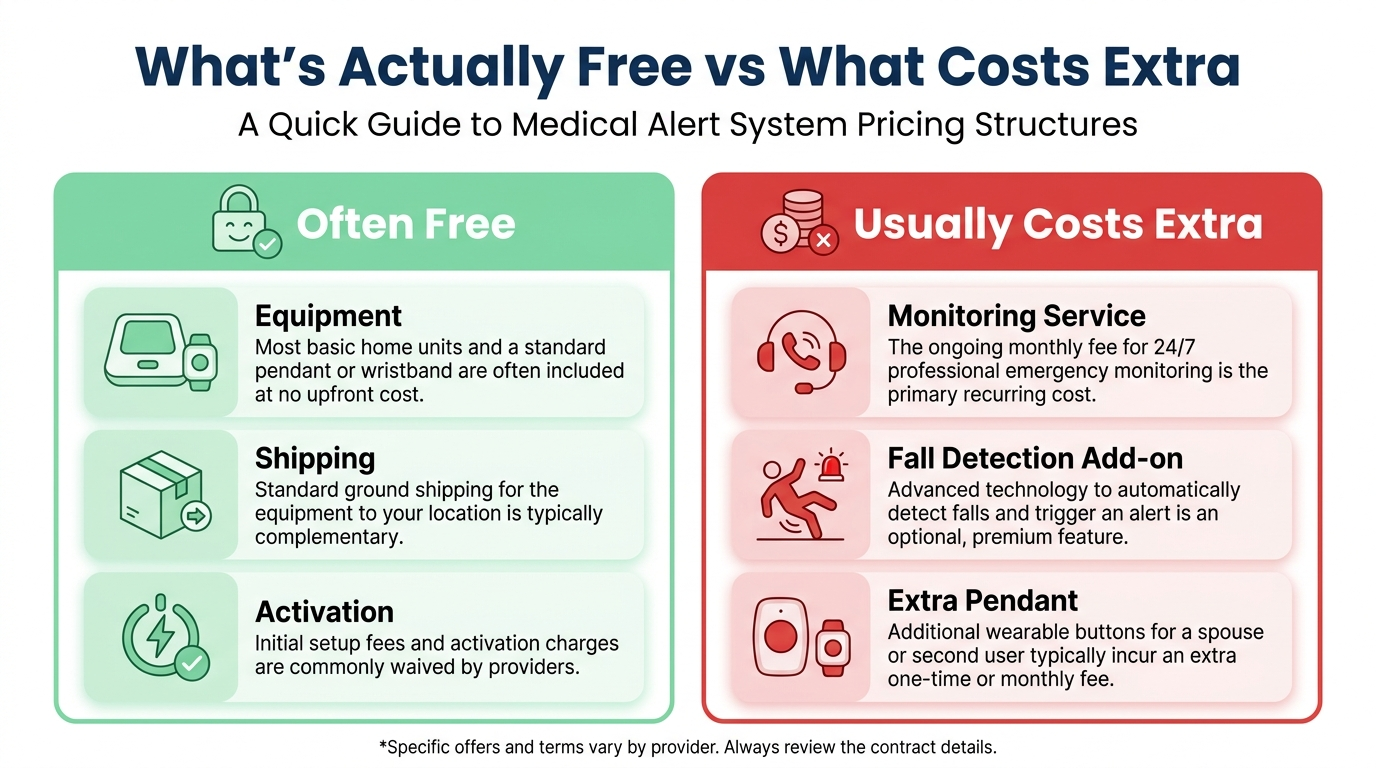
Type 2 — “Free device” promotions: The device costs nothing upfront, but the monitoring service costs $28–$40/mo on a 12-month contract. The first month may also be free. Year 1 total: $336–$480. This is a marketing approach, not a free system.
Most competitor sites blur these two categories. They list “free device” promotions alongside genuine $0 programmes as if they are equivalent. They are not. A family that cannot afford $28/mo cannot afford a “free device” promotion — because the monthly cost is identical to any other subscription plan.
This guide covers only genuinely free options in sections 2–5. Sections 6 and 7 address affordable medical alert systems for families who do not qualify for any free programme.
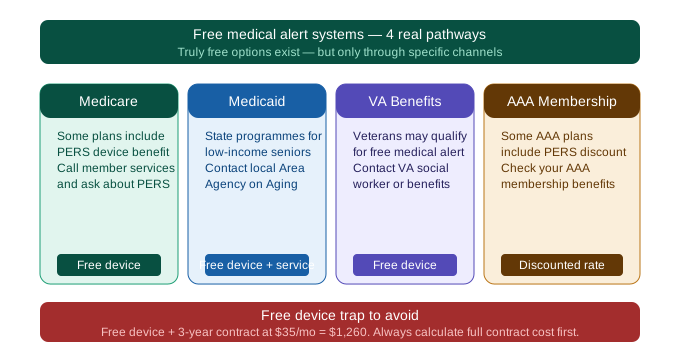
Truly Free Option 1 — Medicare Advantage Plans with PERS Benefit
This is the most widely accessible genuinely free option, and the one most caregivers do not know to ask about. Caregivers evaluating free medical alert systems for seniors will find the key details in this section.
Standard Medicare (Parts A and B) does not cover medical alert systems. But many Medicare Advantage plans — the private insurance alternative to standard Medicare — include personal emergency response systems (PERS) as a supplemental benefit. For qualifying plan members, this means a medical alert device and monitoring at $0 additional cost.
Not every Medicare Advantage plan includes this benefit. It varies by plan, by insurer, and by region. But enough plans include it that every caregiver should check before paying for a system out of pocket.
How to check your Medicare Advantage plan for PERS coverage in four steps:
Step 1: Find the member services number
Find the member services number on the back of your parent’s Medicare Advantage card.
Step 2: Call and ask specifically about PERS coverage
Call and say exactly this: “I would like to know whether my plan includes coverage for a personal emergency response system or medical alert device.”
Step 3: If the first answer is no, ask a second time with different wording
Ask: “Does my plan have any supplemental benefits that cover PERS devices or fall detection devices?” PERS benefits are often classified under supplemental or wellness categories that frontline representatives may not initially locate.
Step 4: If coverage is confirmed, ask how to access it
Ask: “How do I access this benefit? Do I need a referral from my doctor? Which devices or providers are covered under my plan?”
Plans that commonly include PERS benefits include many UnitedHealthcare Medicare Advantage plans (particularly those with AARP branding), some Humana Medicare Advantage plans, and some Blue Cross Blue Shield Medicare Advantage plans. Coverage details vary by year and region — always verify directly with your parent’s specific plan.
If your parent’s plan does include PERS coverage: the insurer will direct you to an approved provider. The device and monitoring are typically covered at $0 for the member, for the duration of plan enrolment.
Truly Free Option 2 — Area Agencies on Aging Loaner Programmes
Area Agencies on Aging (AAA) are federally funded local organisations that coordinate services for older adults in every county and region of the United States. Some — not all — operate medical alert loaner programmes for income-qualified seniors. Caregivers evaluating free medical alert systems for seniors will find the key details in this section.
These programmes provide a medical alert device — typically a basic in-home pendant with monitored emergency response — at no cost to qualifying seniors. Eligibility criteria typically include: age 60 or 65 and older, income at or below a defined threshold (often 150–200% of the federal poverty level), and residency within the AAA’s service area.
How to find your local AAA:
- Call the Eldercare Locator: 1-800-677-1116 (free, national helpline, operates Monday–Friday)
- Or visit online: eldercare.acl.gov
When you reach your local AAA, ask specifically: “Does your agency operate a medical alert loaner programme or do you know of any local programmes that provide free medical alert devices for income-qualified seniors?”
Important caveats: AAA loaner programmes are not available everywhere. In areas where they do exist, there may be waiting lists. Equipment is typically basic — standard in-home pendant, no GPS, often no auto-fall detection. For seniors with dementia or significant nighttime fall risk, a basic AAA loaner may not provide sufficient coverage on its own.
Truly Free Option 3 — Veterans Administration PERS Programmes
Veterans who receive healthcare through the VA may qualify for a personal emergency response system through the VA’s prosthetic and sensory aids service — at no cost. Caregivers evaluating free medical alert systems for seniors will find the key details in this section.
Eligibility is not automatic. The senior must: be enrolled in VA healthcare, have a clinical need for a PERS device as assessed by a VA care team, and receive a recommendation from their VA primary care provider or relevant specialist.
How to access VA PERS:
- Step 1: If your parent is not enrolled in VA healthcare, enrolment is the first step. Visit va.gov/health-care/apply or call 1-877-222-VETS (1-877-222-8387).
- Step 2: Contact the VA medical centre and ask to speak with the prosthetics and sensory aids department or a social worker.
- Step 3: Request an assessment for a personal emergency response system. The VA care team will determine eligibility based on clinical need.
VA PERS equipment varies by facility. Some VA medical centres provide devices directly. Others coordinate with community-based providers. A VA social worker is the most effective starting point for navigating the process.
Truly Free Option 4 — Medicaid HCBS Waivers
Some state Medicaid programmes cover medical alert systems — including the device and monitoring — for qualifying low-income seniors under Home and Community-Based Services (HCBS) waivers.
HCBS waivers are state-specific programmes that allow Medicaid to fund services that help seniors remain in their homes rather than entering nursing facilities. In states where PERS is an approved HCBS waiver service, qualifying seniors can receive a medical alert system at no cost.
Not all states include PERS in their HCBS waivers. Coverage, eligibility, and available equipment vary significantly by state.
How to check Medicaid HCBS PERS coverage in your state:
- Step 1: Contact your state’s Medicaid office. Each state has a different name for its Medicaid programme (Medi-Cal in California, TennCare in Tennessee, etc.).
- Step 2: Ask: “Does your state’s Medicaid HCBS waiver programme cover personal emergency response systems or medical alert devices?”
- Step 3: If yes, ask about eligibility requirements, the application process, and which devices are covered.
Alternative: Contact your local Area Agency on Aging (see above) — AAA staff typically know which Medicaid HCBS programmes cover PERS in their region and can assist with applications.
The “Free Device” Trap — When $0 Upfront Costs $36/Month
This section exists because caregivers searching for free options repeatedly encounter promotions that say “free medical alert system” and mean something very different.
Here is what “free device” actually means:
Bay Alarm Medical “free device” promotion: The device has no upfront cost. Monthly monitoring starts at $27.95. A 12-month commitment is typically required for the free device offer. Year 1 total: $335.40.
Medical Guardian free device promotion: $0 device with annual subscription commitment. Monthly fee: $37.95–$47.95. Year 1 total: $455.40–$575.40.
GetSafe free equipment: Free sensors and hub with professional monitoring commitment at $14.99–$34.99/mo. Year 1 total: $179.88–$419.88.
LifeFone free pendant promotion: Occasional offer with activation fee still applicable. Monthly fee: $29.95. Year 1 with activation fee: $384.40.
The point: a “free device” promotion reduces the upfront cost from $0 to $0 — but the ongoing monthly cost is identical to any other subscription plan. For a family that cannot afford the monthly fee, a free device changes nothing.
The only exception worth noting: Bay Alarm Medical’s no-monthly-fee device purchase plan (see our article on medical alert systems with no monthly fee) allows outright device purchase for $249 with no mandatory ongoing monitoring fee. This is not “free” — but it is the only plan in the category where the long-term cost approaches $0/month.
What If No Free Option Is Available? The Best Low-Cost Alternatives
For families who check all four options above and find none applies — wrong insurance plan, wrong state Medicaid coverage, not a veteran, no local AAA programme — these are the most affordable legitimate paid options in 2026.
QMedic — Cheapest Monthly Rate ($19.95–$24.95/mo)
The lowest-priced monitored medical alert system currently available. Landline plan: $19.95/mo. Cellular plan: $24.95/mo. No activation fee. No contract. Professional monitoring included. Fall detection availability varies — confirm before purchasing.
Bay Alarm Medical — Best Value With Fall Detection ($27.95/mo base)
$27.95/mo base with 1,000 ft in-home range — widest in the affordable category. Fall detection add-on: $10/mo. Use promo code OFFER17 for 17% off annual billing, reducing the effective monthly rate to approximately $23.20. No activation fee. No contract.
MobileHelp Solo — Reliable Budget Option ($27.95/mo)
Matches Bay Alarm on base price. No activation fee. No contract. Fall detection add-on: $5/mo. Good for smaller homes where the 600 ft range is sufficient.
LifeFone At-Home ($29.95/mo)
Strong customer service ratings. $25 activation fee (one-time). No contract. Fall detection add-on: $5/mo. 1,000 ft range, matching Bay Alarm.
For families in genuine financial hardship where even $20–$28/mo is not manageable:
Ask your parent’s GP or social worker for a referral to local financial assistance programmes. Many communities have emergency assistance funds, charity care programmes, or local senior service organisations that can cover or subsidise medical alert costs on a case-by-case basis.
Contact the National Council on Aging’s BenefitsCheckUp programme — a free tool that identifies state and federal benefit programmes a senior may qualify for, including some that cover assistive devices.
Can Free Medical Alert Systems Handle Dementia or Nighttime Falls?
This is the question the other “free medical alert” guides do not answer — and it matters.
Free systems provided through AAA loaner programmes and some Medicare Advantage plans typically include: a basic in-home pendant, connection to a monitoring centre, and a base station. They typically do not include: auto-fall detection, GPS tracking, or long-battery-life devices suitable for overnight wear.
For a senior with mild fall risk who will wear the pendant consistently during waking hours, a basic free system is meaningful protection.
For a senior with dementia and wandering risk: a free basic pendant is unlikely to be sufficient. GPS tracking — which requires a cellular-enabled device — is generally not available through free loaner programmes. This may mean a paid plan is necessary even when finances are tight.
For a senior with significant nighttime fall risk: a basic pendant that comes off at bedtime leaves the highest-risk hours uncovered. If the free device is a standard in-home pendant, establish a deliberate routine of wearing it overnight — and place a wall button by the toilet as an additional backup.
The honest reality: free systems provide foundational protection that is significantly better than no system at all. For higher-complexity needs — dementia, nighttime risk, wandering — supplementary paid options may be necessary even when the budget is severely constrained. See our full comparison of the best medical alert systems for higher-complexity scenarios.
How to Talk to a Parent About a Free or Low-Cost Medical Alert Without Hurting Their Dignity
This is the hardest part. And it is the part no guide addresses.
For a proud parent, “free” carries connotations they may find difficult: charity, need, dependency, decline. “I don’t need handouts” is a response caregivers hear. So is: “I’m not that old yet.”
Frame it as a benefit they have earned. “Mum, this is available through your health insurance — you’ve been paying for this for years. It’s a benefit you’re entitled to, like your prescription coverage.” Medicare and Medicare Advantage benefits are paid-for coverage, not charity. Framing them as earned entitlements removes the charity stigma.
For VA benefits: “Dad, this is a programme for veterans. You served. This is one of the things your service entitles you to.” For many veterans, framing around service and entitlement is the most effective approach.
Do not lead with “free.” Lead with safety and connection. “I found a way to set up a device so I can stop worrying every time you don’t answer the phone. It’s covered through your insurance.” The financial aspect is secondary to the caregiving relationship.
For the parent who says “I don’t want a charity device”: “This isn’t charity — it’s your insurance benefit. If you had a benefit that covered glasses and refused to use it, I’d think you were being stubborn. Same thing here.”
30-day trial framing still applies. Even if the device is free, agreeing to try it for 30 days reduces the commitment anxiety.
Frequently Asked Questions
Are there truly free medical alert systems?
Yes — through specific channels. Medicare Advantage plans with PERS benefits provide $0 device and $0 monitoring for qualifying members. Some Area Agencies on Aging offer loaner programmes for income-qualified seniors. VA programmes provide PERS for qualifying veterans. Medicaid HCBS waivers fund PERS devices in some states. None of these are universally available — eligibility and coverage vary significantly.
Does Medicare cover medical alert systems?
Standard Medicare (Parts A and B) does not. Some Medicare Advantage plans include personal emergency response systems as a supplemental benefit at no additional cost to the member. Call your parent’s plan and ask specifically about PERS coverage.
Does Medicaid pay for medical alert systems?
In some states, yes — through Home and Community-Based Services (HCBS) waivers. Coverage varies by state. Contact your state’s Medicaid office or local Area Agency on Aging for state-specific information.
Can I get a free medical alert system from the VA?
Veterans enrolled in VA healthcare may qualify for a free PERS device through the VA’s prosthetic and sensory aids service, based on clinical need assessment. Contact your VA medical centre’s prosthetics department or a VA social worker to begin the process.
Are “free device” offers really free?
The device is free upfront, but the monthly monitoring fee is not. A “free device” promotion typically requires a 12-month commitment at $27.95–$47.95/mo. Year 1 total: $335–$575. For families that cannot afford the monthly fee, a free device offer changes nothing.
What are Area Agencies on Aging?
Federally funded local organisations that coordinate services for seniors in every county and region of the US. Some operate medical alert loaner programmes for income-qualified seniors. Find your local AAA by calling the Eldercare Locator at 1-800-677-1116 or visiting eldercare.acl.gov.
Is a free medical alert system as reliable as a paid one?
Equipment quality and monitoring responsiveness vary. Free AAA loaner programmes typically provide basic in-home pendants with professional monitoring — sufficient for standard fall risk. GPS tracking, auto-fall detection, and long battery life are generally not available through free programmes. For complex needs, a paid system may provide meaningfully better coverage.
Does AARP offer free medical alert systems?
No. AARP endorses LifeFone as its official medical alert partner and provides members a discounted rate — but not a free system. See our full breakdown of AARP medical alert systems for what the discount actually saves. AARP membership does not include free medical alert coverage.
I called my Medicare Advantage plan — what specific questions should I ask to check if PERS is covered?
Ask: “Does my plan include coverage for a personal emergency response system or PERS device?” If the answer is no or uncertain, ask again: “Does my plan have any supplemental benefits that cover medical alert devices or fall detection devices?” If yes: “How do I access this benefit, which providers are approved, and do I need a doctor’s referral?” Ask twice — PERS benefits are sometimes classified under supplemental or wellness categories that representatives may not initially locate.
My mum has dementia — are there free GPS tracking options for wandering?
GPS tracking through free programmes is rare. Basic free medical alert systems (AAA loaner, Medicare Advantage PERS) typically cover in-home pendants without GPS. For dementia with wandering risk, a paid GPS-enabled plan is usually necessary. Some Medicaid HCBS waivers cover enhanced PERS including GPS — check with your state Medicaid office. Some non-profit Alzheimer’s organisations have emergency assistance programmes — contact the Alzheimer’s Association helpline (1-800-272-3900) for local resource referrals.
What if I don’t qualify for free programmes but still can’t afford $30/month?
Start with QMedic at $19.95/mo (landline) — the lowest-priced monitored system available. Apply for Bay Alarm Medical’s annual plan with the OFFER17 promo code, reducing the effective monthly rate to approximately $23.20. Contact your local AAA about emergency assistance funds. Run your parent’s profile through BenefitsCheckUp to identify additional benefit programmes. Contact your parent’s GP or hospital social worker for community referrals.
My dad says he doesn’t want a “charity device.” How do I get him to accept a free medical alert system?
Frame it as a benefit he has earned, not charity. “Dad, this is covered by your health insurance — you’ve been paying into this for decades. It’s a benefit like your prescription coverage.” For veterans: “This is a programme for people who served. You earned this.” Do not lead with “free” — lead with safety and the caregiving relationship.
Is a free loaner system from a senior centre different from a professional monitoring service?
It can be. AAA loaner programmes typically contract with professional monitoring centres — the monitoring quality is generally comparable to paid services at the same tier. The equipment may be older or more basic than current paid offerings. Ask your AAA what monitoring company is used and what response time their contract specifies.
What happens to the free medical alert system if my parent moves into assisted living?
This depends on the programme. Medicare Advantage PERS benefits typically end when the senior moves from home into a care facility. AAA loaner devices are returned. VA PERS provision may also end upon facility entry. In assisted living, fall detection and emergency response are typically provided by the facility itself — check with the specific facility about their emergency response protocols.
Can I use an FSA or HSA for a medical alert system device even if I also apply for free options?
Yes — if a free option is not available or only partial coverage is provided, FSA and HSA funds can cover the remaining device or plan cost. Medical alert system devices are generally FSA/HSA eligible as qualified medical expenses. Monthly monitoring fees are typically not eligible, but device purchase costs on device-only plans qualify.
Our Final Recommendation
Start with the four genuinely free options before spending anything:
- Call your parent’s Medicare Advantage plan and ask specifically about PERS coverage — this takes five minutes and may result in a $0 system.
- Call the Eldercare Locator (1-800-677-1116) and ask about AAA loaner programmes in your area.
- If your parent is a veteran, contact the VA and ask a social worker about PERS eligibility.
- If your parent qualifies for Medicaid, ask about HCBS waiver coverage in your state.
If none of those options apply: QMedic at $19.95/mo is the starting point for legitimate paid monitoring.
If fall detection is needed too: Bay Alarm Medical at $27.95/mo base + $10/mo fall detection ($37.95/mo total) remains a strong option, though LifeFone’s $5/mo add-on makes it the cheaper fully-protected choice. Use OFFER17 for 17% off annual billing.
The goal is not to find the cheapest device. It is to find the most protection your budget actually allows — starting with $0 options and working from there.
Your parent’s safety is not a luxury. Finding a way to fund it is the problem we are trying to solve together.
This article was researched and written by the SafeElderCare editorial team, which evaluates senior safety products to help family caregivers make confident, informed decisions for the people they love most.