Most families call Life Alert expecting to pay around $50 a month. They end up agreeing to $69.95.
That gap — between the advertised starting price and the price you actually pay — is the first thing to understand about Life Alert’s cost. The second is the number almost no one calculates upfront: the total commitment over three years.
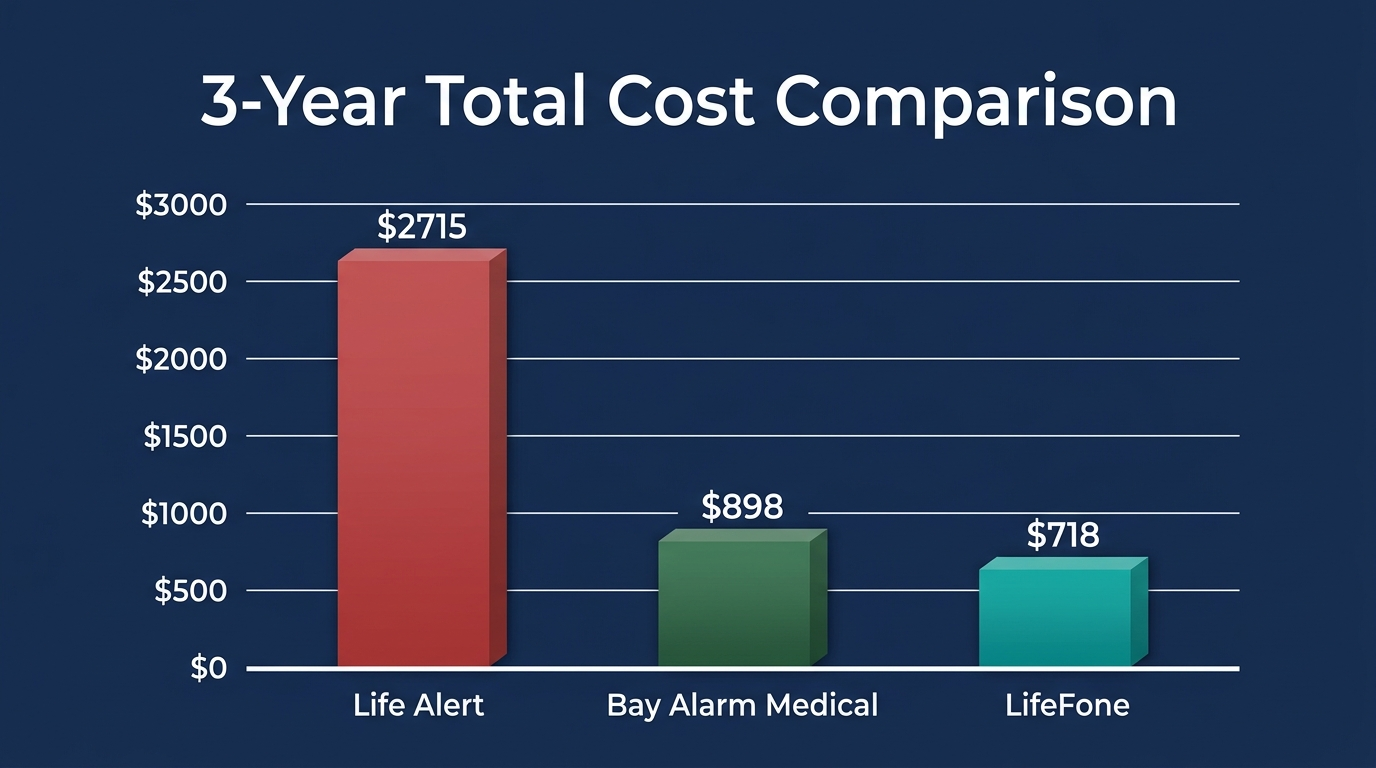
If you sign up for Life Alert’s standard plan at $69.95 per month and pay the $197 activation fee, you will spend $2,715 before your contract ends.
For comparison, LifeFone — one of the top-rated alternatives — starts at $24.95 per month on an annual plan (or $29.95/mo month-to-month) with no contract and no activation fee. Over the same 36 months, that is $898.20. The difference is $1,817.
This guide explains exactly what Life Alert costs, why the pricing structure confuses so many families, and whether the product justifies its premium in 2026.
What Does Life Alert Actually Cost Per Month?
Life Alert does not publish its pricing on its website. You have to call to get a quote. Based on confirmed 2026 pricing gathered by senior care researchers who called directly, here is the breakdown.
Life Alert offers three configurations.
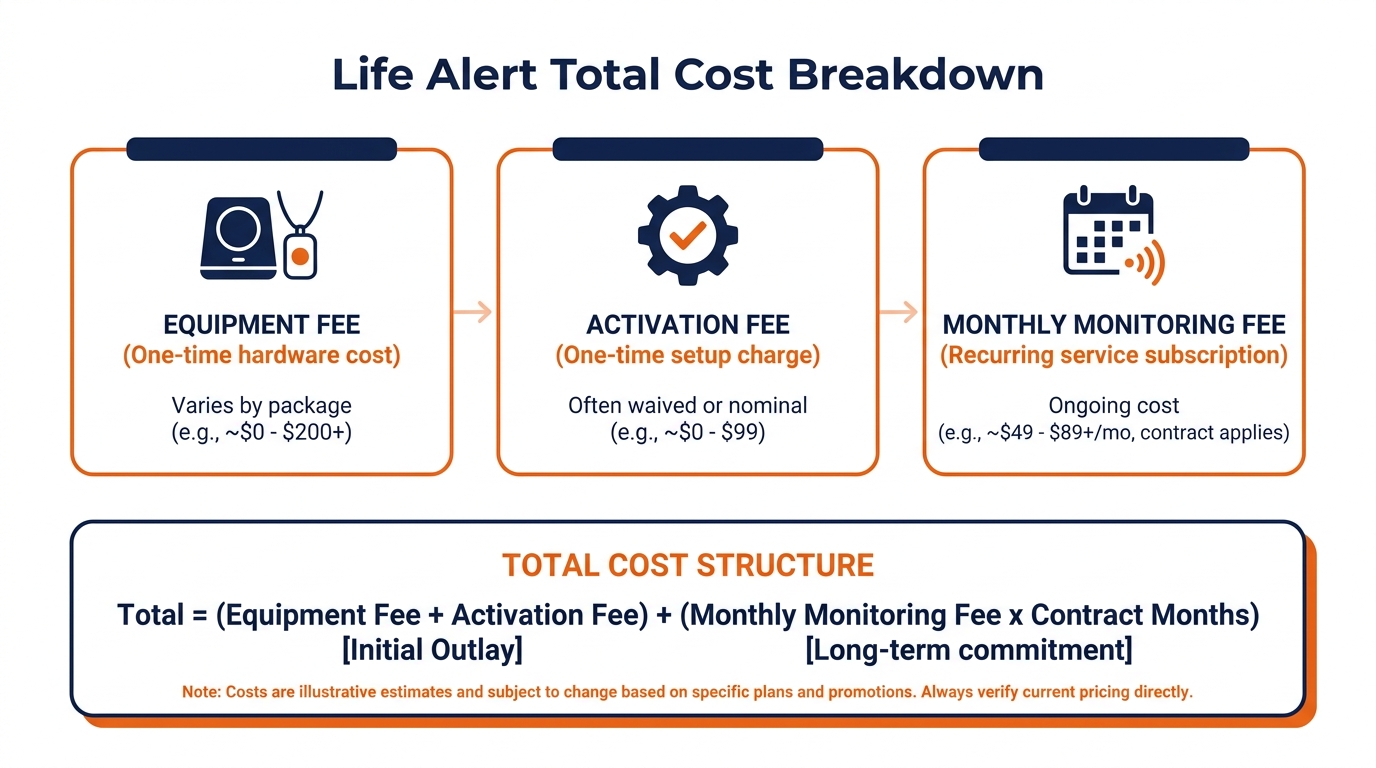
The base in-home system — the Micro Voice Pendant System — is priced at $49.95 per month. This includes a home base unit and one wearable help button. However, it requires this plan to be bundled with at least one additional device. In practice, this plan is rarely offered and requires special approval from a representative. Most callers are quoted the bundle price.
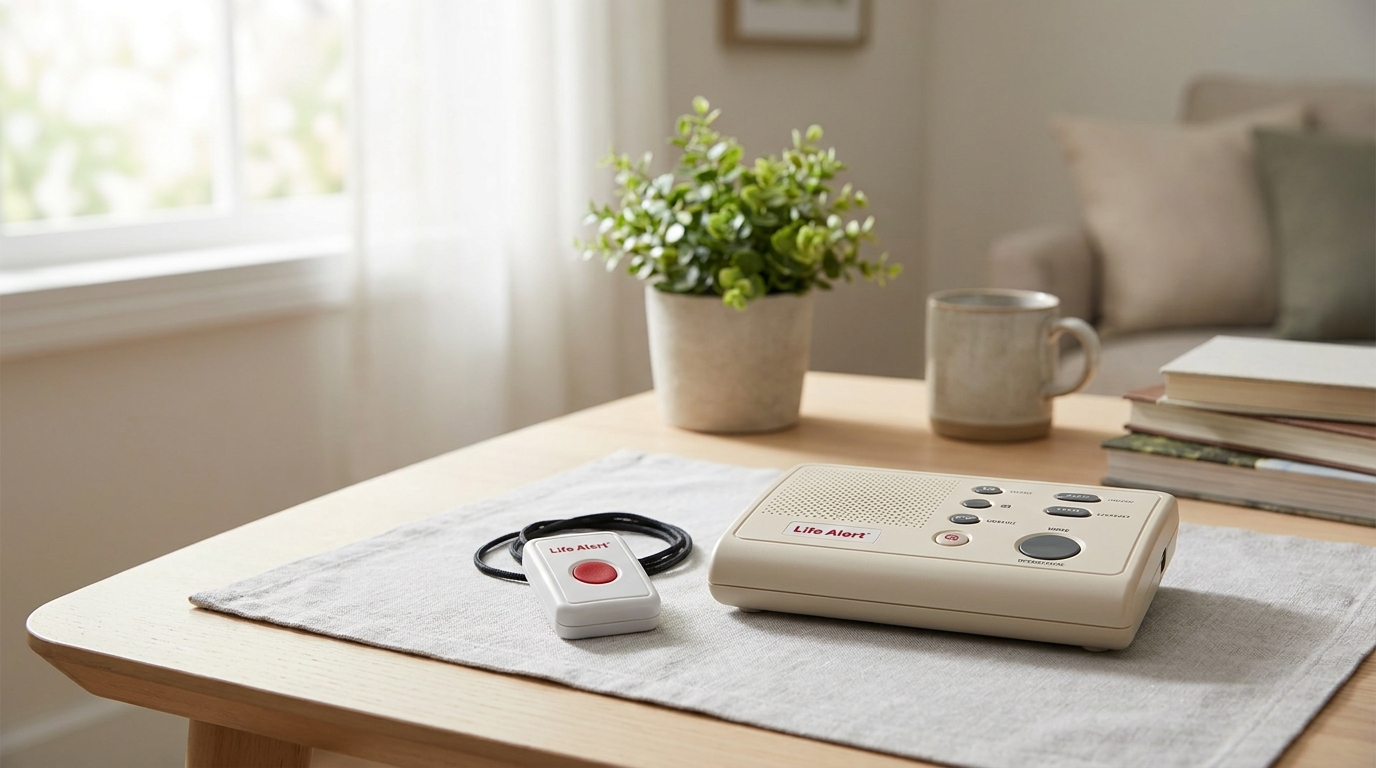
The standard bundle is $69.95 per month. This includes the base unit plus one additional device — either a mobile GPS pendant or a wall-mounted shower button. This is the plan most families end up on.
The full bundle is $89.95 per month and includes the base unit, the mobile GPS pendant, and the wall-mounted shower button. This is the all-devices plan.
In addition to the monthly fee, it charges a one-time activation fee of $197. This covers professional installation, equipment activation, and a walkthrough of the system with a technician. It is significantly higher than the $99 to $125 activation fee typical among most medical alert providers.
The Number Nobody Talks About — The 3-Year Total
It requires all customers to sign a 36-month contract. This is unusual in 2026. Most medical alert providers — including LifeFone, Bay Alarm Medical, and Medical Guardian — operate on a month-to-month basis with no long-term commitment required.
When you factor in the activation fee and the full contract term, here is what it actually costs.
Standard bundle at $69.95 per month: $69.95 multiplied by 36 months equals $2,518.20, plus the $197 activation fee. Total commitment: $2,715.20.
Full bundle at $89.95 per month: $89.95 multiplied by 36 months equals $3,238.20, plus $197. Total commitment: $3,435.20.
These figures assume no price increases over the contract term, which it does not guarantee. After 36 months, a month-to-month option becomes available.
What happens if you need to cancel before the 36 months are up? Life Alert’s contract allows early termination only under two specific conditions: the death of the subscriber, or the subscriber’s transition to a full-time care facility. There is no trial period, no 30-day cancellation window, and no other exit clause documented in the standard service agreement.
Does Life Alert Cost More Than Competitors?
Yes — significantly. Here is a direct comparison using confirmed 2026 pricing.
LifeFone starts at $24.95 per month on an annual plan (or $29.95/mo month-to-month) with no contract and no activation fee. Fall detection is available as an add-on. Over 36 months: $898.20 total. Saving versus Life Alert’s standard bundle: $1,817.
Bay Alarm Medical starts at $27.95 per month with no contract and no activation fee. Fall detection available ($10/mo add-on). Over 36 months: $1,006.20 total. Saving versus Life Alert: $1,709.
Medical Guardian starts at $31.95 per month with no contract. Fall detection available for $10 per month extra. Over 36 months: $1,150 total. Saving versus Life Alert: $1,565.
In every comparison, it costs more — often by a factor of two or three over the full contract period. The National Council on Aging reviewed the major medical alert providers in 2026 and specifically recommends against Life Alert due to its high cost and multi-year contract requirements.
Does Medicare Cover Life Alert?
No. Medicare Part A and Part B do not cover Life Alert or any personal emergency response system. Medical alert systems are not classified as durable medical equipment under Medicare, which means standard Medicare offers no reimbursement.
Some Medicare Advantage (Part C) plans previously offered limited coverage for personal emergency response systems as a supplemental benefit. However, several major Medicare Advantage providers — including UnitedHealthcare AARP plans — discontinued this coverage in 2024. If you have a Medicare Advantage plan, check directly with your insurer about current benefits, as they vary by plan and region.
Medicaid offers better options. Many states provide coverage for personal emergency response systems through Home and Community-Based Services waiver programmes, which help seniors remain in their homes rather than transitioning to institutional care. Eligibility depends on your state, income, and medical need. Contact your state’s Medicaid office or call the Eldercare Locator at 1-800-677-1116 to find local assistance programmes.
AARP discounts come up frequently in this conversation. AARP does not have a discounting partnership with Life Alert. Any AARP-branded medical alert content refers to AARP-branded plans operated by other companies, not Life Alert itself.
Is Life Alert Available at Walmart?
No. It is not sold at Walmart, online or in-store. Searches for “life alert cost walmart” are common, but it does not have a retail distribution partnership with Walmart or any other retailer. The only way to purchase it is directly through the company by calling their sales line.
Every purchase requires a phone call, a sales consultation, and signing the 36-month service agreement.
Is Life Alert Worth the Cost in 2026?
There are genuine reasons some families still choose Life Alert. The company has been operating since 1987 and has strong name recognition. Their monitoring service is reliable — operators are US-based and available 24 hours a day, seven days a week. Professional installation means the system is set up correctly from day one. It holds an A+ rating from the Better Business Bureau.
However, the product has significant limitations that the price does not justify in 2026.
It does not offer automatic fall detection on any plan. Fall detection — which triggers a call to the monitoring centre without the user pressing a button — is now standard on most competing systems. Medical Guardian’s and Bay Alarm Medical’s fall detection add-ons are $10/mo; LifeFone’s is $5/mo.
It has no mobile companion app for caregivers. Most modern medical alert systems include an app that lets family members track GPS location, monitor battery status, and receive emergency notifications. It offers none of this at any price tier.
Response time is another concern. In independent testing, Life Alert’s monitoring centre averaged 120 seconds to answer calls — two full minutes. Medical Guardian averaged 8 seconds. Bay Alarm Medical averaged 16 seconds. In a genuine emergency, that gap matters.
The 3-year contract removes flexibility at exactly the moment when a senior’s needs may change. If your parent’s health deteriorates and they need to move to assisted living within 18 months, you remain bound to the remaining contract unless it chooses to grant an exception.
Best Life Alert Alternatives Under $30 Per Month
If Life Alert’s pricing gives you pause, two alternatives provide the same core protection — 24/7 monitoring, waterproof help button, two-way communication — at significantly lower cost.
LifeFone is our top recommendation for families switching from Life Alert. Plans start at $24.95 per month on an annual plan ($29.95/mo month-to-month) with no equipment fee, no activation fee, and no long-term contract. LifeFone covers both in-home and mobile protection, and fall detection is available as a $5/mo add-on. Battery life on mobile systems reaches up to 18 days — longer than most competitors. 30-day money-back guarantee. See plans at LifeFone.
For a broader look at options, see our guide to medical alert systems with no monthly fee and our full medical alert comparison.
Frequently Asked Questions
How much does Life Alert cost per month in 2026?
It costs $49.95, $69.95, or $89.95 per month depending on the plan. The $49.95 base plan is rarely offered — most customers are quoted $69.95 for the standard bundle, which includes the base unit plus one additional device.
Does Life Alert charge an activation fee?
Yes. It charges a one-time $197 activation fee. This is higher than the $99 to $125 typical among most medical alert providers and covers professional installation and equipment setup.
Does Medicare cover Life Alert costs?
No. Medicare Part A and Part B do not cover Life Alert or any personal emergency response system. Some Medicare Advantage plans previously offered limited PERS coverage but many discontinued this benefit in 2024. Medicaid HCBS waivers may cover costs in qualifying states.
Can you get Life Alert for free?
No. Life Alert does not offer free plans, trials, or promotional pricing. The only programmes that can reduce medical alert costs are government assistance schemes such as Medicaid waivers, Veterans Benefits, or local Area Agency on Aging grants.
How much does Life Alert cost over 3 years?
On the standard $69.95 per month bundle with the $197 activation fee, it costs $2,715 over the 36-month contract. On the full $89.95 per month bundle, the 3-year total is $3,435.
Is Life Alert cheaper at Walmart?
No. It is not sold at Walmart. It is only available directly through Life Alert by calling their sales line.
What is cheaper than Life Alert with the same quality?
LifeFone starts at $24.95 per month on an annual plan with no contract and no activation fee. Bay Alarm Medical starts at $27.95 per month. Both provide 24/7 US-based monitoring, waterproof help buttons, and fall detection — the same core protection as Life Alert at significantly lower cost.
Our Recommendation
It is the most recognised name in medical alert systems, but it is not the best value in 2026. The 3-year contract, $197 activation fee, absence of fall detection, and 120-second average response time make it difficult to justify against modern alternatives that cost half as much and perform better in independent testing.
If your parent has specifically requested Life Alert by name, it is worth a conversation about what they are actually looking for. In most cases, they want the reassurance of a familiar brand — and that reassurance is available from providers that offer faster response, fall detection, a caregiver app, and no long-term contract at a fraction of the price.
Start with LifeFone at LifeFone — $24.95/mo (annual plan), no contract, 30-day money-back guarantee. If speed is the priority, Medical Guardian at Medical Guardian is the fastest-responding system we have tested. Both are better choices for most families than Life Alert in 2026.
For more on affordable options, see our guide to affordable medical alert systems and our full Life Alert alternatives comparison.
—
This article was researched and written by the SafeElderCare editorial team. Pricing data reflects publicly available rates as of June 2026. Affiliate links are marked. SafeElderCare earns a commission if you purchase through our links at no extra cost to you.