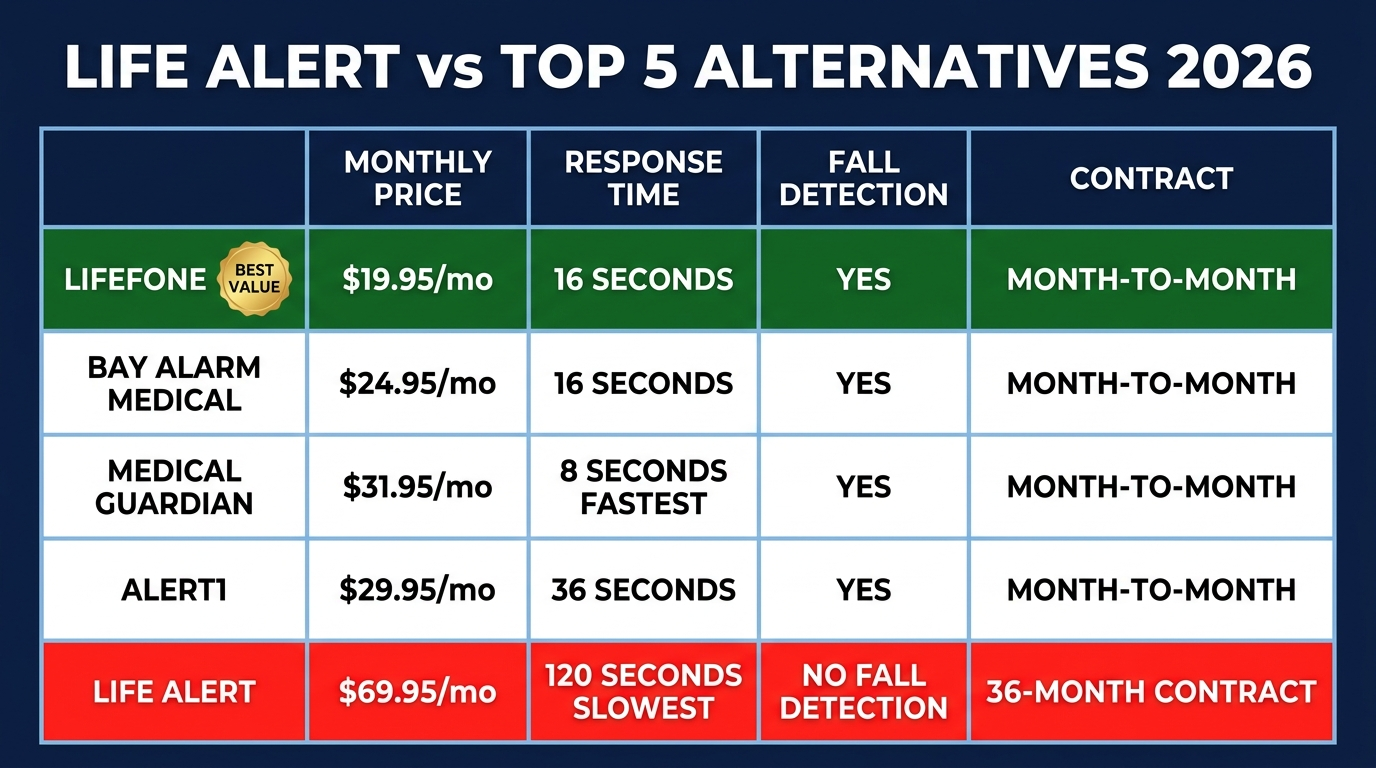
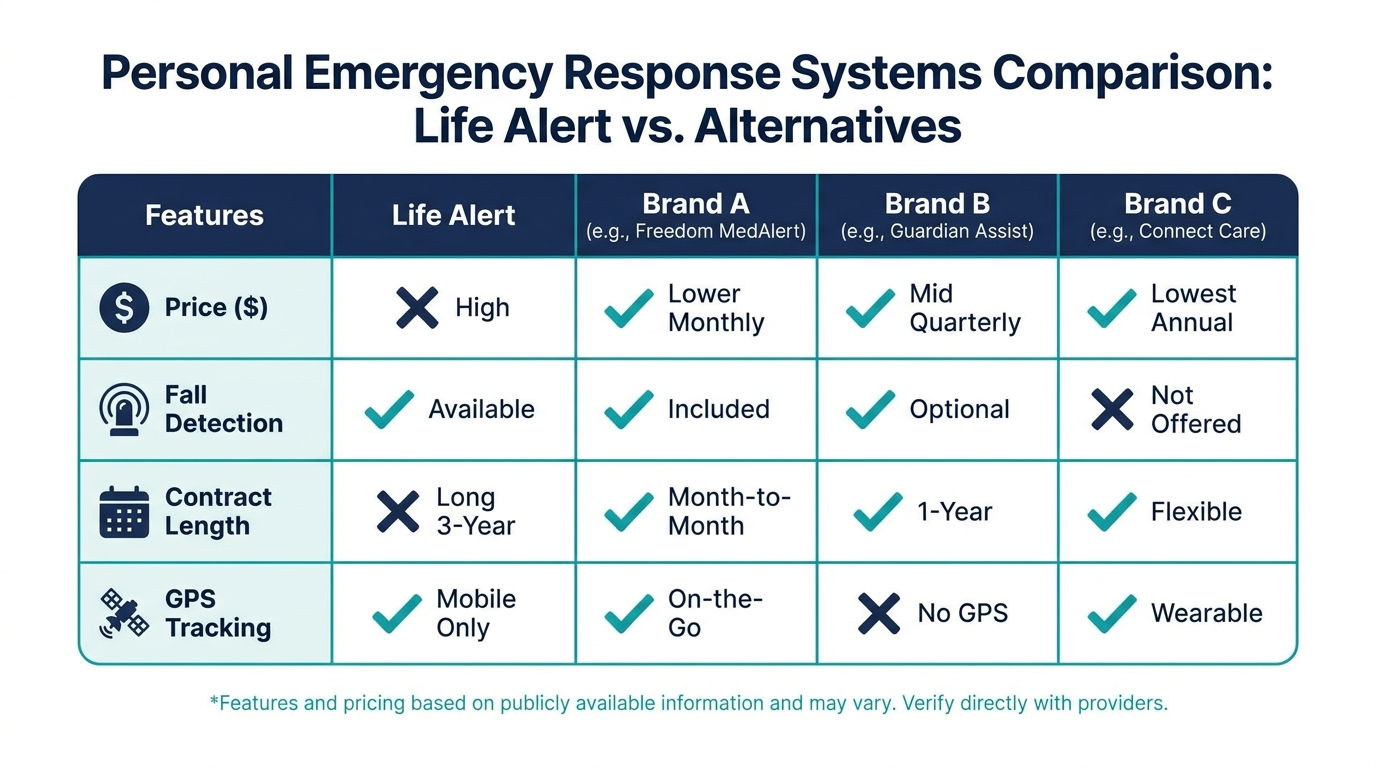
Life Alert has one of the most recognisable names in medical alert systems. It also has a 120-second average response time, no fall detection, a 3-year mandatory contract, and a starting price nearly double most competitors.
The National Council on Aging — a non-profit organisation that independently evaluates medical alert systems — reviewed the major providers in 2026 and specifically recommends against Life Alert due to its high cost and multi-year contract requirements.
This guide compares the five best Life Alert alternatives that offer the same core protection — 24/7 monitored emergency response — without the contract, the price premium, or the feature gaps.
For a full breakdown of what Life Alert charges and why families are looking for alternatives, see our Life Alert cost guide.
Why Families Are Leaving Life Alert
The 3-Year Contract Problem
Every Life Alert plan requires a 36-month service agreement. This is the most restrictive contract structure of any major medical alert provider in 2026. If your parent’s health changes, if they move to assisted living, or if they simply stop using the device, you are bound to the remaining monthly payments — unless Life Alert grants an exception for death or transition to a full-time care facility.
Every Life Alert alternatives on this list operates month-to-month. You can cancel at any time by returning the equipment, with no penalty.
The Response Time Problem
In independent testing, Life Alert’s monitoring centre averaged 120 seconds to answer emergency calls. That is two full minutes from pressing the help button to speaking with an operator.
Bay Alarm Medical averaged 16 seconds in the same type of testing. Medical Guardian averaged 8 seconds — the fastest recorded in 2026.
In a genuine emergency — a fall, a stroke, a cardiac event — the difference between 8 seconds and 120 seconds is significant. This is the single most important reason to consider an alternative.
The Fall Detection Gap
Life Alert does not offer automatic fall detection on any plan. The company has stated publicly that it does not consider the technology reliable enough.
Every Life Alert alternatives on this list offers fall detection as an add-on. Fall detection uses accelerometer and gyroscope sensors to detect the motion pattern of a fall and automatically triggers a call to the monitoring centre — without the user needing to press a button. For seniors who may be unconscious, disoriented, or unable to reach their button after a fall, this matters.
What the NCOA Says About Life Alert
The National Council on Aging evaluated Life Alert alongside five competing providers. Their assessment: Life Alert’s pricing and three-year contract make it less suitable than modern alternatives for most families. The NCOA’s recommended providers all operate on month-to-month plans with faster response times and more flexible features.
The 4 Best Life Alert Alternatives in 2026
Life Alert Alternatives: LifeFone — Best Overall Value
Starting price: $24.95 per month (annual plan) or $29.95 per month (monthly billing)
Contract: None
Activation fee: None
Fall detection: $5 per month add-on
Response time: Not independently timed but US-based 24/7 monitoring confirmed
LifeFone is the strongest value alternative to Life Alert for families who want the lowest ongoing monthly cost without sacrificing monitoring quality. Plans start at $24.95 per month on an annual plan — less than half of Life Alert’s standard bundle price.
There is no activation fee, no contract, and a 30-day money-back guarantee. LifeFone includes a free lockbox and free shipping on annual plans. Battery life on their mobile VIPX2 device reaches up to 18 days — significantly longer than most competitors including Life Alert’s mobile pendant.
LifeFone covers both in-home and mobile protection, with landline and cellular options for the home system. Fall detection is available as a $5/mo add-on. For most families making a value-based decision, LifeFone is the starting point.
Over 36 months at $24.95 per month: $898.20 total. Life Alert over 36 months: $2,715.20. Saving: $1,817.
See current LifeFone plans at LifeFone.
Life Alert Alternatives: Bay Alarm Medical — Best Response Time at Entry Price
Starting price: $27.95 per month
Contract: None
Activation fee: None
Fall detection: $10 per month add-on
Response time: 16 seconds average (independently tested)
Bay Alarm Medical is the top-rated alternative for families where response speed is critical but budget is also a consideration. At $27.95 per month with no activation fee and no contract, it is more affordable than Medical Guardian while offering faster response than most of the market.
In independent testing, Bay Alarm Medical agents answered emergency calls in an average of 16 seconds — compared to Life Alert’s 120-second average. The gap is enormous. Bay Alarm Medical also includes a free caregiver app that provides real-time GPS tracking, battery monitoring, and emergency notifications — something Life Alert does not offer at any price. For a full breakdown of every Bay Alarm system, plan, and fee, see our Bay Alarm Medical review.
Fall detection is available as an add-on for $10 per month. Bay Alarm Medical holds an A+ Better Business Bureau rating, the same as Life Alert.
Life Alert Alternatives: Medical Guardian — Fastest Response Time
Starting price: $31.95 per month
Contract: None — but 90-day minimum service term
Activation fee: None
Fall detection: $10 per month add-on
Response time: 8 seconds average (independently tested — fastest in 2026)
If speed to help is the absolute priority, Medical Guardian is the choice. Their monitoring centre averaged 8 seconds in independent testing — the fastest recorded for any major provider in 2026, and fifteen times faster than Life Alert.
Medical Guardian offers five systems — three in-home and two mobile — giving families more choice than most competitors. The in-home cellular system has a 1,400-foot pendant range, wider than most alternatives. The MGMove smartwatch is the most distinctive option for seniors who refuse to wear a pendant.
The caregiver app is included at no extra cost. Plans start at $31.95 per month with no long-term contract. Note that there is a 90-day minimum service commitment — shorter than Life Alert’s 36 months, but worth knowing.
For our full Medical Guardian assessment, see our Medical Guardian review.
See current Medical Guardian plans at Medical Guardian.
Life Alert Alternatives: MobileHelp — Best for Active Seniors Who Travel
Starting price: $24.95 per month
Contract: None
Activation fee: None on some plans
Fall detection: Available add-on
Response time: Not independently timed but US-based 24/7 monitoring confirmed
MobileHelp specialises in mobile medical alert coverage, making it suitable for active seniors who spend time outside the home. Their mobile system is one of the smallest and lightest in the category, which addresses the common objection that devices are too bulky to wear consistently.
MobileHelp offers bundle options that cover both in-home and mobile protection under one subscription — useful for families who want comprehensive coverage without managing two separate systems.
Head-to-Head: Life Alert Alternatives
The following comparison uses confirmed 2026 pricing and independently tested response times where available.
LifeFone: $24.95/mo (annual) vs Life Alert $69.95/mo. No contract vs 3-year contract. Fall detection $5/mo vs not offered. No activation fee vs $197. US-based monitoring. BBB A+ rating.
Bay Alarm Medical: $27.95/mo vs $69.95/mo. No contract vs 3-year contract. Fall detection $10/mo vs not offered. 16-second response vs 120-second response. Free caregiver app vs no app.
Medical Guardian: $31.95/mo vs $69.95/mo. No long-term contract vs 3-year contract. Fall detection $10/mo vs not offered. 8-second response vs 120-second response. Free caregiver app vs no app.
MobileHelp: $24.95/mo vs $69.95/mo. No contract vs 3-year contract. Fall detection available vs not offered.
Life Alert: faster emergency service costs more. Every metric that matters to safety and flexibility favours the alternatives.
What to Look for in Life Alert Alternatives
Response Time — The Number That Matters Most
Response time is the interval between pressing the help button and speaking with a monitoring agent. In a medical emergency, this is the most consequential performance metric. Independent testing across multiple sources consistently shows Life Alert averaging 120 seconds. Medical Guardian at 8 seconds and Bay Alarm Medical at 16 seconds are dramatically faster.
Fall Detection — Why the Gap Matters
Fall detection removes the requirement for the user to press a button. For seniors who lose consciousness, experience a stroke, or land in a position where they cannot reach their button, automatic fall detection is the difference between rapid help and lying on the floor undiscovered. Life Alert’s decision not to offer this feature in 2026 is a significant gap.
Contract Terms — Month-to-Month vs 3-Year Lock-In
A 3-year contract is appropriate for a cable subscription. It is not appropriate for a medical device for an elderly person whose health and living situation may change significantly within that period. Every alternative on this list allows cancellation at any time.
Equipment Fees and Hidden Costs
Life Alert charges $197 upfront. Most alternatives charge nothing upfront or a modest shipping fee. When comparing monthly prices, always factor in the first-year total including all upfront costs.
Who Should Still Choose Life Alert?
Life Alert is worth considering in two specific situations. First, if your parent has specifically requested Life Alert by name and will not wear a device from another brand — compliance is more important than specification. Second, if your parent lives in an area with very poor cellular coverage and needs a landline-based system with professional installation, Life Alert’s installation service is genuinely valuable.
In all other circumstances, the alternatives in this guide provide equivalent or superior protection at lower cost with greater flexibility.
Frequently Asked Questions on Life Alert Alternatives
What is the best alternative to Life Alert in 2026?
LifeFone is the best value alternative at $24.95 per month on an annual plan with no contract and no activation fee. Medical Guardian is the best alternative for response speed at 8 seconds average. Bay Alarm Medical is the best mid-range alternative at $27.95 per month with 16-second response times.
Is there Life Alert alternatives with no contract?
Yes. LifeFone, Bay Alarm Medical, Medical Guardian, and MobileHelp all operate month-to-month with no long-term contract.
Which Life Alert alternatives have the fastest response time?
Medical Guardian averaged 8 seconds in independent 2026 testing — the fastest of any major provider. Bay Alarm Medical averaged 16 seconds.
Do Life Alert alternatives offer fall detection?
Yes. All four alternatives listed here offer fall detection as an add-on. Life Alert does not offer fall detection on any plan.
Is Bay Alarm Medical better than Life Alert?
On every measurable metric — monthly price, response time, fall detection availability, caregiver app, contract flexibility — Bay Alarm Medical outperforms Life Alert. The only advantage Life Alert holds is brand recognition.
What does the NCOA recommend instead of Life Alert?
The National Council on Aging reviewed major medical alert providers in 2026 and recommended against Life Alert due to its high cost and multi-year contract. Their recommended providers include Medical Guardian, Bay Alarm Medical, and LifeFone — all of which appear on this list.
Our Recommendation
For most families, LifeFone at LifeFone is the right starting point. At $24.95 per month on an annual plan with no contract, no activation fee, and a 30-day money-back guarantee, it provides equivalent 24/7 monitoring protection at a fraction of Life Alert’s cost.
If response speed is the priority, Medical Guardian at Medical Guardian answered test calls in 8 seconds — fifteen times faster than Life Alert.
For our full medical alert comparison covering C1 through C5 providers, see our best medical alert systems guide. For fall detection specifically, see our fall detection medical alert guide.
—
This article was researched and written by the SafeElderCare editorial team. Response time data sourced from independent testing by senior care review publications in 2026. Pricing reflects publicly available rates as of June 2026. Affiliate links are marked. SafeElderCare earns a commission if you purchase through our links at no extra cost to you.