Table of Contents
This review is based on Bay Alarm Medical’s current published pricing (verified directly from bayalarmmedical.com), independent lab and field testing published by NCOA, Forbes Health, and SeniorLiving.org, and real customer feedback from the Better Business Bureau and Consumer Affairs. We have not physically tested this device ourselves — where we reference hands-on findings, we’ve credited the organization that conducted that testing. Pricing verified as of July 2026.
Bay Alarm Medical Review
If you’re comparing medical alert systems for a parent or loved one, Bay Alarm Medical is one you’ll keep running into — and for good reason. It consistently earns “Best Customer Service” honors from independent reviewers, its pricing starts lower than most name-brand competitors, and it’s one of the few major providers still family-owned rather than backed by private equity. That last point matters more than it might sound: family-owned companies in this space tend to compete on service quality rather than short-term margins, since there’s no outside investor pushing for a quick exit.
That said, it’s not the right fit for everyone. If you need a smartwatch with all-day battery life, Bay Alarm’s SOS Smartwatch — at 6 to 16 hours depending on use, reported inconsistently across independent tests — falls noticeably short of competitors like Medical Guardian’s MGMove (up to 24 hours). Below, we break down each system, real current pricing, and who it actually makes sense for.
At a glance
| System | Best for | Starting price | Fall detection |
|---|---|---|---|
| SOS Home | In-home use, landline or cellular | $27.95/mo | +$10/mo add-on |
| SOS Micro | Compact on-the-go coverage | Equipment ~$104 + monitoring | Included on mobile systems |
| SOS All-in-One 2 | Active seniors who leave the house often | $34.95/mo ($44.95 w/ fall detection) | Included at $44.95 tier |
| SOS Smartwatch | Discreet, wearable coverage | $39.95/mo ($49.95 w/ fall detection) | Included at $49.95 tier |
No activation fees. No long-term contracts. 15-day risk-free trial on all systems. BBB rating: A+. Consumer Affairs: 4.5/5 stars across 3,600+ reviews.
SOS Home — the in-home base system
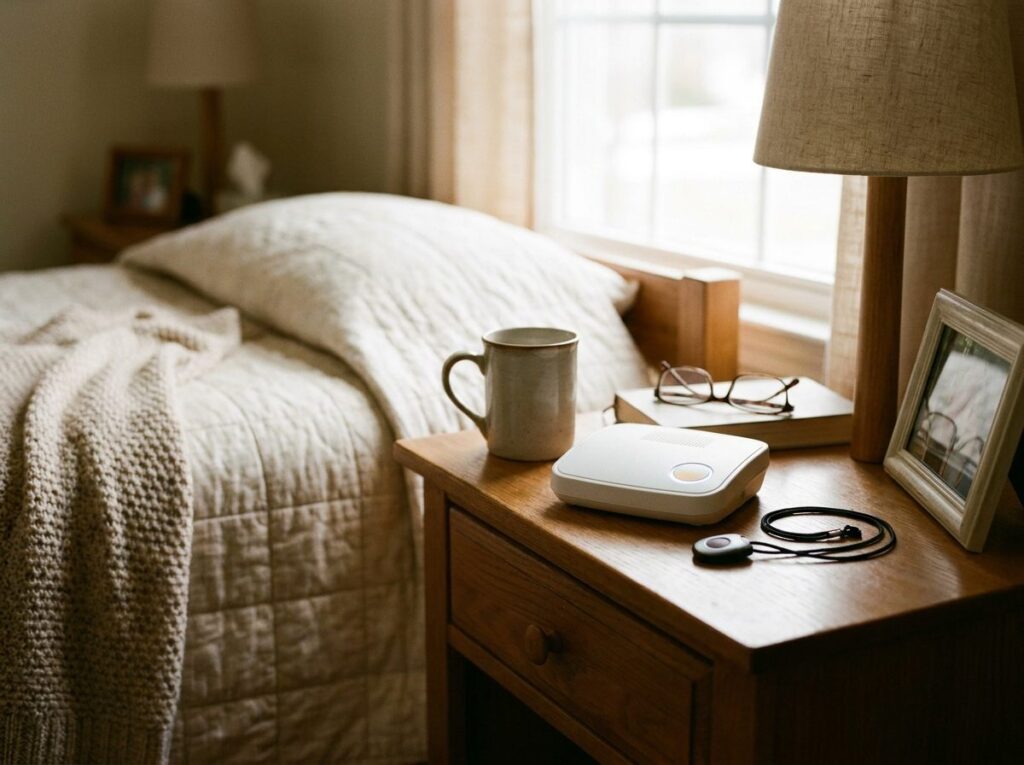
Bay Alarm’s in-home system starts at $27.95/month for the landline version, with a cellular option available for homes without a landline. It comes with a wall-mountable base unit, a waterproof pendant or wristband help button with an 800–1,000 foot range, and — a nice touch competitors often charge extra for — four additional wall-mounted help buttons included in the box. Independent testers have consistently clocked Bay Alarm’s response times at under 30 seconds, among the fastest in the category.
Fall detection isn’t included by default on SOS Home; it’s a $10/month add-on, requiring a separate pendant.
SOS Micro, SOS All-in-One 2, and SOS Smartwatch — coverage away from home

For anyone who spends real time away from home, Bay Alarm’s mobile lineup covers a range of needs. The SOS All-in-One 2 is the most fully-featured option — GPS location, cellular connectivity anywhere, and, at its top $54.95/month tier, a “360 Bundle” with additional caregiver features. The SOS Micro is the most compact and discreet, aimed at those who want something barely noticeable rather than maximum features. The SOS Smartwatch adds step tracking and a more conventional wearable form factor, but — worth repeating — its battery life is genuinely its weak point compared to the rest of the lineup.
How it compares to Life Alert and Medical Guardian
| Bay Alarm Medical | Life Alert | Medical Guardian | |
|---|---|---|---|
| Starting price | $27.95/mo | Not published (call required) | ~$29.95+/mo |
| Contract required | No | Yes, typically | No |
| Activation fee | None | Yes, reported | Varies |
| Response time (independently tested) | ~30 sec | Not independently disclosed | Comparable |
| Ownership | Family-owned | Private | Backed by Water Street Healthcare Partners |
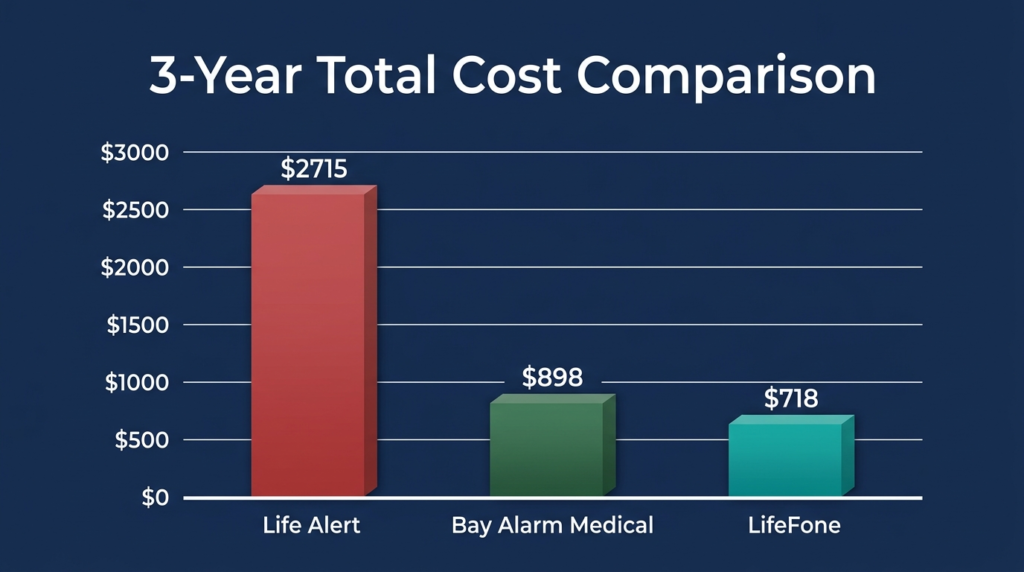
Bay Alarm’s biggest structural advantage over Life Alert specifically is pricing transparency — Life Alert requires a phone call to get pricing at all, while Bay Alarm’s costs are published openly. Against Medical Guardian, the two are closer competitors on price and features; Medical Guardian’s larger scale (600,000+ active members, following its 2024 MobileHelp acquisition) gives it a broader product ecosystem, while Bay Alarm’s smaller, family-run structure shows up in consistently high customer-service ratings, including an A+ rating with the Better Business Bureau and independent recognition from the National Council on Aging as a top-tested provider.
According to the Centers for Disease Control and Prevention, falls are the leading cause of injury among adults 65 and older — one of the reasons independent testing organizations put so much weight on a system’s actual, verified response time rather than marketing claims alone.
For a deeper look at how these two competitors stack up on their own, read our full Medical Guardian review and our guide to the best Life Alert alternatives.
Pros and cons
Pros:
- Transparent, published pricing with no phone call required
- No long-term contracts or activation fees
- Consistently fast, independently-verified response times
- Family-owned, not private-equity backed
- 15-day risk-free trial across all systems
Cons:
- Smartwatch battery life is short relative to competitors
- Fall detection isn’t included on the base in-home plan
- Some customers report a cumbersome cancellation/return shipping process
Frequently asked questions
Does Medicare cover Bay Alarm Medical?
Traditional Medicare (Parts A and B) doesn’t cover medical alert systems, including Bay Alarm Medical. Some Medicare Advantage (Part C) plans and select long-term care insurance policies may offer partial coverage — check with your specific plan.
What is Bay Alarm Medical’s average response time?
Independent testing has consistently recorded average response times under 30 seconds, among the fastest publicly tested in the category.
Does Bay Alarm Medical require a long-term contract?
No. All Bay Alarm Medical plans are month-to-month with no long-term contract and no activation fee.
How does Bay Alarm Medical compare to Life Alert on price?
Bay Alarm Medical publishes its pricing openly starting at $27.95/month; Life Alert requires calling for a quote, making direct comparison difficult, though third-party sources report Life Alert typically costs more once activation fees are included.
Is fall detection included with Bay Alarm Medical?
Not by default. It’s available as an add-on for roughly $10/month on the in-home system, and is bundled into higher tiers of the mobile and smartwatch plans.
Can I try Bay Alarm Medical before committing?
Yes — every system comes with a 15-day risk-free trial period.