Table of Contents
This review is based on AngelSense’s current published pricing and specifications (verified directly from angelsense.com), independent testing from PCWorld, SafeWise, and Hot Air Tag, and real customer feedback from Trustpilot. We have not physically tested this device ourselves — hands-on findings are credited to the outlets that conducted them. Pricing and specs verified as of July 2026, referring to AngelSense’s current redesigned device, not the discontinued earlier model some older reviews describe.
AngelSense GPS Tracker for Elderly and Seniors with Dementia
Here’s something worth knowing upfront: AngelSense wasn’t originally built for older adults. It was designed for children with autism and special needs who are prone to wandering — but its core feature set turns out to map almost exactly onto what families managing a loved one’s dementia-related wandering actually need, and AngelSense’s own product listings explicitly include “Elderly” and “Dementia” as intended use cases. This review looks at it specifically through that lens.
If you’ve searched for a GPS tracker for elderly parents, you’ve probably found a lot of options built for pets, cars, or luggage repurposed for people. AngelSense is different: it’s a real-time, cellular-connected wearable built specifically around the problem of someone who might leave and not be able to explain where they are or why.
At a glance
| AngelSense | Apple AirTag | Jiobit | |
|---|---|---|---|
| Real-time GPS | Yes, continuous | No (relies on nearby Apple devices) | Yes |
| Two-way voice | Yes | No | No |
| Monthly cost | ~$45–65 | None (device only, ~$29) | Lower than AngelSense |
| Tamper-resistant wearing | Yes (magnetic pin, compression shirt, belt clip) | No | Limited |
| Battery life | Up to 48 hours | Up to 1 year (no active tracking) | Longer than AngelSense |
| Best for | Active wandering risk, needs real-time alerts | Passive backup tracker only | Lower-cost real-time tracking without voice |
AngelSense GPS Tracker for Elderly: How It Works

The current AngelSense device is about 50% smaller than its predecessor, runs on 4G LTE for nationwide coverage, and lasts up to 48 hours on a charge. It connects to a smartphone app that gives caregivers continuous location tracking, automatic alerts when the wearer leaves a set safe zone, and a two-way speakerphone — meaning a caregiver can call the device directly and it auto-answers, useful for someone who might not be able to operate a phone themselves during a wandering episode.
A feature called Runner Mode increases the tracking frequency automatically once the device detects movement outside expected patterns — designed for exactly the kind of unpredictable, urgent movement that makes dementia-related wandering so frightening for families.
Wearability — the detail that matters most for dementia specifically
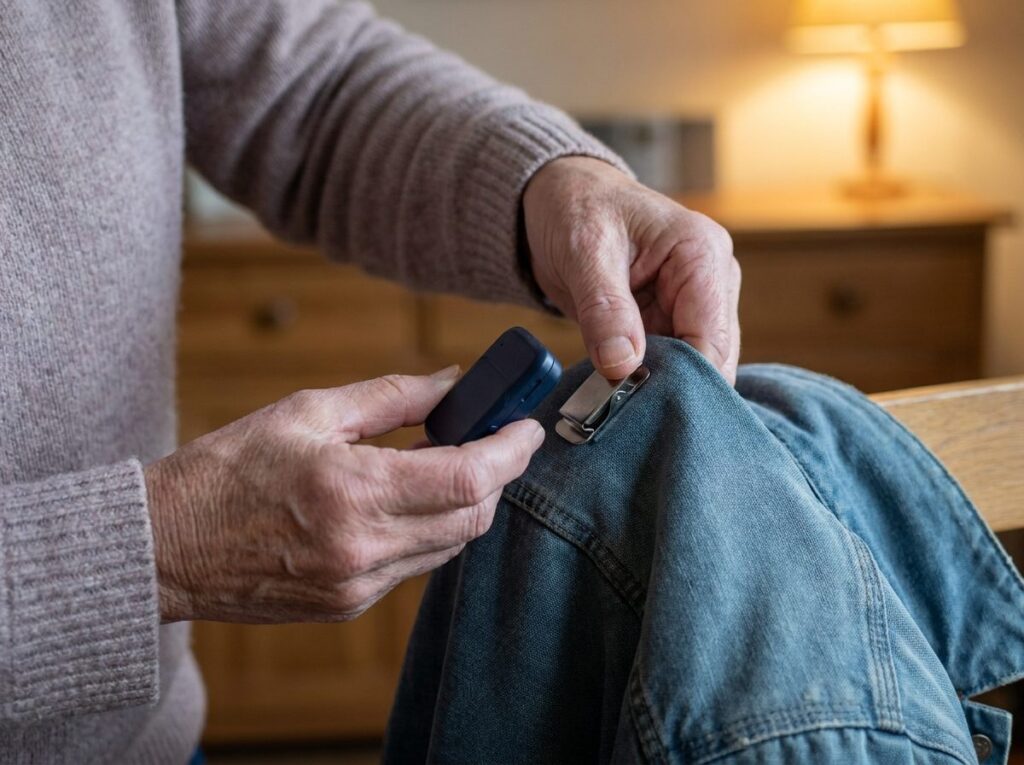
Unlike most consumer trackers, AngelSense is built to be difficult to remove — attachment options include a magnetic safety pin worn inside a waistband, a compression undershirt with a built-in pocket, and a belt clip. This was designed with children who might resist wearing a visible device in mind, but the same design solves a real problem in dementia care: someone in the middle of an episode may remove or lose a device they don’t remember the purpose of. A tracker that’s genuinely hard to take off matters more here than in almost any other use case. If a wrist-worn device would be better tolerated day-to-day, see our guide to the best GPS locator watch for seniors with dementia.
Pricing — verified current
| Plan | Cost |
|---|---|
| Device | $229 retail (frequently discounted or free with 1-year contract) |
| Month-to-month subscription | ~$65/month |
| 1-year contract subscription | ~$50/month |
| Prepaid annual subscription | ~$540/year (≈$45/month) |
| Additional device on same account | ~$30/month or $300/year |
Price is the single most consistent complaint across independent reviews and customer feedback — this is meaningfully more expensive than general-purpose trackers like Jiobit or a repurposed AirTag, and that gap should be weighed honestly against how much the two-way voice and tamper-resistant wearing actually matter for your specific situation.
An honest consideration: the “Listen-in” feature and consent
AngelSense includes a “Listen-in” feature that lets a caregiver silently listen through the device’s microphone. For a child, this raises privacy questions reviewers have already flagged. For a cognitively impaired adult, it raises a different and arguably more serious question: consent and legal capacity. Depending on your loved one’s diagnosis stage and your legal authority (power of attorney, guardianship, or none), silently monitoring audio may carry different ethical and legal weight than it does for a minor. This is worth discussing directly with your loved one’s care team or an elder law attorney before relying on this specific feature — it’s not something to activate by default without that conversation. The Alzheimer’s Association notes that six in 10 people with dementia will wander at least once, which is part of why tracking tools like this exist in the first place — but that same guidance stresses balancing safety monitoring with preserving dignity wherever possible.
Pros and cons
Pros:
- Real-time, continuous GPS tracking with nationwide 4G LTE coverage
- Two-way auto-answer speakerphone, useful during an actual wandering event
- Genuinely tamper-resistant wearing options, unusual among consumer trackers
- Runner Mode for automatic elevated tracking during unusual movement
- Purpose-built for exactly this kind of monitoring, not a repurposed general tracker
Cons:
- Meaningfully more expensive than general GPS trackers or repurposed AirTags
- Marketed primarily toward children/special needs, not senior care specifically
- “Listen-in” feature raises real consent questions with cognitively impaired adults
- Requires its own dedicated subscription per device, adding ongoing cost
Frequently asked questions
Is AngelSense designed for elderly users, or just kids?
AngelSense was originally designed for children with autism and special needs, but its product listings explicitly include elderly and dementia use cases, and its core features — real-time tracking, tamper-resistant wearing, two-way voice — map directly onto dementia wandering support.
How much does AngelSense cost per month?
Subscription pricing runs approximately $45–65/month depending on contract length, plus a one-time device cost of $229 (often discounted or waived with a contract).
Can someone remove the AngelSense tracker?
It’s designed to be difficult to remove using attachment methods like a magnetic safety pin worn inside clothing or a compression undershirt, though no wearable device is fully tamper-proof.
Is the “Listen-in” feature legal or ethical to use on a parent with dementia?
This depends on your loved one’s cognitive capacity and your legal authority to make decisions on their behalf. It’s worth discussing with an elder law attorney or your loved one’s care team before using this feature, rather than assuming it’s automatically appropriate.
How does AngelSense compare to an Apple AirTag for tracking a senior with dementia?
An AirTag is a passive tracker that relies on nearby Apple devices and offers no real-time alerts or two-way voice — it can work as a low-cost backup but isn’t designed for active wandering monitoring the way AngelSense is.
What is Runner Mode?
A feature that automatically increases how often the device reports its location when it detects unusual movement patterns, designed to give caregivers faster, more frequent updates during an actual wandering event.