The bathroom accessories that matter most for seniors are, in order of falls prevented per dollar: grab bars ($12–$40), a non-slip bath mat ($10–$22), a shower chair or bench ($45–$120), a raised toilet seat or safety frame ($28–$95), and a handheld showerhead ($35). Outfitting a complete safe bathroom costs $150–$350 — less than one emergency room visit, and about 80% of senior falls at home happen in the bathroom. This guide covers each category with real products and verified prices, so you can fix the whole room in one weekend.
Table of Contents
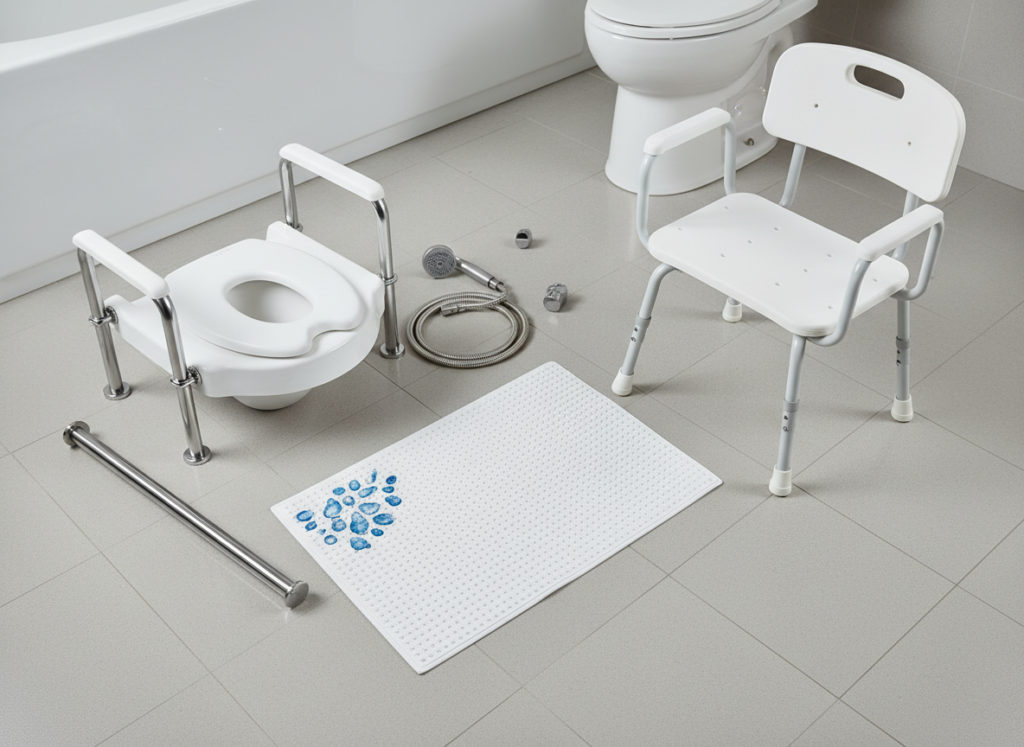
Essential bathroom accessories at a glance
| Accessory | Price range (verified July 2026) | Best for | Key spec |
|---|---|---|---|
| Grab bars | $12.24–$38.99 | Every senior bathroom, no exceptions | 250 lb rated, screw-in beats suction |
| Non-slip mats | $9.99–$21.99 | Tub floor + exit spot | Suction-cup underside, antimicrobial |
| Shower chair | $45.23–$119.99 | Anyone unsteady standing 10+ minutes | 250–300 lb capacity, drainage holes |
| Raised toilet seat | $27.52–$69.99 | Knee/hip trouble sitting low | Locking mechanism, 300 lbs |
| Toilet safety frame | $45.82–$94.23 | Needs armrests to push up from | 300 lb capacity, non-slip feet |
| Handheld showerhead | $34.99 | Seated bathing | Long hose (60″+), pause control |
| Bathtub rail | $40.83–$62.42 | Stepping over a tub wall | Clamp-on, 200 lbs |
Why the bathroom is the room to fix first
Hard surfaces, water, and movements that combine standing, turning and stepping over obstacles — no other room in the house concentrates fall risk like the bathroom. The CDC counts roughly 3 million older adults treated in emergency departments for fall injuries every year, and the bathroom is consistently the most dangerous room per minute spent in it. When evaluating this for a parent, walk through their actual routine: where do they steady themselves getting out of the tub?
What do they grab when standing from the toilet? If the answer is a towel bar or the sink edge, neither is rated to hold a falling adult, and that is exactly what this list fixes.
The right bathroom accessories are half the answer; the other half is making sure help arrives if a fall happens anyway. That is covered separately in our guides to emergency buttons for seniors and in-home medical alert systems — most are waterproof precisely because of bathroom falls.
1. Grab bars — the highest-value $25 in elder safety
Start with three locations: inside the shower or tub, at the shower entrance, and beside the toilet. The Carex Textured Wall Grab Bar (from $23.55, sizes 12–32 inches, stainless steel, drilling required) is the workhorse — the textured chrome surface stays grippable with wet, soapy hands. The Carex Ultra Grip line starts at $12.24, and Vive Health’s Metal Grab Bar runs $17.99–$38.99 depending on length. All prices verified on the merchants’ sites in July 2026.
One rule matters more than brand: screw-mounted bars anchored to studs or rated anchors, not suction cups, for any bar that will catch a falling adult. Suction bars are balance helpers only — they are not rated to arrest a fall. Weight-rated mounting (250 lbs under the ADA standard) is what separates a safety device from a false sense of security.
2. Non-slip mats — cheap, boring, effective
Two mats: one suction-cup mat inside the tub or shower, one absorbent mat with a rubber backing at the exit. Vive Health’s range covers both — the 22″ x 22″ Shower Mat at $21.99 and bath mats from $9.99 — and Carex sells a suction-cup rubber bathtub mat through its non-slip mat line. Look for antimicrobial material, because a mildewed mat gets thrown out and never replaced. Replace any mat whose suction cups no longer bite — they age out in about two years of daily use.
3. Shower chairs and benches — sit-down bathing without losing dignity
For a parent who gets tired or dizzy standing through a shower, a chair converts the highest-risk ten minutes of their day into a seated activity. The Carex Shower Chair ($45.23) and Adjustable Bath & Shower Seat with Back ($47.11) cover most needs; the Shower Chair with Padded Arms ($75.38) adds push-up support for standing back up — worth the extra $30 for anyone with weak quadriceps. All are height-adjustable with drainage holes.
For heavier users or wet-room setups, Elenker’s shower chair line runs deeper: the KLD-3329 360° swivel heavy-duty shower chair is $99.99 and its sliding models range up to $189.99 — the swivel seat eliminates the twisting motion that causes many tub exits to go wrong. If stepping over the tub wall itself is the hazard, skip ahead to a transfer bench: Vive Health’s Tub Transfer Bench ($94.99, 400 lb capacity) bridges the tub wall so your parent sits first, then swings their legs over.
4. Toilet aids — raised seats and safety frames
Standard toilets sit 15–16 inches off the floor — low enough that arthritic knees and replaced hips struggle both directions. A raised seat adds 2–5 inches. The Carex E-Z Lock Raised Toilet Seat ($43.74, adds 5 inches, 300 lb capacity) locks onto the bowl without tools; the version with adjustable armrests is $42.40.
For a parent who needs something to push up on, the Carex Toilet Safety Frame ($45.82) adds armrests to the existing toilet, and the Stand-Alone Adjustable Toilet Safety Frame ($94.23) works where nothing can bolt to the bowl. Vive Health’s equivalents — Toilet Seat Riser with Arms ($69.99) and Stand Alone Toilet Rail ($59.99) — are solid alternatives, and Elenker’s HFK-3367KD-3 4-in-1 height-adjustable padded seat is the budget pick at $54.99.
5. Handheld showerheads and bathtub rails
A handheld showerhead is what makes seated bathing actually work — washing from a chair with a fixed overhead spray means leaning and reaching, which defeats the chair. Vive Health’s Handheld Shower Head is $34.99; pair it with a hose long enough to reach lap height (60 inches minimum).
Bathtub rails clamp to the tub wall and give a solid handhold for the step-over. The Carex Bathtub Rail in chrome is $40.83, the Tri-Grip with three grip heights is $62.42 — both rated to 200 lbs and installed without tools. These suit steadier seniors; if your parent genuinely cannot step over the wall safely, a transfer bench is the right answer, not a rail.
Which bathroom accessories to buy first on a tight budget
If you can only spend $60 this month: two grab bars (about $40 installed with rated anchors) and a tub mat ($15). That combination addresses the single most dangerous movement — the wet-footed tub exit. Next month, add the shower chair; the month after, the toilet aids. For a parent who has already fallen once, do it all at once and add fall detection: our guide to fall detection watches for seniors covers the wearable side.
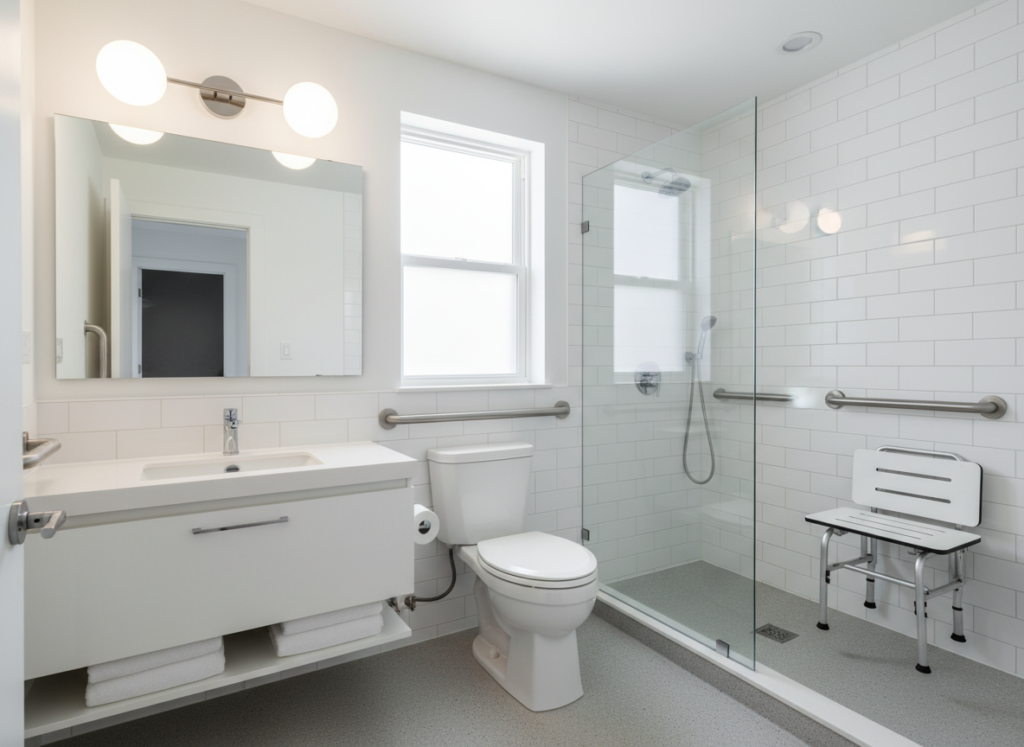
Room-by-room walkthrough: the 20-minute safety audit
Do this audit on your next visit, in your parent’s actual bathroom, with them present. At the door: is there a threshold or rug that catches a shuffling foot? Rugs without rubber backing go, today, for free.
The path to the toilet at night: is there a light? A $10 motion-sensing night light prevents the disoriented 2 a.m. stumble that no grab bar can.
At the toilet: watch them sit and stand once. Pushing off the sink or the towel bar means they need a frame or riser this week. At the tub: ask them to show you exactly how they get in.
Watch their hands — whatever they grab is what needs replacing with rated hardware in that exact spot. Inside the shower: soap on a rope or a wall dispenser beats bending for a dropped bottle on a wet floor; it is the cheapest fix on this list.
The audit does two jobs at once: it produces your bathroom accessories shopping list, and it shows your parent — rather than tells them — where the risks are. Families report far less resistance when the senior watched their own workaround (the sink push-off, the door-frame grab) get named as the problem.
Full comparison table
| Product | Price | Capacity | Size/spec | Where to buy |
|---|---|---|---|---|
| Carex Textured Wall Grab Bar | from $23.55 | 250 lbs line | 12–32″, steel, screw-in | Carex |
| Vive Metal Grab Bar | $17.99–$38.99 | 250–300 lbs | Multiple lengths | Vive Health (no affiliation) |
| Vive 22×22 Shower Mat | $21.99 | — | Suction underside | Vive Health (no affiliation) |
| Carex Shower Chair | $45.23 | 250–300 lbs | Height adjustable | Carex |
| Elenker KLD-3329 Swivel Shower Chair | $99.99 | Heavy duty | 360° swivel seat | Elenker |
| Vive Tub Transfer Bench | $94.99 | 400 lbs | Reversible, suction feet | Vive Health (no affiliation) |
| Carex E-Z Lock Raised Toilet Seat | $43.74 | 300 lbs | Adds 5″, locking | Carex |
| Carex Toilet Safety Frame | $45.82 | 300 lbs | Bolts to bowl | Carex |
| Vive Handheld Shower Head | $34.99 | — | Long hose | Vive Health (no affiliation) |
| Carex Tri-Grip Bathtub Rail | $62.42 | 200 lbs | 3 grip levels, clamp-on | Carex |
Renting, or can’t drill? The no-drill bathroom accessories hierarchy
Plenty of seniors live in apartments or assisted-living units where drilling into tile is not allowed. The safe substitutions, in order of preference: a clamp-on bathtub rail (the Carex Tri-Grip at $62.42 installs without a single hole and is genuinely weight-rated to 200 lbs, unlike suction bars), a freestanding toilet frame (the $94.23 Carex Stand-Alone straddles the toilet with floor-standing legs), a transfer bench that works by geometry rather than mounting, and floor-standing support poles that tension between floor and ceiling. What should never substitute for a real bar: suction grab bars used as fall protection, towel bars, or the sliding shower door frame — the three things unsteady hands reach for by default.
Renters should also know that some landlords must permit reasonable accessibility modifications under the Fair Housing Act if the tenant pays — a doctor’s note describing medical need makes that conversation short.
When accessories aren’t enough: the structural tier
If your parent uses a wheelchair, cannot lift a foot over a 4-inch threshold, or needs a caregiver physically in the bathing area, bathroom accessories have reached their limit and the conversation becomes structural: walk-in showers with zero threshold ($3,000–$10,000 installed), walk-in tubs ($5,000–$15,000), and widened doorways. Before signing anything, have an occupational therapist do a home assessment — many Area Agencies on Aging arrange them free — because a $200 accessory package solves a surprising share of cases that walk-in tub salespeople quote at $12,000. Be especially wary of “free walk-in shower for seniors” advertising: legitimate funding exists (Medicaid HCBS waivers, USDA Section 504 grants for rural low-income homeowners, VA HISA grants for veterans), but it runs through application processes, not through a contractor’s sales pitch.
Getting a parent to actually use the equipment
Bathroom accessories only work if they survive the dignity conversation. Three things consistently help. First, install grab bars in finishes that read as “bathroom hardware,” not “hospital” — chrome and brushed nickel bars look like towel-rack upgrades, and guests will not know the difference. Second, frame the shower chair around comfort rather than decline: plenty of able-bodied people sit to shower, and a padded-arm chair reads as a spa stool more than a medical device.
Third, involve them in choosing. A parent who picked the chrome bar over the white one has agreed, in a small but real way, that the bar belongs there. When evaluating this for my own family, the change that faced zero resistance was the one my mother chose herself — the pattern repeats in nearly every caregiver account we have read.
Frequently asked questions
What bathroom safety equipment does Medicare pay for?
Very little, and this surprises most families. Original Medicare classes grab bars, shower chairs, raised toilet seats and bath mats as convenience or comfort items, not durable medical equipment — so they are not covered. Some Medicare Advantage plans include an over-the-counter or home-safety allowance that does cover them, so check the specific plan before paying out of pocket.
What are the most important bathroom accessories for the elderly?
Properly mounted grab bars — one inside the bathing area, one at its entrance, one beside the toilet. They address the most dangerous movements (wet transfers) for the least money, starting around $12–$24 per bar plus mounting hardware.
How much does it cost to make a bathroom safe for seniors?
A complete bathroom accessories retrofit — three grab bars, two mats, a shower chair, a raised toilet seat or frame, and a handheld showerhead — runs $150–$350 at July 2026 prices. Structural work like a walk-in shower conversion is a different budget ($3,000–$15,000), and usually unnecessary if the accessory layer is done properly.
Are suction cup grab bars safe for the elderly?
Only as balance assists — never to catch body weight. Suction mounts can release without warning, especially on textured tile or with temperature changes. Any bar that might catch a falling adult must be screw-mounted into studs, blocking, or anchors load-rated to 250 lbs.
Where should grab bars be placed in a senior’s bathroom?
Three spots: a vertical bar at the tub/shower entrance for the step-in, a horizontal or angled bar on the long wall inside the bathing area, and a bar beside the toilet at elbow height. Mount 33–36 inches from the floor for the horizontal bars, and always into structure, not just drywall.
Do seniors need a shower chair or a transfer bench?
A shower chair suits seniors who can step into the shower but tire while standing. A transfer bench suits anyone who cannot safely step over a tub wall — it straddles the wall so they sit down first, then bring their legs over. If there has already been a near-miss at the tub edge, choose the bench.
The bottom line
Buy bathroom accessories in this order: grab bars and mats first, seated bathing second, toilet support third. Buy screw-mounted over suction, 300 lb ratings over 200, and finish the job with a way to call for help if a fall happens anyway. Every product above has a verified July 2026 price under $120 — the whole room costs less than a single month of assisted living.