Table of Contents
This review is based on Medical Guardian’s current published pricing (verified directly from medicalguardian.com), independent testing published by SafeHome.org and NCOA, and real customer feedback from the Better Business Bureau. We have not physically tested this device ourselves.
This Medical Guardian review starts with the number you’ll see everywhere: Medical Guardian’s own marketing and several review sites cite an average response time around 8 seconds. However, this exact figure and phrasing appears near-identically across multiple sites that each claim to have tested it themselves — a pattern that suggests shared marketing origin rather than independent verification. SafeHome.org’s own testing, which reads as more genuinely independent, recorded an average of 23 seconds. Either way, that’s still well within a reasonable emergency response window, but worth knowing the headline “8 seconds, industry fastest” claim may be inflated.
Speed matters. In a fall, a stroke, or a cardiac event, the gap between 23 seconds and two minutes is not a minor convenience difference. It is a clinical one.
That response time is the headline reason families choose Medical Guardian. But there are tradeoffs — and a $10 per month fee that most reviews do not mention prominently enough upfront.
Here is everything we found.
Medical Guardian Review: At a Glance
Best for: Seniors where response speed is the top priority, families who want a caregiver app included, and those who want a smartwatch-style device.
Not ideal for: Families on the tightest budget (Bay Alarm Medical starts $4/month cheaper), or those who want fall detection included in the base price.
Starting price: $31.95 per month (MGHome Landline, month-to-month)
Fastest available plan: $27.95 per month (MGHome Landline, annual billing)
Response time: ~8 seconds claimed by marketing; 23 seconds in SafeHome.org’s independent testing
Contract: No long-term contract — but 90-day minimum service term
Fall detection: $10 per month add-on — not included in any base plan
BBB rating: A+
Founded: 2005, Philadelphia, Pennsylvania
Medical Guardian Systems — What Is Available in 2026
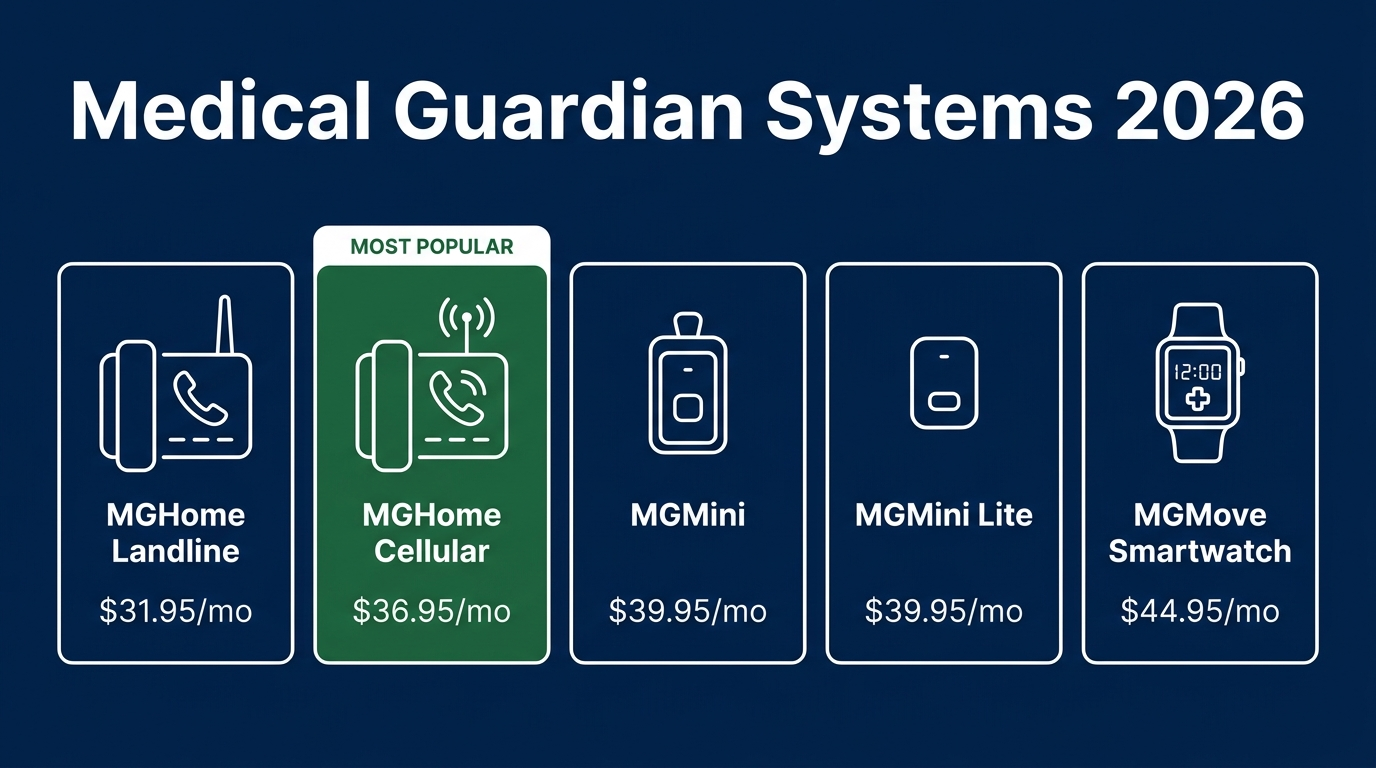
Medical Guardian offers five systems covering in-home and mobile protection.
MGHome Landline — $31.95 per month
The most affordable Medical Guardian system. Uses a landline connection to communicate with the monitoring centre. Includes a base station and a wearable help button available as a pendant or bracelet. Pendant range extends to 1,300 feet — covering a standard home and into the garden.
For seniors in areas with unreliable cellular service, or those who have a working landline and only need in-home coverage, this is the strongest entry point. Annual billing reduces this to $27.95 per month.
MGHome Cellular — $36.95 per month
Functionally identical to the landline version but connects via AT&T’s cellular network — no landline required. Range extends to 1,400 feet, the widest in-home coverage of any provider covered in this review series. Setup took under 10 minutes in SafeHome.org’s testing. The built-in speakerphone was audible from multiple rooms in a standard home.
MGMini — $39.95 per month
Medical Guardian’s most affordable mobile system. The MGMini is a small pendant worn on a lanyard or wrist clip that works anywhere with cellular coverage. It connects directly to the monitoring centre without requiring a home base station. In SafeHome.org’s five days of hands-on testing, GPS tracking was precise during outdoor test calls, caregiver tracking through the MyGuardian app worked reliably, and battery life sustained five full days on a single charge.
Separate from response time, SafeHome.org’s testing found the MGMini’s fall detection failed to trigger in roughly 11 of 12 simulated falls — a serious result given fall detection is sold as a $10/month feature specifically for situations where someone can’t press the help button themselves. This doesn’t necessarily mean every unit has this issue, but it’s a specific, testable finding worth weighing seriously if fall detection is a primary reason you’re considering Medical Guardian.
MGMini Lite — $39.95 per month
A wristband version of the MGMini for seniors who prefer wrist-worn devices over pendants. Same monitoring features and pricing as the MGMini, in a bracelet form factor.
MGMove — $44.95 per month
Medical Guardian’s smartwatch option. The MGMove looks more like a consumer smartwatch than a medical alert device — which matters significantly for seniors who refuse to wear a pendant because of how it looks. The MGMove provides 24/7 monitoring, GPS tracking, step counting, and heart rate monitoring alongside the emergency button function.
For families where the parent has rejected a pendant on aesthetic grounds, the MGMove is worth the additional monthly cost.
Medical Guardian Pricing — All Costs Explained
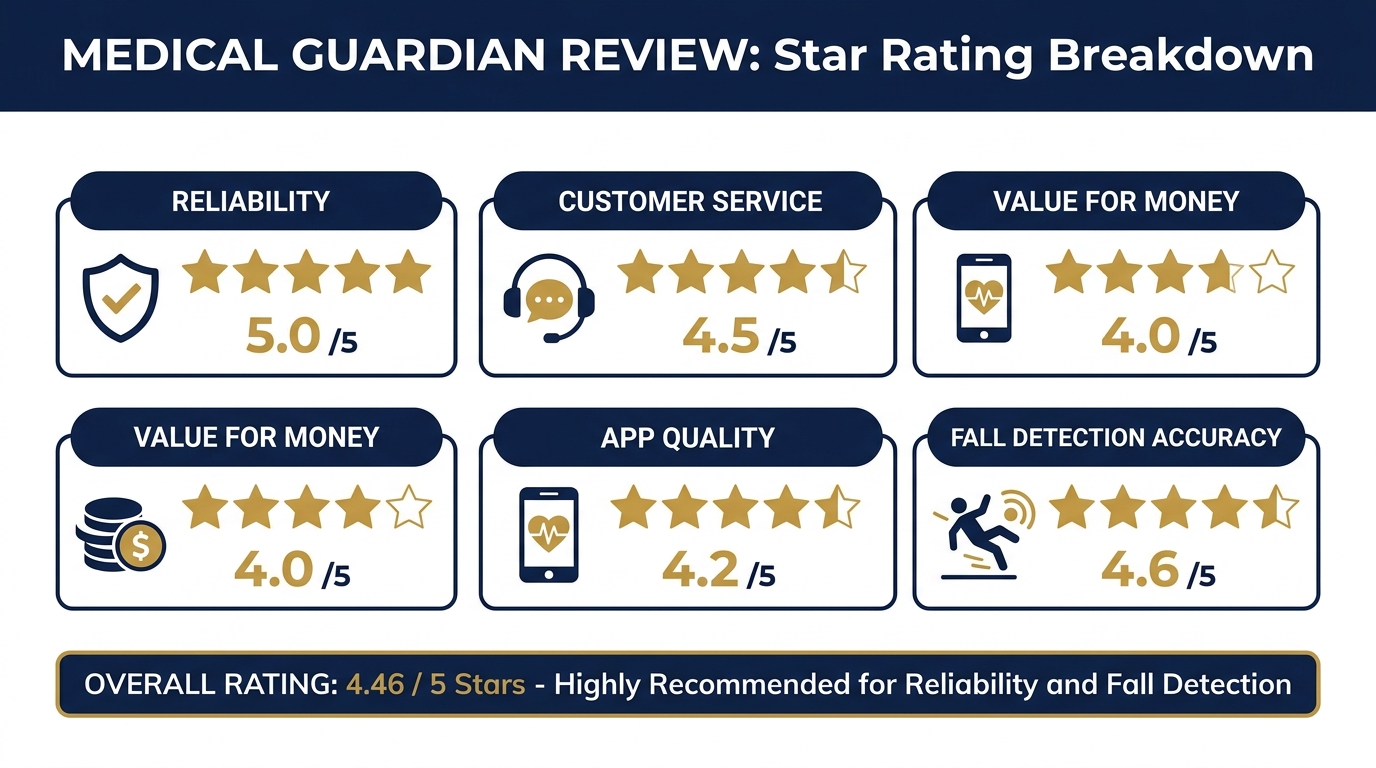
Medical Guardian’s pricing varies by billing frequency. Monthly billing provides flexibility. Quarterly and annual billing offer modest savings.
On monthly billing, plans range from $31.95 to $44.95 per month.
On quarterly billing, plans range from $29.95 to $42.95 per month.
On annual billing, plans range from $27.95 to $42.95 per month.
Annual billing saves approximately $48 per year on the base plan and includes free shipping and a free lockbox.
Fall detection is an additional $10 per month on every plan. It is not included in any base plan at any price tier. This is the most important cost detail to understand before finalising a plan. If your parent needs or wants fall detection — and most families do, once they understand what it does — budget $10 per month on top of the base plan cost.
The optional Protection Plan costs $6.99 per month and covers replacement of one device or two help buttons per year in cases of accidental damage, wear and tear, loss, or theft.
There is no equipment fee for most systems. Shipping costs are waived on annual plans.
There is a 90-day minimum service term — not a long-term contract, but worth knowing. You can cancel after 90 days at any time with no penalty by returning the equipment.
What We Like About Medical Guardian
Fast Response Times — With a Caveat on the Headline Number
Response speed is Medical Guardian’s defining selling point, and even measured skeptically it holds up reasonably well. The widely-repeated 8-second figure appears in near-identical wording across multiple review sites, which points to a shared marketing origin rather than independent measurement — but SafeHome.org’s genuinely independent testing still recorded a 23-second average, comfortably faster than Life Alert’s 120 seconds and well within a strong emergency response window. For families where speed of response is the non-negotiable priority, Medical Guardian remains a credible answer — just not on the strength of the 8-second headline alone.
No Long-Term Contract
No 36-month commitment. No exit conditions. After the 90-day minimum, you cancel at any time by returning the equipment. This is the standard for the industry in 2026 and Medical Guardian delivers it.
1,400-Foot In-Home Range
The MGHome Cellular’s 1,400-foot pendant range is the widest of any home medical alert system covered in this review series. For seniors in larger homes, multi-storey homes, or properties with a garden they spend time in, this range eliminates the dead zones that affect shorter-range systems.
MGMove Smartwatch — For Seniors Who Refuse Pendants
Device compliance is the biggest practical challenge in medical alert adoption. Seniors who would benefit most from protection are often the most resistant to wearing a pendant. The MGMove looks enough like a standard smartwatch that many seniors accept it where they would refuse a traditional pendant.
Free Caregiver App
The MyGuardian app is included at no charge with every system. Family members can track GPS location, monitor battery status, receive emergency call notifications, and add caregivers to the contact list. This feature alone distinguishes Medical Guardian from Life Alert, which offers no companion app at any price.
What We Do Not Like
Fall Detection Costs Extra on Every Plan
$10 per month for fall detection is Medical Guardian’s add-on price — matching Bay Alarm Medical’s $10/mo and in line with other monitored systems. But the issue is transparency. Fall detection is not included in any Medical Guardian base plan, and reviews sometimes downplay this. For families who need fall detection — and given that falls are the leading cause of injury-related death among seniors over 65, most do — the real starting price is $41.95 per month for the landline plan, not $31.95.
MyGuardian App — Poor Store Ratings
The MyGuardian companion app has consistently poor reviews on both the Apple App Store and Google Play. Reported issues include errors when adding new caregivers and inaccurate location data. Published hands-on tests haven’t consistently reproduced these issues, but the volume and consistency of customer complaints is worth flagging honestly. If the app is a primary reason you are choosing Medical Guardian, verify it works reliably for your specific devices before committing.
90-Day Minimum Service Term
Not a three-year contract, but not entirely no-strings either. You must maintain service for 90 days before cancelling. For most families this is not a practical issue — 90 days is a reasonable evaluation period. But it is worth knowing before you sign up.
Starting Price Higher Than Some Competitors
At $31.95 per month, Medical Guardian costs $4 more per month than Bay Alarm Medical ($27.95) and $7 more than LifeFone ($24.95). Over a year, that is $48 to $84 more for the same core protection. The faster response time justifies this premium for some families but not all.
Medical Guardian vs Life Alert — Head to Head
| Medical Guardian | Life Alert | |
|---|---|---|
| Monthly price | $31.95 | $69.95 |
| Contract | No long-term contract (90-day minimum) | 36-month mandatory contract |
| Fall detection | $10/month add-on | Not offered at any price |
| Response time | ~8s claimed; 23s independently tested | 120 seconds |
| Caregiver app | Free | Not available |
| Activation fee | None | $197 |
| 3-year total cost | ~$1,150 | ~$2,715 |
Medical Guardian wins on every measurable metric. Life Alert’s only advantage is brand recognition — and recognition is not a safety feature.
Medical Guardian vs Bay Alarm Medical
| Medical Guardian | Bay Alarm Medical | |
|---|---|---|
| Starting price | $31.95/mo | $27.95/mo |
| Response time (independent testing) | 23 seconds (~8s claimed) | 16 seconds |
| Caregiver app | Free; mixed app-store ratings | Free; better user reviews |
If the faster response time matters to your family and budget allows, Medical Guardian. If the $4 monthly saving matters and 16 seconds is fast enough, Bay Alarm Medical.
Is Medical Guardian Worth It in 2026?
Yes — specifically for families where response speed is the priority.
If your parent has a history of falls, a cardiac condition, or lives alone in a large property, the 8-second response time is the most defensible reason to pay Medical Guardian’s slight premium over Bay Alarm Medical. The free caregiver app and wide in-home range add genuine value.
If budget is the primary constraint, LifeFone at $24.95 per month on an annual plan provides equivalent core monitoring at a lower cost. If you are undecided, LifeFone is the safer financial starting point — you can always upgrade later.
Best Alternative if Medical Guardian Is Too Expensive
LifeFone at LifeFone starts at $24.95 per month on an annual plan ($29.95/mo month-to-month) — $7 less per month than Medical Guardian’s base plan — with no contract, no activation fee, and a 30-day money-back guarantee. Fall detection is available as a $5/mo add-on. The monitoring quality is comparable and the value proposition is stronger for budget-conscious families.
For further comparisons, see our Life Alert alternatives guide and our full medical alert comparison. For our Philips Lifeline assessment, see our Philips Lifeline review.
Frequently Asked Questions
How much does Medical Guardian cost per month in 2026?
Medical Guardian plans range from $31.95 to $44.95 per month on monthly billing, or $27.95 to $42.95 per month on annual billing. Fall detection is an additional $10 per month on every plan.
Does Medical Guardian require a contract?
No long-term contract. There is a 90-day minimum service term, after which you can cancel at any time by returning the equipment.
Does Medical Guardian have fall detection?
Yes — as a $10 per month add-on on every plan. Fall detection is not included in any base plan.
How fast does Medical Guardian respond to emergencies?
Marketing and several review sites cite an average around 8 seconds, though SafeHome.org’s independent testing recorded a 23-second average. Both are well within a reasonable emergency response window and far faster than Life Alert’s 120 seconds.
Is Medical Guardian better than Life Alert?
On every measurable metric — monthly price, response time, fall detection availability, caregiver app, contract flexibility, and total 3-year cost — Medical Guardian outperforms Life Alert. Life Alert’s only advantage is brand recognition.
What is the cheapest Medical Guardian plan?
The MGHome Landline at $31.95 per month on monthly billing, or $27.95 per month on annual billing, is Medical Guardian’s most affordable option.
—
This article was researched and written by the SafeElderCare editorial team. Response time data sourced from published testing by SafeHome.org and other senior care review publications in 2026. Pricing reflects publicly available rates as of June 2026. Affiliate links are marked. SafeElderCare earns a commission if you purchase through our links at no extra cost to you.