Toilet safety rails give a senior two solid armrests to push up from, and the right one costs $45–$95: bolt-on frames (like the Carex Toilet Safety Frame, $45.82) attach to the toilet’s own seat bolts, while freestanding frames (Carex Stand-Alone Adjustable, $94.23) surround the toilet without touching it. Choose bolt-on for stability on a standard toilet, freestanding for rentals, unusual bowls, or anyone over 300 lbs who needs a bariatric-rated frame. Prices verified on merchant sites, July 2026 — here is how to pick between the types, what the height numbers mean, and the mistakes that make rails wobble.
Table of Contents
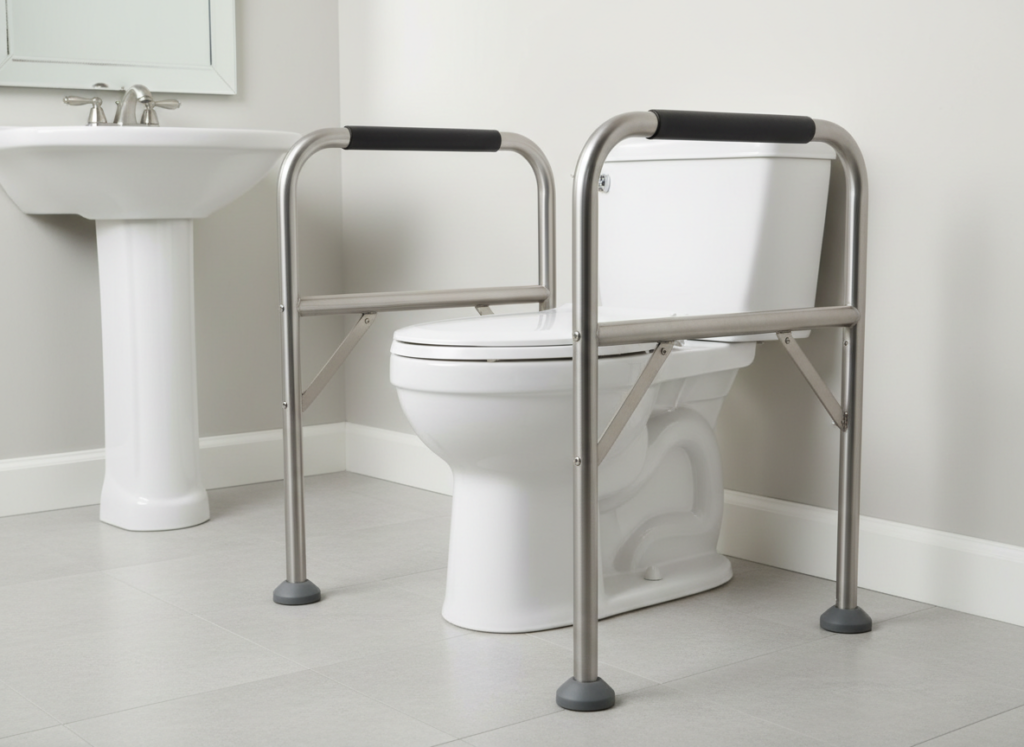
Toilet rail options at a glance
| Product | Price (verified July 2026) | Type | Best for |
|---|---|---|---|
| Carex Toilet Safety Frame | $45.82 | Bolt-on | Standard toilets, most users |
| Vive Toilet Safety Frame | $69.99 | Bolt-on | Padded-arm alternative |
| Carex Stand-Alone Adjustable Frame | $94.23 | Freestanding | Rentals, non-standard toilets |
| Vive Stand Alone Toilet Rail | $59.99 | Freestanding | Budget freestanding pick |
| Vive Toilet Seat Riser with Arms | $69.99 | Riser + rails combo | Height AND push-up support |
Why the toilet is where falls happen
The sit-to-stand movement at the toilet combines everything that goes wrong with aging balance at once: a low start position (standard bowls sit 15–16 inches), trousers around the ankles restricting the recovery step, night-time grogginess, and blood pressure that drops on standing — orthostatic hypotension affects roughly one in five older adults, and it peaks exactly at that push-up moment. Toilet safety rails work because they let the arms share a load the legs can no longer manage alone, and because a controlled push from two fixed points beats the grab-whatever-is-near improvisation that ends with a towel bar in the floor and a parent beside it.
When evaluating this for a parent, watch one real sit-and-stand. If they rock for momentum, push off their knees, or reach for the sink, they need rails now — the fall has already been rehearsed. And because a fall beside the toilet often means a fall behind a closed door, pair the rails with a waterproof emergency button they actually wear in the bathroom.
Bolt-on frames: maximum stability per dollar
Bolt-on frames clamp under the toilet seat’s own mounting bolts, so push-up force transfers into the porcelain rather than the floor. The Carex Toilet Safety Frame ($45.82, 300 lb class) is the value benchmark: width-adjustable arms, textured grips, tool-light installation of about fifteen minutes. Vive Health’s Toilet Safety Frame ($69.99) does the same job with padded armrests — worth the difference for thin or bruise-prone forearms that will bear weight several times a day.
The catch: bolt-ons need a standard two-piece toilet with accessible seat bolts. One-piece designer toilets, wall-hung bowls, and bidet seats with wide mounting plates often will not take them — check before ordering, because “it didn’t fit” is the top return reason in this category.
Freestanding frames: fit anything, drill nothing
Freestanding frames stand on their own legs around the toilet. The Carex Stand-Alone Adjustable Frame ($94.23) height-adjusts to match user and bowl, fits any toilet shape including one-piece and wall-hung, and moves out for cleaning. Vive’s Stand Alone Toilet Rail ($59.99) is the budget version of the same idea. Two rules make freestanding frames safe: every foot tip must have intact rubber (bare metal on tile slides), and the frame must be sized so the arms sit just above thigh height — arms too low turn a push-up into a push-forward.
Elenker sells a related option worth knowing about: the HFK-3367KD-3 4-in-1 raised toilet seat ($54.99, verified July 2026) combines a padded height-adjustable seat with built-in handles — one purchase where the parent needs both lift and leverage. Vive’s Toilet Seat Riser with Arms ($69.99) is the same combo in a locking bolt-on format.
What about Medline and the Amazon listings?
Medline’s toilet safety rails are a hospital-supply staple and a perfectly good product — they simply sell through medical distributors and marketplaces rather than direct, so prices swing by seller; check the current listing. On Amazon generally, the same marketplace caution applies here as everywhere in senior safety: buy brands with a real weight rating printed in the specs (250 lbs minimum, 300 preferred), sold by the brand’s own storefront, and skip anything whose “adjustable” mechanism is unrated plastic push-buttons. The rail takes full body weight at its worst moment — this is not the category for the $22 no-name special.
Getting the height right (the spec everyone skips)
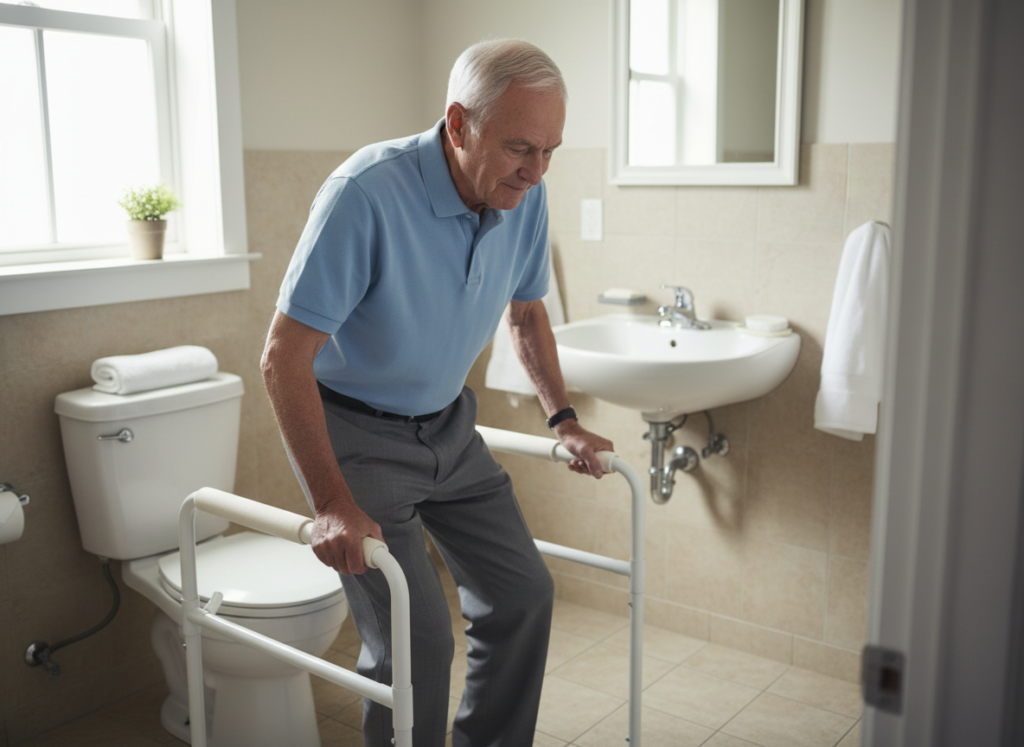
Armrest height decides whether rails help or hurt. The test: seated on the toilet, your parent’s elbows should bend about 90 degrees with palms flat on the armrests — for most people that is 26–31 inches from the floor, which is exactly the adjustment range on quality frames. Too low and they lean forward to reach, loading the shoulders at a bad angle; too high and the push goes backward into the tank. Adjustable-height models exist precisely because toilets vary (15–17 inches standard, 17–19 for “comfort height” bowls) — measure the actual bowl before assuming.
Weight capacity has a margin rule: choose a rated capacity at least 50 lbs above the user’s weight, because a push-up is a dynamic load, not a static one. Standard frames run 250–300 lbs; genuinely bariatric frames (up to 500 lbs) exist from Carex’s Safe Lock line and hospital-supply brands.
Installation mistakes that make rails wobble
Four recurring ones. First, bolt-on frames tightened onto a loose toilet seat — fix the seat first; the frame inherits every wobble. Second, freestanding frames on wet tile without checking the rubber tips monthly.
Third, frames assembled with the arms at different heights (check with a level, not eyes — bathroom floors lie). Fourth, positioning the frame so far back that the arms end mid-thigh: the grip section should end roughly above the knee line, where a palm lands naturally at the start of a push. Fifteen careful minutes at installation buys years of trust in the equipment — and a senior who trusts the rails uses them, while one wobble sends their hand back to the sink edge for good.
Worth knowing before you buy anything: if a bathroom renovation is on the horizon anyway, a comfort-height toilet (17–19 inches) plus a wall grab bar is the permanent version of the riser-plus-frame combo — no attachments to clean around, nothing to wobble, and it looks like a normal bathroom. At $200–$400 installed for a mid-range bowl, it costs more than any frame but outlasts them all. The frames earn their place when renovation is not on the table, which for most families deciding this week, it is not.
Rail, riser, or both? A two-question decision
Question one: seated on the toilet, are your parent’s knees above their hips? If yes, the bowl is too low for their joints and a riser (or comfort-height toilet) is part of the answer. Question two: do they use their arms — on knees, sink, or wall — to stand? If yes, they need rails.
Both answers yes means both products, ideally integrated. Height without leverage still strands weak quadriceps; leverage without height asks the shoulders to make up four missing inches every single time. The failure pattern we see in caregiver forums is buying only the riser, seeing improvement for a few months, then a fall anyway — because the underlying strength kept declining and there was still nothing to push on.
Three quick scenarios. A 78-year-old with knee osteoarthritis, standard 15-inch toilet, steady arms: riser alone works — Carex E-Z Lock at $43.74 adds 5 inches. An 84-year-old post-stroke with one strong side: bolt-on frame, because she pulls asymmetrically and freestanding legs can walk under uneven force — plus the grab bar on her strong-side wall. An 89-year-old at 320 lbs in a rented flat: bariatric-rated freestanding frame only; bolt-ons at that load stress porcelain mounting points, and the landlord keeps his tiles undrilled.
The bidet seat complication (and opportunity)
Washlet-style bidet seats are increasingly common in senior bathrooms because they reduce the wiping and reaching that strain balance in the first place. But their mounting plates occupy the same seat bolts that bolt-on safety frames need, and many combinations physically cannot coexist. If your parent has or wants a bidet seat, choose a freestanding frame and confirm the frame’s arm spacing clears the bidet’s side control panel. Done right, the pairing is genuinely excellent — the bidet removes the hardest hygiene tasks while the frame secures the transfers.
Keeping rails trustworthy: the monthly minute
Toilet rails live in the wettest, most-cleaned corner of the house, and cleaning products attack them. Once a month: wiggle-test the whole frame (a newly loose bolt announces itself here first), check each rubber foot tip for splits and grit, retighten seat bolts on bolt-on models, and wipe the grip surfaces with plain soap and water — bleach sprays degrade textured plastic grips into smooth ones within a year or two. If any foot tip is missing or torn, stop using the frame until the replacement arrives; manufacturers sell tip sets for a few dollars, and a bare metal leg on wet tile is the exact failure the frame exists to prevent.
Night-time: where toilet rails earn their keep
Most senior toilet trips that end in falls happen between midnight and 6 a.m., when blood pressure medication is peaking, the hallway is dark, and nobody is awake to hear a call for help. The toilet safety rails handle the transfer, but audit the journey too: a motion night light in the hallway and bathroom (under $15), a clear path with no rug edges, and the phone or pendant within reach of the toilet, not on the nightstand. Families using a monitored in-home medical alert system should check the base station covers the bathroom — the room where help is most often needed is the room installers most often leave marginal.
Full comparison
| Product | Price | Type | Capacity | Height range | Where to buy |
|---|---|---|---|---|---|
| Carex Toilet Safety Frame | $45.82 | Bolt-on | 300 lbs class | Width-adjustable arms | Carex |
| Vive Toilet Safety Frame | $69.99 | Bolt-on, padded | 300 lbs class | Adjustable | Vive Health (no affiliation) |
| Carex Stand-Alone Adjustable Frame | $94.23 | Freestanding | 300 lbs class | 26–31″ typical | Carex |
| Vive Stand Alone Toilet Rail | $59.99 | Freestanding | 250–300 lbs | Adjustable | Vive Health (no affiliation) |
| Vive Toilet Seat Riser with Arms | $69.99 | Riser + rails | 250–300 lbs | Adds seat height | Vive Health (no affiliation) |
| Elenker HFK-3367KD-3 4-in-1 Seat | $54.99 | Riser + handles | 300 lbs class | 4 height settings | Elenker |
| Medline Toilet Safety Rails | Varies by seller | Bolt-on | 250–300 lbs | Adjustable | Medical distributors (no affiliation) |
Frequently asked questions
What are the best toilet safety rails for elderly people?
For a standard two-piece toilet and a user under 300 lbs, the Carex Toilet Safety Frame ($45.82) is the best stability per dollar because it bolts to the toilet itself. For rentals or non-standard toilets, the freestanding Carex Stand-Alone Adjustable ($94.23) or Vive Stand Alone Rail ($59.99) fit anything.
Do toilet safety rails attach to the toilet or stand alone?
Both types exist. Bolt-on frames clamp under the seat’s mounting bolts and are the most stable on standard toilets; freestanding frames surround the toilet on their own legs and fit one-piece, wall-hung and unusual bowls. Match the type to the toilet, then the height to the user.
How high should toilet safety rails be?
Seated with palms on the armrests, elbows should bend about 90 degrees — typically 26–31 inches from the floor. Arms too low force a forward lean; too high and the push drives backward. Measure with your parent seated on their actual toilet.
Are adjustable toilet safety rails worth it?
Yes — adjustable toilet safety rails are worth it in almost every case, because toilets vary from 15 to 19 inches tall and users vary more. Fixed-height frames only make sense when one user, one toilet, and a tape measure have already agreed. The $10–$20 premium for adjustability also future-proofs the frame if the toilet is later upgraded to comfort height.
Will Medicare pay for toilet safety rails?
Usually not — like most bathroom safety equipment, Original Medicare classes them as convenience items. A raised toilet seat prescribed after hip surgery sometimes qualifies through Part B as durable medical equipment; Medicare Advantage OTC allowances, HSA/FSA funds, and Medicaid waivers are the reliable routes for the rest.
Can toilet rails be used with a raised toilet seat?
Yes, and the combination is common: the riser fixes the height problem, the rails fix the leverage problem. Either buy them integrated (Vive Toilet Seat Riser with Arms, $69.99; Elenker 4-in-1, $54.99) or pair a freestanding frame with any riser — bolt-on frames and bolt-on risers can compete for the same mounting points, so check compatibility.
The bottom line
Choosing toilet safety rails comes down to the toilet and the user. Standard toilet, user under 300 lbs, no landlord issues: Carex Toilet Safety Frame, $45.82, fitted in fifteen minutes. Rental or unusual toilet: Vive’s freestanding rail at $59.99, or the Carex Stand-Alone at $94.23 if you want height adjustment.
Height and leverage both failing: a riser-with-arms combo from $54.99. Then watch one real sit-and-stand with the new equipment — if the elbows bend near 90 degrees and the feet stay planted, you got it right.