The word “smart” in the smart pill dispenser for seniors category means something specific — and it means two different things depending on which device you are looking at.
In This Guide
- Overview
- Comparison
- Best Options
- Our Recommendation
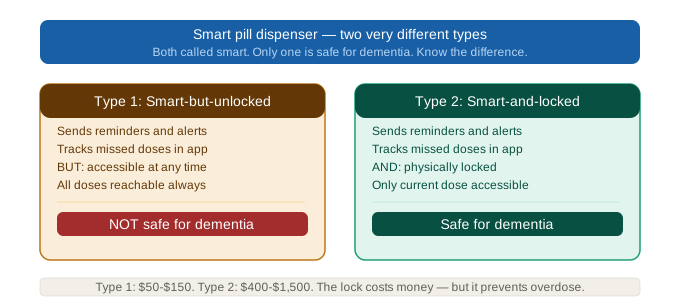
Smart-but-Unlocked: The dispenser connects to an app, sends you text alerts when doses are missed, and tracks medication history. The pills dispense into an open cup. Your parent can reach in and take more at any time. For further reading, see smart home medication reminders.
Smart-and-Locked: The dispenser connects to an app or cellular network, sends you text and call alerts when doses are missed, and tracks medication history. The pills are physically locked until the scheduled dose time.
Both are “smart.” Only one is appropriate for a parent with dementia.
This guide explains the distinction, walks through the best smart pill dispenser in each category, and helps you decide which type — and which device — is right for your parent’s specific situation.
What Makes a Pill Dispenser “Smart”? — Smart Pill Dispenser For Seniors
A smart pill dispenser does at least one of the following: Caregivers evaluating smart pill dispenser for seniors will find the key details in this section.
App control: The caregiver can view medication history, update the schedule, and receive alerts via a smartphone app.
Caregiver notifications: Text messages, email alerts, or phone calls go to designated contacts when a dose is missed or taken late.
Missed dose escalation: If a dose is missed, the alert escalates — first an alarm, then a text, then a phone call to the next contact on the list.
Connectivity: The device connects to Wi-Fi or cellular network to communicate with the caregiver’s phone regardless of physical distance.
“Smart” specifically means remote communication between the device and the caregiver. A basic pill dispenser that only alarms locally is not a smart dispenser — the alarm goes to the senior, not to you.
Smart-but-Unlocked: Hero — Best Smart Pill Dispenser for Remote Caregivers ($149 + $36.95/mo)
Hero is the best smart-but-unlocked pill dispenser for remote caregivers whose parent does not have dementia.
When a dose time arrives, Hero alarms and dispenses pills into a removable cup. If your parent does not take the pills within the configured window, Hero sends a text and email notification to the caregiver app. The app shows a full medication history — which doses were taken, which were missed, and refill status.
The subscription ($36.95/mo) includes: app access, caregiver text alerts, cellular connectivity, medication tracking, and refill reminders.
Device: $149–$179
Monthly: $36.95
Connectivity: Wi-Fi required
Lock: Unlocked — pills accessible at all times
Year 3 total: $1,479
Smart features: App medication history, text alerts, email alerts, refill reminders
When Hero is the right smart dispenser: Remote caregiver who needs daily confirmation. Parent is forgetful but not at double-dosing risk. Reliable home Wi-Fi. Tech-comfortable caregiver who will use the app.
The critical limitation: Unlocked. A dementia parent can access pills at any time. If your parent has any cognitive decline that might lead to taking extra doses, Hero is not safe. Move to the Smart-and-Locked category below.
Smart-and-Locked: MedMinder Maya — Best Smart Pill Dispenser for Dementia ($0–$30 + $35–$49/mo)
MedMinder Maya is the best smart-and-locked pill dispenser — combining remote caregiver alerts with physical locked dispensing that prevents overdose.
At each dose time, the rotary mechanism unlocks one compartment and dispenses that dose. All other compartments remain physically locked. Your parent cannot access extra pills between doses regardless of their cognitive state.
The cellular plan operates without Wi-Fi — making MedMinder the only fully smart dispenser that works in rural areas or homes with unreliable internet. When a dose is missed, the escalation system triggers: loud alarm → text to caregiver → phone call to caregiver → next contact on the list.
Device: $0–$30
Monthly: $35–$49
Connectivity: Cellular (no Wi-Fi needed) or Wi-Fi
Lock: Yes — physically locked between doses
Capacity: 28 days
Battery backup: 48 hours
Year 3 total: ~$1,290
Smart features: Caregiver text and call alerts, escalating missed dose response, remote schedule management, medication history, cellular connectivity
When MedMinder is the right smart dispenser: Dementia or cognitive decline. Any double-dosing risk. Rural home or poor Wi-Fi. Caregiver needs phone call escalation, not just a push notification.
Smart-and-Locked Portable: MedMinder Janey — Best Smart Dispenser for Active Seniors ($0–$30 + $20–$30/mo)
MedMinder Janey is the portable equivalent of MedMinder Maya — a pendant-style smart locked dispenser for seniors who spend time away from home.
Battery-powered and cellular-connected, Janey travels with the senior to appointments, visits, and short trips. It holds 7 days of medication and sends caregiver alerts on missed doses. For an active senior who needs locked dispensing and caregiver alerts outside the home, Janey is the only device in this category that delivers both portability and smart monitoring.
Device: $0–$30
Monthly: $20–$30
Capacity: 7 days
Lock: Yes
Connectivity: Cellular
Year 3 total: ~$750–$1,110
Budget Smart Alternative: Livi Smart ($99–$149 + $29.95/mo)
Livi Smart is a Wi-Fi connected unlocked dispenser with caregiver alerts at a slightly lower monthly cost than Hero. The interface is similar — app control, text notifications on missed doses, medication history — at approximately $7/mo less than Hero.
The trade-offs compared to Hero: less established brand, smaller product ecosystem, and comparable but slightly less polished app experience. For caregivers who want Hero’s functionality at a slightly lower cost and are comfortable with a newer brand, Livi is worth considering.
Device: $99–$149
Monthly: $29.95
Lock: Unlocked
Connectivity: Wi-Fi
Year 3 total: ~$1,028
Smart vs “Dumb” — Is the Monthly Fee Worth It?
This is the value question that no competitor frames honestly.
A $40 TabTimer (local alarm only) vs a $1,479 Hero over three years. The $1,439 difference buys exactly one thing: the certainty that you receive a text message when your parent does not take their pills.
Not a phone call. Not an ambulance. A text message that tells you: “Mom did not take her 8pm dose.”
For a caregiver who visits daily, that text message has limited additional value. They will find out when they visit.
For a caregiver who lives three hours away, that text message is the difference between knowing and not knowing for the next 23 hours. It is worth it.
The monthly fee question is not “is this device better?” It is “do I need to know the moment my parent misses a dose?” If yes, pay the subscription. If you will find out anyway through regular contact, the $40 local alarm achieves the same outcome.
Wi-Fi vs Cellular — The Connectivity Decision
This is the most underreported technical distinction in the smart pill dispenser category.
Hero requires Wi-Fi: If the home internet goes down (router failure, power outage, service disruption), Hero cannot send caregiver alerts. The device will still alarm locally — but your notification stops. For a remote caregiver relying on alerts for daily confirmation, an internet outage is a reliability gap.
MedMinder Maya on cellular: Connects via the cellular network directly. Internet outage does not affect alert delivery. Works in rural areas with limited broadband. Works in assisted living facilities where the senior does not manage their own Wi-Fi account.
For seniors in urban homes with reliable internet: Wi-Fi dependency is a minor concern. For seniors in rural areas, areas with frequent outages, or seniors who do not manage their own internet: cellular connectivity is the only reliable smart option.
Dementia and Smart Pill Dispensers
This section is the most important in the guide for a significant proportion of caregivers searching this keyword.
“Smart” does not mean safe for dementia. A smart-but-unlocked dispenser (Hero, Livi) provides notifications — but pills remain accessible. A dementia parent who takes extra pills is not prevented by a text message on your phone. The text tells you what happened; it does not prevent it.
Only a smart-and-locked dispenser (MedMinder Maya) addresses both the notification need and the overdose prevention need simultaneously.
If your parent has dementia: the correct device is MedMinder Maya. Not Hero, regardless of how many review sites rank it first.
If your parent has mild cognitive decline and is not yet at double-dosing risk: Hero may be appropriate now, with a planned transition to MedMinder Maya as cognitive decline progresses.
If your parent is cognitively intact: Hero is the strongest smart dispenser for remote caregiving.
Frequently Asked Questions
Q: What is a smart pill dispenser for seniors?
A: A pill dispenser that connects to a smartphone app or cellular network and sends caregiver notifications when doses are missed. “Smart” refers to remote communication capability — distinguishing these devices from local-alarm-only dispensers.
Q: What is the best smart pill dispenser for seniors?
A: Depends on the situation. Best smart-but-unlocked: Hero. Best smart-and-locked (dementia): MedMinder Maya. Best portable smart: MedMinder Janey. Best budget smart: Livi Smart.
Q: Does a smart pill dispenser need Wi-Fi?
A: Hero and Livi require Wi-Fi. MedMinder Maya and Janey offer cellular plans that work without Wi-Fi. For homes with poor or unreliable internet, MedMinder’s cellular plan is the only viable smart option.
Q: Is a smart pill dispenser worth the monthly fee?
A: If you need to know the moment your parent misses a dose and cannot find out through regular check-ins: yes. If you visit daily or call every morning: the $30–$37/mo subscription may not add value over a $40 local alarm dispenser.
Q: Can a smart pill dispenser help with dementia?
A: Only if it is locked. Smart-but-unlocked dispensers (Hero) notify you when a dose is missed but do not prevent your parent from taking extra doses. Smart-and-locked dispensers (MedMinder Maya) do both.
Q: How hard is a smart pill dispenser to set up?
A: Hero: requires smartphone, Wi-Fi setup, app download, and medication programming. Setup typically takes 30–60 minutes for a tech-comfortable caregiver. MedMinder: can be set up by the caregiver remotely, with the senior operating via a simple keypad — no smartphone needed on the senior’s side.
Q: What does “smart” actually mean for a pill dispenser — app control, caregiver alerts, or both?
A: Both, in most cases. A smart pill dispenser connects to an app or cellular network (remote connectivity) and sends caregiver alerts when doses are missed (remote notification). App control allows remote schedule management. Caregiver alerts notify you of missed doses. The combination of both features is what makes a dispenser genuinely “smart” — remote connectivity without alerts (or vice versa) is only partially smart.
Q: My mum has dementia — is a smart but unlocked pill dispenser (Hero) safe, or do I need a locked one?
A: A locked one. Hero is smart but unlocked — it notifies you when a dose is missed but does not prevent your parent from taking extra doses. For a dementia parent, the physical locked design of MedMinder Maya is the essential safety feature. Being notified after an overdose has occurred is not the same as preventing it.
Q: What is the annual cost of Hero vs MedMinder as a smart pill dispenser?
A: Hero: $36.95 × 12 = $443.40/year (plus $149 device in Year 1). MedMinder Maya: approximately $35–$49 × 12 = $420–$588/year (plus $0–$30 device in Year 1). Annual costs are comparable; MedMinder is slightly cheaper in Year 1 (lower device cost) and comparable in subsequent years. The key difference is locked vs unlocked — not the price.
Q: Which smart pill dispenser is best for a parent in a rural area with poor internet?
A: MedMinder Maya on the cellular plan. It does not require home Wi-Fi. Hero requires a stable Wi-Fi connection and stops functioning as a smart device when the internet goes down.
Q: Is a smart pill dispenser worth it over a $40 pill timer?
A: For a remote caregiver who cannot know whether their parent took their medication without a notification: yes. The monthly subscription buys real-time caregiver alerts. For a caregiver who visits daily or has other reliable ways to verify compliance, a $40 local alarm may be sufficient.
Our Final Recommendation
For a forgetful parent without dementia, remote caregiver, reliable Wi-Fi: Hero. Hero Health
For a parent with dementia or any double-dosing risk: MedMinder Maya. MedMinder Maya
For an active senior who needs portable locked dispensing with alerts: MedMinder Janey. MedMinder Janey
For the lowest-cost smart option: Livi Smart. Livi Smart
Check your parent’s Medicare Advantage plan for medication management device coverage before purchasing. FSA/HSA funds can be used for the device cost.