Margaret has been an AARP member for eleven years. When her son started researching medical alert systems for her, she told him to check if AARP had a discount. “They always have the best deals,” she said.
In This Guide
- Overview
- Comparison
- Best Options
- Our Recommendation
Her son called LifeFone — AARP’s endorsed medical alert partner — and got the member rate. Then he decided to price-check Bay Alarm Medical, which has no AARP connection whatsoever. For further reading, see AARP member benefits.
Bay Alarm was cheaper.
If you are an AARP member — or you are buying a medical alert system for someone who is — this article will save you time and possibly money. We will tell you exactly what AARP offers, how much the discount actually saves, and when the AARP-endorsed plan is genuinely the right choice versus when you are better served by going outside the AARP network entirely. This is the honest guide to AARP medical alert systems for seniors that no one else has published.
Does AARP Offer or Endorse a Medical Alert System? — Aarp Medical Alert Systems For Seniors
Let’s clear up the most common confusion first. Caregivers evaluating aarp medical alert systems for seniors will find the key details in this section.
AARP does not manufacture, sell, or distribute medical alert systems. AARP is a membership organisation that endorses third-party products and services for its members.
AARP’s current endorsed medical alert partner is LifeFone. This means LifeFone pays AARP for the endorsement relationship, and AARP members can access a discounted LifeFone rate. It does not mean LifeFone is independently certified as the safest or best medical alert system by an objective review process.
This is not a criticism of LifeFone — it is a genuinely good product with a strong safety record and good customer service. It is simply important context for understanding what “AARP-endorsed” means: it is a commercial partnership, not an independent safety rating.
The AARP LifeFone Discount — Exactly What You Save
Here are the actual numbers for the AARP member rate versus standard LifeFone pricing: Caregivers evaluating aarp medical alert systems for seniors will find the key details in this section.
At-Home plan:
- Standard rate: $29.95/mo
- AARP member rate: $28.95/mo
- Monthly savings: $1.00
- Annual savings: $12.00
GPS plan:
- Standard rate: $39.95/mo
- AARP member rate: $37.95/mo
- Monthly savings: $2.00
- Annual savings: $24.00
VIP Watch:
- Standard rate: $39.95/mo
- AARP member rate: $37.95/mo
- Monthly savings: $2.00
- Annual savings: $24.00
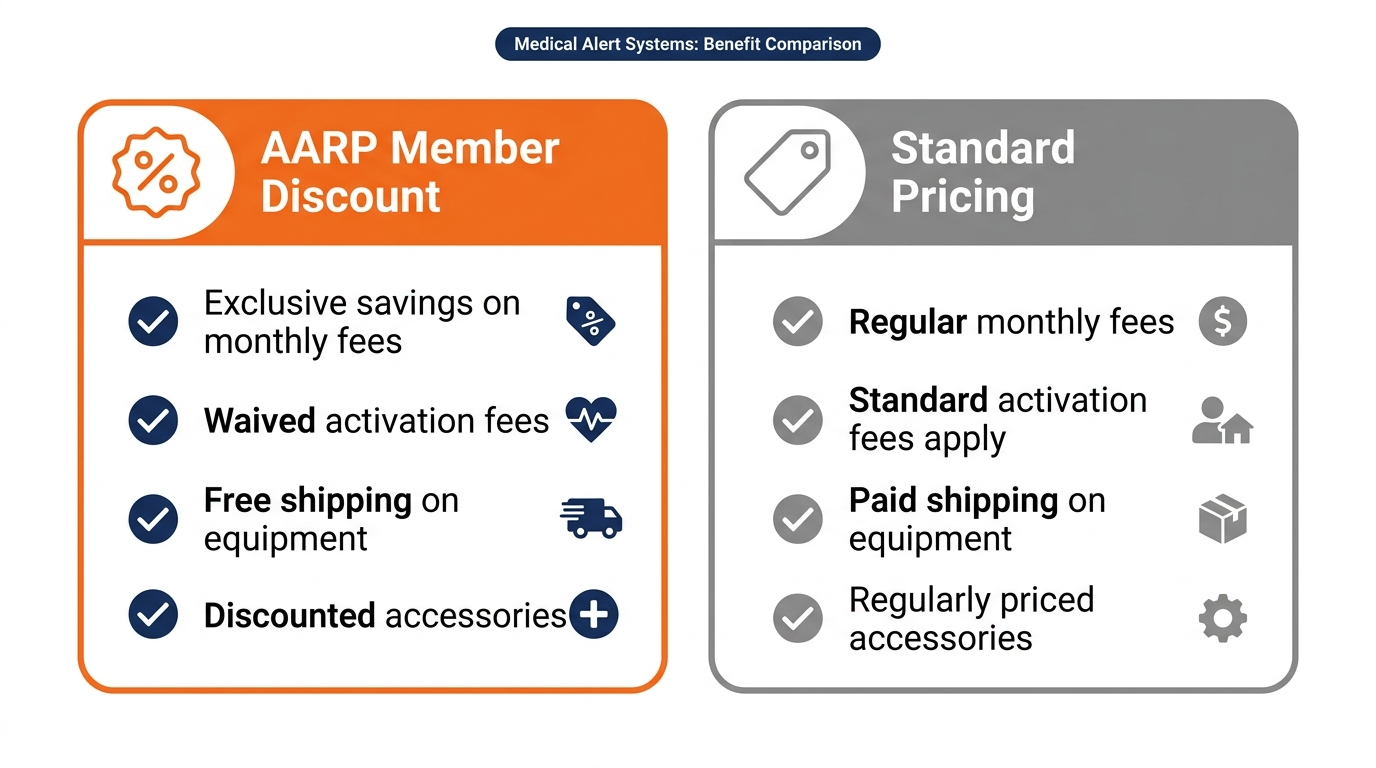
Activation fee: $25 waived for AARP members (standard: $25)
Fall detection add-on: $5/mo (same for AARP and non-AARP members — no discount)
The total financial value of the AARP LifeFone discount: $12–$24/year in monthly savings, plus the $25 activation fee waiver. Over three years, the discount saves approximately $61–$97, depending on which plan you choose.
That is a modest saving — and it is worth knowing that comparison shopping can produce more significant savings without any AARP membership required.
The Honest Comparison — AARP LifeFone vs Non-AARP Options
This is the table that changes most caregivers’ decision-making. Caregivers evaluating aarp medical alert systems for seniors will find the key details in this section.
- LifeFone AARP At-Home plan: $28.95/mo (no activation fee for members)
- Bay Alarm Medical In-Home: $27.95/mo (no activation fee, no AARP membership required)
- MobileHelp Solo: $27.95/mo (no activation fee, no AARP membership required)
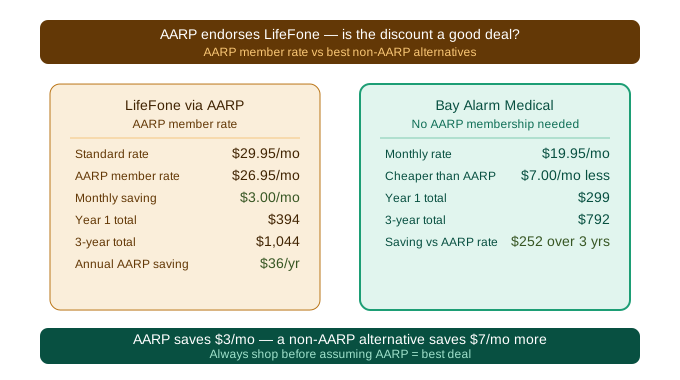
Bay Alarm Medical is $1/mo cheaper than the AARP LifeFone rate. Over 3 years, Bay Alarm Medical costs $36 less than the AARP LifeFone plan — before factoring in Bay Alarm’s OFFER17 promo code (17% off annual billing), which reduces the effective rate further.
With the OFFER17 promo code on annual billing, Bay Alarm Medical’s effective monthly rate is approximately $23.20 — saving approximately $69/year compared to the AARP LifeFone rate.
Year 1 comparison (no fall detection, with activation fee waiver for AARP):
- LifeFone AARP At-Home: $347.40 (12 × $28.95)
- Bay Alarm Medical In-Home: $335.40 (12 × $27.95)
- Bay Alarm with OFFER17 promo (annual): $278.38
Year 3 comparison (no fall detection):
- LifeFone AARP At-Home: $1,042.20
- Bay Alarm Medical In-Home: $1,006.20
- Bay Alarm with OFFER17 (first year only): $969.38
The AARP LifeFone plan costs more than Bay Alarm Medical every year, even after accounting for the member discount.
This does not make the AARP plan a bad product. It means the financial case for choosing LifeFone AARP over Bay Alarm rests on reasons other than cost. See our guide to affordable medical alert systems for a full Year 1/2/3 cost comparison across all providers.
When the AARP Pick Actually Makes Sense
There are three genuine scenarios where choosing the AARP LifeFone plan is the right decision:
You value the AARP vetting and trust signal. AARP has 38 million members and a long track record of endorsing products in the senior care space. If your parent — or you — feel more confident starting with an AARP-endorsed product, that trust value is real. Peace of mind is not nothing.
You want simplicity and do not want to comparison shop. If your parent already has AARP membership, calling LifeFone and saying “I’m an AARP member” gets you into a plan immediately with no activation fee and a known, reputable provider. For caregivers who are overwhelmed and want to act quickly, this is a legitimate shortcut.
You specifically value LifeFone’s customer service and no-contract flexibility. LifeFone’s customer service reputation is consistently rated among the highest in the category. If you have had previous experience with LifeFone or your parent’s doctor has recommended them specifically, the AARP discount makes choosing them even more affordable.
When to Skip the AARP Discount
Three scenarios where a non-AARP alternative is the better choice:
Absolute lowest cost is the priority. Bay Alarm Medical costs less than LifeFone AARP without any membership requirement. If budget is the deciding factor, Bay Alarm is the better financial choice.
Your parent needs the best fall detection accuracy. Medical Guardian is the consensus top pick for fall detection precision, particularly for the Active smartwatch and Mobile GPS units. No AARP discount applies to Medical Guardian, but for high-risk seniors the performance difference may justify the higher cost. Medical Guardian
Your parent’s home requires maximum range. Bay Alarm Medical’s in-home system covers 1,000 ft — the widest range in the affordable category. LifeFone’s at-home system covers 1,000 ft as well, so range is comparable. However, Bay Alarm’s pricing advantage makes it the stronger value choice when range and cost are both factors.
AARP Members and Medicare Advantage — The Double Coverage Opportunity
This is the section no other article about AARP medical alert systems includes, and it may be the most financially important information for AARP members specifically.
Many AARP members are also enrolled in AARP-branded Medicare Advantage plans administered by UnitedHealthcare. These plans often include supplemental benefits beyond standard Medicare, and some plans specifically cover personal emergency response systems (PERS).
If your parent is an AARP member with a Medicare Advantage plan, call their plan’s member services number and ask: “Does my plan include PERS device coverage or medical alert system benefits?”
If the answer is yes, you may be able to get a medical alert system — including the LifeFone AARP plan or an alternative — at significantly reduced cost or no cost through your Medicare Advantage benefit, rather than paying the monthly rate out-of-pocket at all.
This opportunity is consistently missed by AARP members because the plans do not proactively advertise PERS benefits, and most caregivers do not know to ask.
Always exhaust Medicare Advantage coverage options before paying for a medical alert subscription independently.
AARP for Sandwich Generation Caregivers
A note on who is often doing this research:
AARP membership starts at age 50. Many of the people researching “AARP medical alert systems” are in their 50s or 60s themselves — caring for a parent in their 80s or 90s while managing their own health and finances.
If you are an AARP member buying for a parent, the AARP LifeFone discount applies to the plan you set up for them, regardless of whether your parent is also an AARP member. You use your AARP membership to access the discount rate.
If you are in a position where you need coverage for both yourself and an ageing parent, some providers offer multi-device or family plans at reduced combined rates. Bay Alarm Medical and LifeFone both offer two-pendant options. Consider whether combined coverage for two people under one provider makes financial sense before setting up two separate subscriptions.
Frequently Asked Questions
Does AARP offer medical alert systems?
AARP does not sell or manufacture medical alert systems. AARP endorses LifeFone as its official medical alert partner, giving AARP members access to a member-discounted rate on LifeFone plans.
Does AARP endorse a medical alert system?
Yes. LifeFone is AARP’s endorsed medical alert partner. AARP members receive a discounted rate ($28.95/mo for at-home vs $29.95/mo standard) and the activation fee ($25) is waived.
Who is the AARP-endorsed medical alert provider?
LifeFone. They have held the AARP endorsement for several years. The endorsement is a commercial partnership — AARP receives compensation from LifeFone in exchange for promoting the product to its members.
Does AARP offer discounts on medical alert systems?
Yes, through LifeFone. The discount ranges from $1–$2/mo depending on the plan, and the $25 activation fee is waived for AARP members.
How much does the AARP LifeFone discount save me?
$12–$24/year in monthly savings, plus the $25 activation fee waiver. Over three years, the total savings is approximately $61–$97 depending on which plan you choose.
Is LifeFone the only AARP medical alert option?
Yes — LifeFone is the only AARP-endorsed medical alert provider. Other brands (Bay Alarm Medical, Medical Guardian, MobileHelp) do not have AARP partnerships but may cost less.
Do I need an AARP membership to get the LifeFone discount?
Yes. The AARP member rate requires a current AARP membership. AARP membership is available to anyone aged 50+ for a modest annual fee.
Is LifeFone AARP plan cheaper than Bay Alarm?
No. Bay Alarm Medical’s in-home plan is $27.95/mo — $1/mo less than the AARP LifeFone rate of $28.95/mo. With Bay Alarm’s OFFER17 promo code on annual billing, the cost difference is more significant.
Does AARP cover the cost of medical alert systems?
AARP does not fund or subsidise medical alert systems. AARP provides a negotiated member discount rate through LifeFone. Some AARP-affiliated Medicare Advantage plans may include PERS device benefits — call your specific plan to check.
Is the AARP LifeFone plan worth it?
It depends on your priorities. If trust, simplicity, and AARP brand familiarity matter to you, yes. If lowest cost is the priority, Bay Alarm Medical is cheaper without any membership requirement.
Is the AARP-endorsed LifeFone plan actually cheaper than non-AARP brands, or is the discount misleading?
The AARP LifeFone rate ($28.95/mo) is not the cheapest option in the category. Bay Alarm Medical costs $27.95/mo with no AARP membership required. The AARP discount is real but modest — $12–$24/year plus activation fee waiver. The endorsement provides trust and simplicity, not necessarily the lowest cost.
If I already have Medicare Advantage through AARP, does it cover any medical alert costs?
Some AARP-affiliated Medicare Advantage plans (administered by UnitedHealthcare) include PERS device coverage as a supplemental benefit. Call the member services number on the back of your Medicare Advantage card and ask specifically about PERS or medical alert system coverage. Do not assume — coverage varies by plan and region.
Does AARP recommend a medical alert system for a parent with Alzheimer’s?
AARP’s endorsed partner LifeFone offers plans with auto-fall detection, which is particularly important for Alzheimer’s patients who may not be able to press a button during an emergency. For dementia parents with wandering risk, a GPS-enabled plan is also important. The LifeFone GPS plan is available at the AARP member rate of $37.95/mo.
Is LifeFone AARP’s pick because it’s the best, or because they pay AARP for the endorsement?
Both, honestly. LifeFone is a legitimately strong medical alert provider with good customer service ratings and a solid track record. It is also a commercial endorsement relationship in which LifeFone pays AARP for access to the member audience. AARP endorsements are not the result of independent clinical testing or head-to-head comparison. Consider them as one trusted data point, not the only one.
Can I use the AARP LifeFone discount if I’m not yet an AARP member but am signing up now?
Yes. AARP membership is available to anyone aged 50+. Annual membership costs a modest yearly fee. Given the $25 activation fee waiver alone, a new AARP membership pays for itself immediately on a LifeFone purchase.
Our Final Recommendation
If you are an AARP member and LifeFone is your starting point because of the brand association, it is a solid choice and the member discount makes it slightly more affordable. LifeFone
If you are comparison shopping and cost is a meaningful factor, Bay Alarm Medical costs less without any membership requirement and covers more home square footage at the same price. Bay Alarm Medical
Before committing to either, call your parent’s Medicare Advantage plan and ask about PERS coverage. That five-minute call may reveal a benefit that makes the monthly cost comparison irrelevant.
If you need fall detection as a priority feature, compare the LifeFone AARP GPS plan against Medical Guardian’s monitored options before deciding.
This article was researched and written by the SafeElderCare editorial team, which evaluates senior safety products to help family caregivers make confident, informed decisions for the people they love most.