She visited every Sunday morning.
In This Guide
- Overview
- Comparison
- Best Options
- Our Recommendation
She would sit at the kitchen table with her mother’s medications spread out in front of her, and fill the weekly pill dispenser for seniors while her mother made tea. Seven compartments. Morning and evening. It took about fifteen minutes and she had been doing it for two years — the kind of quiet routine that a weekly pill dispenser for seniors is meant to replace. For further reading, see weekly medication adherence.
What she had not thought about was what happened on the days between Sundays — when her mother opened the wrong compartment of the weekly pill dispenser for seniors, mixed up which day she had taken, or took her Thursday pills on Wednesday because the box looked “about right.”
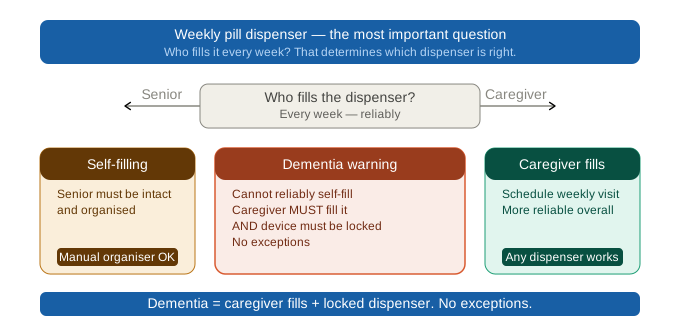
A weekly pill dispenser for seniors sounds like the most natural, manageable solution. Once a week, fill it. Done. The reality is more nuanced — and the most important question is not which dispenser to buy. It is who fills it.
The First Question — Who Fills the Weekly Pill Dispenser? — Weekly Pill Dispenser For Seniors

This question determines everything about which weekly pill dispenser is right.
Scenario A: Your parent fills it themselves
Your parent organises their own weekly pills. They are cognitively intact, understand the compartment system, and reliably fill and take their medication. The dispenser provides convenience, not management.
→ A manual pill organiser or timer is the right tool. Low cost, no complexity.
Scenario B: You fill it for your parent
You fill the weekly dispenser at the start of each week — during a visit or by mailing pre-filled trays. Your parent opens and takes from the pre-filled system. The dispenser provides controlled access — your parent takes from what you prepared, when the device allows.
→ An automatic locked dispenser is the right tool. Prevents your parent from accessing all doses at once.
Scenario C: You fill it and need to be notified if doses are missed
Same as Scenario B, but you cannot verify compliance in person between fills. You need to know when your parent does not take their pills.
→ A smart locked dispenser with caregiver alerts is the right tool.
Identify your scenario. Read the relevant section.
Scenario A — Parent Fills It Themselves
AM PM Pill Organiser ($5–$15, $0/mo) — Best Basic Weekly Organiser
For a senior who reliably fills their own pill box and has no memory issues beyond occasional forgetfulness — a basic AM PM pill organiser is the right weekly dispenser.
Seven daily compartments, typically two to four slots per day (AM, noon, PM, bedtime). The senior fills it once a week. No alarm, no lock, no technology.
Cost: $5–$15 one-time. Year 3 total: ~$10 (replacement every 2–3 years).
This is the most common medication management system for independently functioning seniors, and it is appropriate for that population. The challenge arises when cognitive decline makes it unreliable — see Dementia Warning below.
TabTimer ($29–$49, $0/mo) — Best Weekly Organiser with Alarm
TabTimer adds a programmable alarm to the manual weekly pill dispenser for seniors. The alarm sounds at each scheduled dose time — your parent opens the correct compartment and takes their pills.
For a senior who fills their own pills but occasionally forgets the time — TabTimer is the upgrade from a basic pill box. No subscription, no lock, no remote alerts. Just a reliable alarm at the right time.
Cost: $29–$49 one-time. Year 3 total: ~$40.
Weekly Pill Box with TimerCaps ($15–$30, $0/mo)
For a senior on multiple medications who wants to track each one individually — timer caps are a useful complement to a weekly pill dispenser for seniors. They attach to individual pill bottles and display the hours since the cap was last opened, beeping when the next dose is due.
Each medication has its own cap and its own timer. For a caregiver who wants to verify compliance remotely by asking “what does the cap say?”, this provides individual medication tracking at low cost.
Cost: $15–$30 one-time. Year 3 total: ~$25.
Scenario B — Caregiver Fills It, No Remote Alerts Needed
Pivotell 7-Day ($99–$149, $0/mo) — Best Locked Weekly Dispenser, No Subscription
Pivotell is the best weekly pill dispenser for caregivers who fill the device and need it to dispense one dose at a time — preventing the senior from accessing all compartments at once.
The rotary locked mechanism releases one compartment per scheduled dose time. The persistent alarm repeats until pills are taken. No smartphone, no Wi-Fi, no subscription. Battery-powered.
For caregivers who visit weekly to refill, want locked dispensing between visits, and do not need remote notification — Pivotell is the right choice.
Cost: $99–$149 one-time. Year 3 total: $149.
Scenario C — Caregiver Fills It and Needs Missed Dose Alerts
MedMinder Janey ($0–$30 + $20–$30/mo) — Best Smart Weekly Dispenser with Caregiver Alerts
MedMinder Janey is the best weekly pill dispenser for seniors — specifically for caregivers who fill the device weekly and need to know when doses are missed.
It is a pendant-style locked weekly pill dispenser for seniors — battery-powered and portable, so your parent can take it to appointments, visits, or short trips. Cellular-connected (no Wi-Fi needed). When a dose is missed, Janey texts and calls the caregiver.
Holds 7 days of medication at up to 4 doses per day. Locks between doses — your parent cannot access extra pills.
Device: $0–$30
Monthly: $20–$30
Connectivity: Cellular (no Wi-Fi)
Lock: Yes
Portability: Yes — battery-powered, not wall-plugged
Year 3 total: ~$750–$1,110
Best for: Remote caregivers who fill weekly and need missed dose alerts. Seniors who travel or spend time away from home. Dementia with caregiver-managed refilling.
The weekly refill means 52 refills per year — at 10–15 minutes each, approximately 9–13 hours per year. If you visit weekly to refill, Janey aligns naturally with the visit cycle.
Weekly vs Monthly — Which Refill Cycle Is Right?
“Weekly pill dispenser” implies a 7-day refill cycle. This is the most common choice — but it is not always the most practical.
Weekly refill (7-day dispensers: TabTimer, Pivotell, MedMinder Janey): 52 refills per year. If the caregiver visits weekly, this aligns with the visit. If the caregiver visits less frequently, it does not.
Monthly refill (28-day dispensers: MedMinder Maya): 13 refills per year. Aligns with monthly caregiver visits. Significantly less caregiver time spent on medication management annually.
If you visit your parent monthly rather than weekly — a 7-day dispenser requires either weekly visits to refill, or a local helper to refill between visits. A monthly dispenser (MedMinder Maya) eliminates that requirement.
The weekly pill dispenser for seniors refill cycle should match your actual visit frequency. If it does not, you are either visiting more than necessary or having a third party manage medication fills — both of which are operational costs that the dispenser’s price does not capture.
The Dementia Warning — Never Use a Manual Weekly Pill Box
This is the most critical section in the guide.
A manual weekly pill box — even a well-organised one with clearly labelled compartments — is not safe for a senior with dementia.
Here is why: a dementia parent can open any compartment at any time. They may take Tuesday’s pills on Monday. They may take all of Monday’s pills at once because all compartments look the same. They may take pills they have already taken because they forgot they took them. The compartment system provides organisation — it does not provide protection.
For a dementia senior, the only safe weekly dispenser is one with locked automatic dispensing: Pivotell (locked, no alerts) or MedMinder Janey (locked, caregiver alerts).
If your parent currently uses a manual weekly pill box and is showing signs of cognitive decline — this is the most urgent medication management change to make. The risk is real and immediate.
Portability — Which Weekly Dispenser Travels?
Many seniors continue to be active — doctor’s appointments, family visits, short holidays. For an active senior, portability matters.
AM PM Organiser: Highly portable — fits in a handbag.
TabTimer: Small, portable, battery-operated.
TimerCaps: Portable with individual bottles.
MedMinder Janey: Designed for portability — pendant style, battery-powered, cellular.
Pivotell: Countertop device, not designed for travel.
For an active senior who regularly leaves home: MedMinder Janey’s portability combined with locked dispensing and caregiver alerts makes it the strongest weekly pill dispenser for seniors with an active lifestyle.
Frequently Asked Questions
Q: What is a weekly pill dispenser for seniors?
A: A pill storage and dispensing system organised on a 7-day cycle. Ranges from a basic manual pill box ($10) to a smart locked automatic dispenser with caregiver alerts ($20–$30/mo).
Q: What is the best weekly pill dispenser for seniors?
A: Depends on who fills it and whether you need alerts. Best for self-filling seniors: TabTimer (with alarm). Best for caregiver-filled, no alerts: Pivotell (locked, persistent alarm). Best for caregiver-filled with alerts: MedMinder Janey (locked, cellular, caregiver notification).
Q: What is the difference between a weekly and monthly pill dispenser?
A: A weekly pill dispenser for seniors holds 7 days of medication and requires 52 refills per year. Monthly dispensers (MedMinder Maya) hold 28 days and require only 13 refills per year. Monthly dispensers suit caregivers who visit monthly. A weekly pill dispenser for seniors suits caregivers who visit weekly — and whose visit schedule aligns with the refill cycle.
Q: Is a weekly pill dispenser good for someone with dementia?
A: Only if it is a locked automatic weekly pill dispenser for seniors. Manual weekly pill dispensers are not safe for dementia — the senior can access all compartments at once. MedMinder Janey (locked, caregiver alerts) and Pivotell (locked, local alarm) are the appropriate options.
Q: What is the easiest weekly pill dispenser for an elderly person to use?
A: For self-managing seniors: a manual weekly pill dispenser for seniors like an AM PM pill box — simple compartments, no technology. For caregiver-managed: MedMinder Janey, where the senior just responds to the alarm and the weekly pill dispenser for seniors handles the rest — no technology required from them.
Q: Can I get a weekly pill dispenser that alerts me if my parent misses a dose?
A: Yes — MedMinder Janey. Cellular-connected, texts and calls designated caregiver contacts when a dose is missed. No Wi-Fi required.
Q: Who fills the weekly pill dispenser — my parent or me?
A: This is the most important question before choosing a weekly dispenser. If your parent fills it themselves and is cognitively intact, a manual organiser (AM PM box, TabTimer) is appropriate. If you fill it and need locked dispensing to protect between fills, Pivotell or MedMinder Janey is the right choice.
Q: My mum has dementia — can I use a weekly pill organiser or do I need an automatic dispenser?
A: You need a locked automatic weekly pill dispenser for seniors. A manual weekly pill dispenser allows your parent to access any compartment at any time — a dementia parent may take all the pills or take the wrong day’s doses. Pivotell (locked, local alarm) or MedMinder Janey (locked, caregiver alerts) are the appropriate choices for a weekly pill dispenser for seniors with dementia safety built in.
Q: What is the best weekly pill dispenser for someone who travels and leaves the house every day?
A: MedMinder Janey — portable pendant-style device, battery-powered, cellular (works without home Wi-Fi), locked dispensing. Designed for active seniors who move between locations.
Q: How long does it take to refill a weekly pill dispenser and how often does it need to be done?
A: Weekly dispensers require 52 refills per year. Each refill typically takes 10–15 minutes depending on the number of medications and compartments. Over a year, a 7-day dispenser requires approximately 8–13 hours of total refill time. A monthly dispenser (28-day) requires only 13 refills, saving approximately 39 refill events annually.
Q: Is a $10 weekly pill organiser as good as a $30/month automatic one?
A: For a cognitively intact senior who fills their own pills and needs no locked access or caregiver alerts — yes, a basic organiser is fully appropriate. For a senior with dementia or any double-dosing risk, or for a remote caregiver who needs missed dose alerts — no. The $30/month buys locked dispensing and caregiver notification, not just a better version of a pill box.
Q: What is the best weekly pill dispenser for someone who takes 10 different medications?
A: For high medication loads, confirm the compartment capacity of the specific device. TabTimer and basic pill boxes typically have AM/noon/PM/HS compartments — each holds multiple pills but physical space is limited for 10+ medications per dose. MedMinder Janey’s compartment capacity per dose slot should be confirmed with the manufacturer for very high pill loads.
Our Final Recommendation
For self-managing seniors with intact memory: TabTimer ($40, alarm, no subscription). TabTimer
For caregiver-filled, locked dispensing needed, no remote alerts: Pivotell ($149, locked, persistent alarm, no subscription). Pivotell
For caregiver-filled, locked dispensing, missed dose alerts needed — including dementia: MedMinder Janey (locked, cellular, caregiver alerts, portable). MedMinder Janey
If your parent visits you or family regularly and needs portability: MedMinder Janey is the only smart locked dispenser in the category that travels.
If your caregiving visits are monthly rather than weekly: consider MedMinder Maya (28-day dispenser, monthly refill cycle) rather than a weekly option — the reduced refill burden is significant over a year.