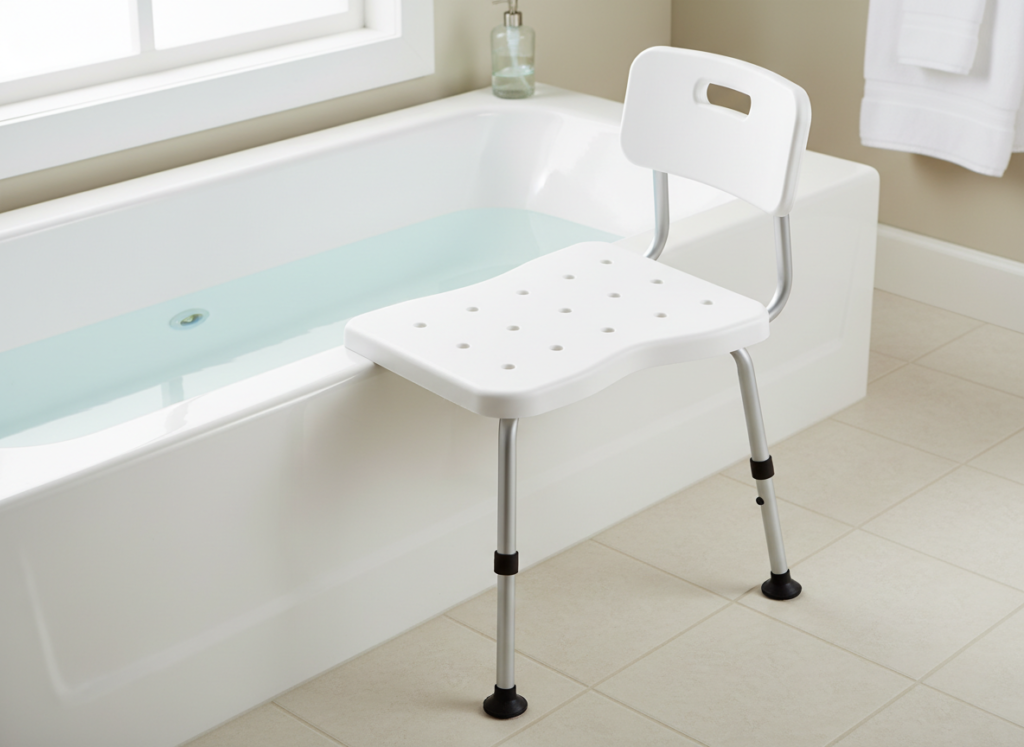
A transfer bench for bathtub entry lets a senior sit down outside the tub and slide across the wall instead of stepping over it — which removes the single most dangerous movement in the home. Expect to pay $44–$149: the Vive Tub Transfer Bench ($94.99, 400 lb capacity) and the Carex line ($44.22–$105.54) cover nearly every situation, with prices verified on merchant sites in July 2026. Here is how to choose the right one for your parent’s tub, body and bathroom — and how to know when a bench beats a walk-in shower conversion costing fifty times more.
Table of Contents
Transfer bench for bathtub options at a glance
| Product | Price (verified July 2026) | Capacity | Best for |
|---|---|---|---|
| Vive Tub Transfer Bench | $94.99 | 400 lbs | Most users; reversible; suction feet |
| Carex Classics Transfer Bench | $74.50 | 300 lbs class | Budget standard bench |
| Carex Easy Transfer Bench | $82.93 | 300 lbs class | Tool-free assembly |
| Carex Bathtub Transfer Bench | $105.54 | 300 lbs class | Handles for extra leverage |
| Carex Bench with Opening & Bucket | $94.89 | 300 lbs class | Toileting + bathing combined |
| Carex Portable Shower Bench | $44.22 | 250–300 lbs | Travel, second bathroom |
Why the tub wall is the enemy
Stepping into a bathtub asks an aging body to balance on one wet foot, swing the other leg over a 14–20 inch wall, and land blind on a slick surface — then repeat it backwards, tired and wet, twenty minutes later. No grab bar fully fixes that movement; it steadies it. A transfer bench for bathtub entry eliminates it: your parent sits on the outboard half of the bench, lifts one leg at a time over the wall while seated, slides across, and bathes seated.
The fall-risk moment simply stops existing. Occupational therapists reach for benches ahead of nearly everything else for exactly this reason — and if a near-miss at the tub has already happened, treat the bench as this week’s purchase, not this month’s. Pair it with a fall detection watch for the rest of the routine.
The picks, by situation
Best for most people: Vive Tub Transfer Bench — $94.99
The Vive Tub Transfer Bench ($94.99, down from $179.99, verified July 2026) gets the transfer bench for bathtub fundamentals right: 400 lb capacity — the highest in this roundup — non-slip suction cups on the interior feet where the bench sits in the tub, and a reversible back and armrest so it configures for left- or right-entry bathrooms. When evaluating a bench for a heavier parent or one who lands hard on seats (common with Parkinson’s), that 400 lb dynamic margin is the difference between rated and merely hopeful.
Best budget bench: Carex Classics — $74.50
The Carex Classics Transfer Bench ($74.50, down from $98.82) is the standard-issue bench: height-adjustable legs, reversible design, drainage seat. Nothing clever, everything necessary. The Easy Transfer Bench ($82.93) adds tool-free assembly — worth $8 if the person assembling it is the same senior who will use it.
Best for caregiving situations: Carex Bench with Opening & Bucket — $94.89
The commode-style Carex bench ($94.89) has a seat opening with a removable bucket, which consolidates toileting and bathing support into one piece of equipment — relevant for small bathrooms and post-surgery months where a bedside commode would otherwise crowd the room. The Carex Bathtub Transfer Bench ($105.54) instead adds handles at the seat edge, giving anxious bathers something to hold during the slide.
For travel and second bathrooms: Carex Portable — $44.22
The Carex Portable Shower Bench ($44.22) is lighter-duty: fine as a seat and for visits to relatives, but its lower mass and simpler feet make it second choice for the daily-driver bathroom. Note the sold-out models on Carex’s site (Universal, $80.45; Deluxe Padded, $148.96) — if a listing you find elsewhere quotes those, confirm stock before planning around them.
Measuring before you buy: the 10-minute check
Four measurements prevent nearly all returns. Tub wall height (floor to rim, outside): the bench’s legs must adjust so the seat sits level or slightly above the rim. Inside tub width: the interior legs must land flat on the tub floor, not on the curve.
Clear floor space beside the tub: a bench extends 10–15 inches beyond the tub edge — measure to the toilet or vanity, because a bench that blocks the toilet gets removed within a month. Glass doors: sliding tub doors and transfer benches are incompatible; the track blocks the slide. Doors must come off (a screwdriver job, reversible for landlords) and be replaced with a weighted curtain, which drapes over the bench mid-seat.
Fit the user, too: seat height at 21 inches and the ideal 19-inch seat depth suit most adults, but a very short parent needs the legs at their lowest setting so feet stay planted during the slide — dangling feet mean an unstable slide. And apply the standard margin rule: rated capacity at least 10–20% above body weight, more if they drop onto seats.
Using it right: the technique that makes it safe
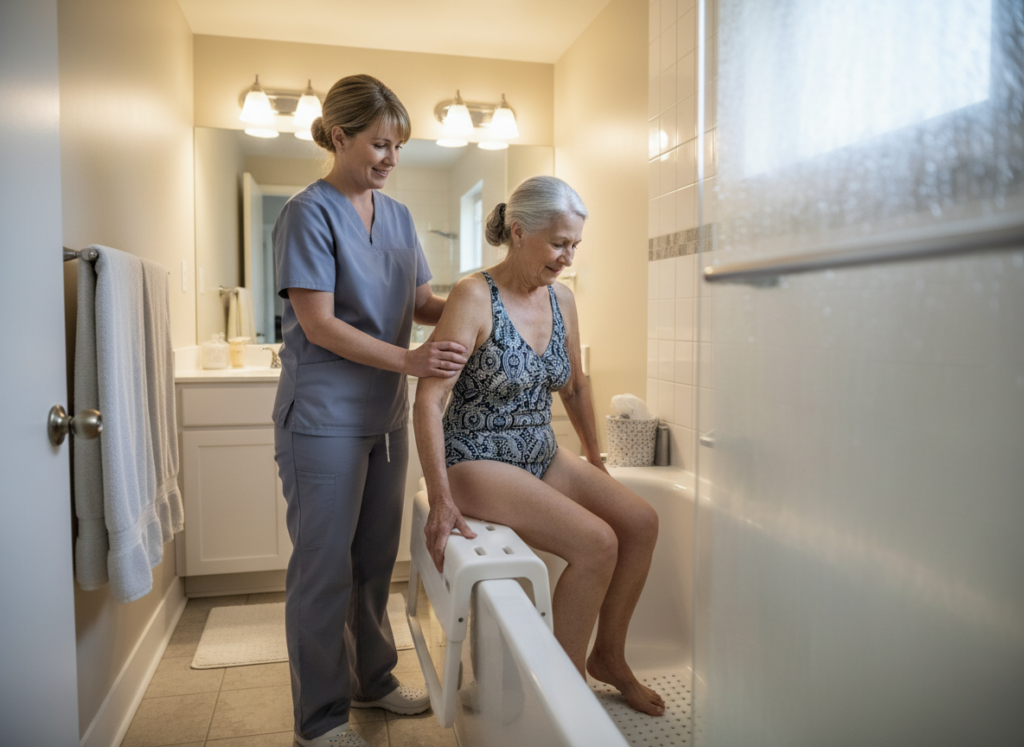
A transfer bench for bathtub bathing is only as safe as the transfer technique. Teach it once, watch it twice: back up to the bench until the legs touch it, reach back with both hands, sit on the outboard section — never straddle-step. Then lift the near leg over the wall while seated, then the far leg, then slide across in two or three small scoots, keeping weight centred.
Reverse it exactly on exit, and finish fully seated outside the tub before standing. The two habits that cause bench accidents: standing up mid-slide, and leaving soap film on the seat — rinse the seat as the last act of every shower. A handheld showerhead (Vive’s is $34.99) is effectively mandatory equipment with a bench; fixed overhead spray reaches a seated bather’s shoulders and little else.
One more product-care note: skip bath oils and bubble bath on transfer-bench days. They leave the seat slicker than soap film alone, don’t rinse away as fully, and undercut the exact risk the bench is meant to remove — if dry skin is the reason for the oil, apply it after the bath once your parent is seated somewhere stable instead.
Bench vs. walk-in shower vs. walk-in tub
A $95 transfer bench for bathtub entry solves the same core problem as a $5,000–$15,000 walk-in conversion: getting a body past the tub wall safely. The structural options earn their price when a wheelchair is involved, when a caregiver must be physically in the bathing area, or when the senior cannot manage a seated slide at all. Short of those, install the bench this week and bank the renovation money — and be properly skeptical of “free walk-in shower for seniors” ads; real funding programs (Medicaid waivers, VA HISA grants, USDA rural grants) exist but run through applications, not door-to-door sales. Photos of walk-in showers for elderly bathrooms make renovation look inevitable; the bench in your parent’s existing tub is the version that can happen by Friday.
Sliding vs. standard benches: when the upgrade earns its price
A category up from the standard bench, sliding transfer benches put the seat on rails so the user is carried across the tub wall rather than scooting — the caregiver or user releases a lock, glides the seat, and locks it again. They cost two to four times a standard bench and earn it in two situations: a user who cannot scoot sideways at all (advanced Parkinson’s, hemiplegia after stroke, significant weakness), or a caregiver doing every transfer, whose back the rails are really protecting. Elenker’s sliding shower chair line — the KLD-3326 sliding chair with large seat ($115.99) and HFK-3146 sliding chair with 360° swivel seat ($189.99), both verified July 2026 — covers this tier, with the swivel model also rotating the user to face the faucet without torso twisting. For everyone else, the fixed bench does the job at half the price with fewer moving parts to fail.
One honest note on padded seats: padding is comfort, not safety, and open-cell pads that stay damp grow mildew faster than families expect. If your parent has fragile skin (common with long-term steroid use), a padded or contoured seat matters; otherwise, smooth drained plastic that dries in minutes is the better daily choice.
Setup day: getting the first bath right
Assemble the bench dry, outside the bathroom, and load-test it with your own weight including a deliberate sideways scoot. Set the legs so the seat clears the tub rim by no more than an inch — lower is more stable. Press the suction feet down inside the dry tub (they grip dry enamel far better than wet).
Then stage the bathroom around a seated bather before anyone undresses: towel within arm’s reach of the seated exit position, soap and shampoo at bench height (not on the tub floor), handheld showerhead docked low, bath mat at the exact spot feet will land. The first bath should have a second person present — not to help, but to watch and adjust. Most families find one or two staging problems (the towel bar is two steps away; the curtain gaps at the bench) that take a minute to fix and would otherwise become the reason the bench “didn’t work.”
Getting a reluctant parent onto the bench
The transfer bench for bathtub bathing fails most often not in the tub but in the conversation. Three framings that work, from families who have run this exact negotiation: position it as temporary (“while your hip settles down” — temporary equipment faces less resistance, and good equipment quietly becomes permanent); position it as caregiving them less (“this means nobody has to stand outside the curtain”); and let them feel the seated slide once with clothes on, dry, before bath night — the movement sells itself better than any argument, because it feels stable in a way words cannot convey. What does not work is installing it as a surprise: equipment that appears without consent reads as a verdict about decline, and verdicts get appealed — usually by the bench living in the garage. Ten minutes of involvement beats ten days of persuasion.
One more note for caregivers of a parent with dementia: the seated slide is learnable well into moderate cognitive decline because it is a body-memory skill, not an instruction-following skill — but it must be the same sequence, same words, every time. Pick one short cue per step (“sit… legs over… slide”) and have every caregiver use the identical script. Inconsistent coaching is more destabilising than the tub wall ever was.
Full comparison
| Product | Price | Capacity | Key features | Where to buy |
|---|---|---|---|---|
| Vive Tub Transfer Bench | $94.99 | 400 lbs | Reversible, suction interior feet | Vive Health (no affiliation) |
| Carex Classics Transfer Bench | $74.50 | 300 lbs class | Height adjustable, drainage | Carex |
| Carex Easy Transfer Bench | $82.93 | 300 lbs class | Tool-free assembly | Carex |
| Carex Bathtub Transfer Bench | $105.54 | 300 lbs class | Leverage handles | Carex |
| Carex Bench w/ Opening & Bucket | $94.89 | 300 lbs class | Commode function | Carex |
| Carex Portable Shower Bench | $44.22 | 250–300 lbs | Light, travel-friendly | Carex |
Frequently asked questions
What is the best transfer bench for bathtub use?
For most users, the Vive Tub Transfer Bench ($94.99): highest weight rating in its price class at 400 lbs, suction feet inside the tub, and a reversible backrest for either bathroom layout. Budget pick is the Carex Classics at $74.50.
How does a bathtub transfer bench work?
Two legs stand inside the tub, two outside, so the seat bridges the tub wall. The user sits outside, lifts each leg over the wall while seated, slides across, and bathes seated — no standing step-over in either direction.
Can you use a transfer bench with sliding glass shower doors?
No — the door track blocks the bench and the slide. Remove the doors (screwdriver job, reversible) and hang a weighted shower curtain instead. This is the most commonly missed compatibility issue in the category.
Will Medicare pay for a transfer bench for the bathtub?
Original Medicare generally does not — transfer benches are classed as convenience items. Some state Medicaid programs and Medicare Advantage home-safety allowances do cover them, and they are HSA/FSA eligible. A doctor’s letter of medical necessity helps with every one of those routes.
What is the difference between a shower chair and a transfer bench?
A shower chair sits entirely inside the bathing area and assumes the user can step in; a transfer bench straddles the tub wall and removes the step entirely. If stepping over the wall is safe, a chair is cheaper and takes less room. If it is not, only the bench solves the problem.
How do you help an elderly person get in the bathtub without a bench?
Short-term: a clamp-on tub rail for the step-over ($40.83–$62.42 at Carex), a non-slip mat inside, and a caregiver spotting from the side, never pulling by the arms. But if this question is being asked at all, the household has outgrown improvisation — a transfer bench for bathtub entry starts at $44.22 and remove the risk rather than manage it.
The bottom line
For most families, the right transfer bench for bathtub use is the Vive Tub Transfer Bench ($94.99), unless a specific reason points elsewhere: tight budget (Carex Classics, $74.50), combined toileting needs (Carex with Opening & Bucket, $94.89), or anxious hands that want mid-slide grips (Carex with handles, $105.54). Measure the tub wall, the inside width and the floor clearance first, take sliding doors off their track, and teach the seated slide before the first solo bath. Done in that order, a transfer bench is the single highest-impact purchase in bathroom elder-safety — it does not reduce the most dangerous moment of the day; it deletes it.