The best automatic pill dispenser is not the same device for every person.
In This Guide
- Overview
- Comparison
- Best Options
- Our Recommendation
That sounds obvious. But every major review site picks one winner — Hero — and applies it universally. Hero is a good product. For some situations, it is genuinely the best automatic pill dispenser. For others, it is the wrong device entirely. For further reading, see FDA medication safety guidance.
This guide gives you four definitive winners, matched to the four most common caregiver situations. By the end, you will know exactly which automatic pill dispenser is best for your specific scenario — and why the other sites get it wrong for the most critical scenario of all.
The “Best” Automatic Pill Dispenser Is Different for Every Situation
Here are the four scenarios that determine which device wins:
Scenario A: Remote caregiver, parent is forgetful but cognitively intact, needs daily confirmation → Hero
Scenario B: Parent has dementia or any double-dosing risk → MedMinder Maya
Scenario C: Budget is the primary constraint, caregiver visits regularly → Bliss Meds
Scenario D: Independent senior who just needs a prompt, no lock needed → TabTimer
The most common mistake: choosing based on Scenario A when Scenario B applies. Hero is the most visible, most marketed, most reviewed device in this category. It is also unlocked — which makes it inappropriate for dementia in any stage.
Best for Remote Caregivers — Hero ($149 + $36.95/mo)
Hero is the best automatic pill dispenser for caregivers who cannot be physically present each day and need digital confirmation that pills were taken.
When a scheduled dose time arrives, Hero alarms and dispenses pills into a removable cup. If your parent does not take the pills within a configured window, Hero sends a text and email alert to the caregiver app. You can view full medication history — which doses were taken, which were skipped, when the dispenser will need refilling.
The app is the primary reason Hero commands the market. The interface is the most polished in the category. Remote management — updating schedules, checking history, receiving alerts — works reliably when the Wi-Fi connection is stable.
Device: $149–$179
Monthly: $36.95
Connectivity: Wi-Fi required — does not function as a smart device without internet
Lock: Unlocked
Capacity: ~90 pills
Battery backup: 8 hours
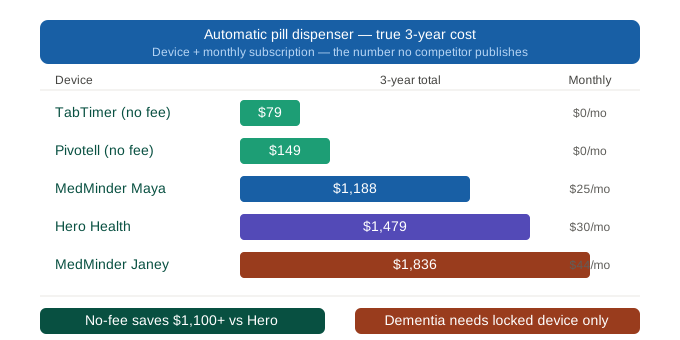
Year 3 total: $1,479
When Hero is the best automatic pill dispenser: Remote caregiver relationship. Parent is forgetful but not at risk of taking extra pills. Reliable home Wi-Fi. Tech-comfortable caregiver who will engage with the app regularly.
When Hero is NOT the best: Parent has dementia (unlocked = accessible pills = overdose risk). No reliable Wi-Fi (alerts stop working). Caregiver does not engage with apps or smartphones.
Best for Dementia — MedMinder Maya ($0–$30 + $35–$49/mo)
MedMinder Maya is the best automatic pill dispenser for any parent with dementia, cognitive decline, or a history of taking extra doses.
The key feature: it is locked. This is not a software lock or a behavioural barrier. It is a physical, mechanical lock. At each scheduled dose time, the rotary mechanism turns to the correct compartment and releases only that one dose. Every other compartment is inaccessible. Your parent cannot take extra pills between doses.
The locked/unlocked distinction is the single most important safety differentiator in the automatic pill dispenser category. Every other feature — app design, capacity, alert quality — is secondary to whether the device physically prevents overdose for a vulnerable senior.
MedMinder’s cellular plan means it works without home Wi-Fi — a critical advantage for seniors in rural areas, in assisted living, or in homes where the internet is unreliable. The escalation system (alarm → caregiver text → caregiver phone call → next contact on list) is the most persistent missed-dose response available in the consumer market.
Device: $0–$30 (promotional)
Monthly: $35–$49
Connectivity: Cellular (no Wi-Fi) or Wi-Fi
Lock: Yes — physically locked between doses
Capacity: 28 days (monthly refill)
Battery backup: 48 hours (best in category)
Year 3 total: ~$1,290
When MedMinder is the best automatic pill dispenser: Dementia at any stage. Cognitive decline creating double-dosing risk. No reliable home Wi-Fi. Caregiver needs escalating notification, not just a text.
Best Value — Bliss Meds ($69–$99, $0/mo)
Bliss Meds is the best automatic pill dispenser for caregivers who need locked dispensing without a monthly subscription.
It is a locked, timer-based device. At each programmed time, it releases the correct dose. The remaining pills are locked. There is a local alarm. There are no remote alerts — if your parent misses a dose, you will not receive a notification.
This is the right choice when the caregiver is physically present or nearby, checking in regularly. The local alarm handles on-site reminders. The locked design handles overdose prevention. The $99 one-time cost handles the budget.
Over three years, Bliss Meds costs $1,380 less than Hero and $1,191 less than MedMinder Maya. If remote notification is not a requirement, that is significant savings with no compromise on the core safety function.
Device: $69–$99
Monthly: $0
Lock: Yes
Alerts: Local alarm only
Year 3 total: $99
When Bliss Meds is best: Caregiver visits daily or every few days. Budget is a primary constraint. Locked dispensing needed without remote monitoring. Senior does not require escalating alerts to caregiver.
Best Simple Automatic Dispenser — TabTimer ($29–$49, $0/mo)
TabTimer is the best automatic pill dispenser for seniors who are cognitively intact and just need a scheduled alarm to remember their medication.
It is a manual organiser with a programmable alarm. Your parent fills it themselves, the alarm sounds at each dose time, and your parent takes the pills from the correct compartment. There is no lock and no caregiver alert. It costs $40.
For a senior with no cognitive decline and no overdose risk, this is not a compromise. It is the appropriate solution. Choosing Hero over TabTimer in this scenario means paying $1,439 more over three years for features — remote alerts, locked dispensing — that this senior does not need.
Device: $29–$49
Monthly: $0
Lock: No
Year 3 total: ~$40
When TabTimer is best: Independent, cognitively intact senior. Caregiver relationship is one of support, not management. The primary problem is “forgets to take pills,” not “takes too many pills.”
Best No-Subscription Locked Dispenser — Pivotell ($99–$149, $0/mo)
Pivotell is the best automatic pill dispenser for caregivers who need locked dispensing, no subscription, and a persistent alarm.
Unlike Bliss Meds which alarms once, Pivotell’s alarm repeats every few minutes until the pills are taken — making it harder for a senior to ignore. The rotary mechanism is mechanical and reliable. Battery-powered, so power outages do not interrupt dispensing.
Device: $99–$149
Monthly: $0
Lock: Yes
Year 3 total: $149
When Pivotell is best: Locked dispensing needed. No subscription preferred. Senior benefits from a repeating rather than single alarm. No remote monitoring required.
3-Year Cost Comparison — All 5 Options
| Device | Device Cost | Monthly | Year 3 Total | Lock | Alerts |
|---|---|---|---|---|---|
| TabTimer | $40 | $0 | $40 | No | Local beep |
| Bliss Meds | $99 | $0 | $99 | Yes | Local beep |
| Pivotell | $149 | $0 | $149 | Yes | Local persistent |
| MedMinder Maya | $30 | $35–$49 | ~$1,290 | Yes | Text + call |
| Hero | $149 | $36.95 | $1,479 | No | Text + email |
The gap between the subscription and no-subscription tiers is $1,140–$1,380 over three years. What that gap buys: remote caregiver notification when a dose is missed.
Whether that notification is worth $380–$460/year depends entirely on whether you can otherwise know if a dose was missed. If you visit daily: probably not worth it. If you live in another city: almost certainly worth it.
The Dementia Safety Section
For any caregiver researching automatic pill dispensers for a parent with dementia, this section is the most important in the guide.
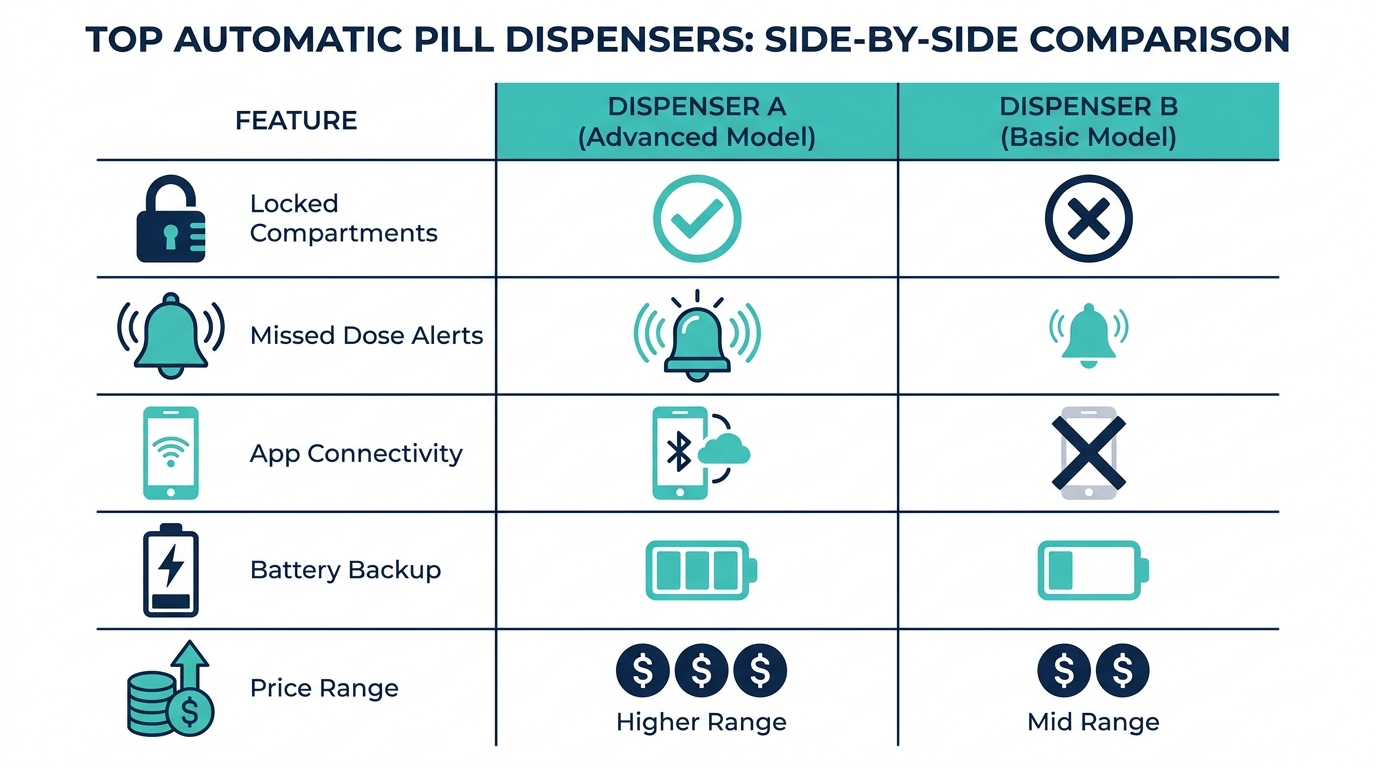
The locked/unlocked distinction is not a minor preference. It is a safety classification. An unlocked dispenser for a dementia parent is a device that can enable medication overdose.
When a dementia parent wakes at 2am feeling unwell, they may reach for the pill cup thinking it will help — not remembering they already took their morning dose. When a dementia parent sees the alarm go off and takes the pills, forgets, sees the alarm go off again (a device error or a subsequent dose alarm) and takes the pills again — the unlocked dispenser made both of those doses accessible.
A locked dispenser removes the physical possibility of this scenario. The pills are not accessible. The dementia parent cannot reach them regardless of intention or state of confusion.
This is why MedMinder Maya — not Hero — is the best automatic pill dispenser for any parent with dementia. And why the universal Hero recommendation on most review sites is a meaningful error for this population.
Does Medicare Cover the Best Automatic Pill Dispenser?
Medicare Part B: May cover automatic pill dispensers as DME if prescribed by a physician for management of a chronic condition. Medicare covers 80% after deductible from a Medicare-enrolled supplier.
Medicare Advantage: Some plans include medication management device benefits. Call member services and ask specifically.
FSA/HSA: Devices are generally eligible. Use pre-tax funds where available.
Medicaid HCBS: Some state programmes fund medication management devices for qualifying seniors. Contact your local Area Agency on Aging.
Frequently Asked Questions
Q: What is the best automatic pill dispenser?
A: Depends on the situation. Remote caregivers, forgetful parent: Hero. Dementia/overdose risk: MedMinder Maya. Budget, no remote alerts needed: Bliss Meds. Independent senior, just needs reminder: TabTimer.
Q: Is Hero really the best automatic pill dispenser?
A: Hero is the best for remote caregivers whose parent does not have dementia and has reliable Wi-Fi. It is not the best for dementia (unlocked), poor-internet homes (requires Wi-Fi), or budget-constrained caregivers (most expensive option over 3 years).
Q: What is the best automatic pill dispenser for someone with dementia?
A: MedMinder Maya. It is locked — physically preventing access to pills outside of scheduled dose times. Hero is not appropriate for dementia.
Q: What is the best automatic pill dispenser without a monthly fee?
A: Bliss Meds ($99, no monthly fee, locked). Pivotell ($99–$149, no monthly fee, locked, persistent alarm). TabTimer ($40, no monthly fee, unlocked, basic alarm).
Q: What is the best automatic pill dispenser for someone who lives alone?
A: MedMinder Maya — locked dispensing, escalating caregiver alerts (text then phone call), cellular option works without Wi-Fi. The escalation system is critical for a solo senior where a missed dose may mean no one notices without direct notification.
Q: Does the best automatic pill dispenser need a smartphone?
A: Hero requires a smartphone and Wi-Fi for full functionality. MedMinder Maya can be set up by the caregiver and operated by keypad by the senior — no smartphone needed for the senior. Bliss Meds and Pivotell require no smartphone.
Q: My parent has dementia and takes extra pills — which automatic pill dispenser prevents that?
A: MedMinder Maya. Physical lock on all compartments except the scheduled dose. Dementia parents cannot access extra pills because they are physically inaccessible, not because they are asked to follow a behavioral rule.
Q: Best automatic pill dispenser vs best for dementia — are they the same device?
A: No. The best overall automatic pill dispenser for most caregivers is Hero (remote alerts, app management, large capacity). The best for dementia is MedMinder Maya (locked, cellular, escalating alerts). These are different products for different safety needs. If your parent has any cognitive decline, the dementia recommendation applies.
Q: What is the best automatic pill dispenser that doesn’t need a smartphone or Wi-Fi?
A: MedMinder Maya on the cellular plan — works without Wi-Fi, caregiver receives alerts on any phone. Bliss Meds — no Wi-Fi, no smartphone, timer-based, local alarm only. Pivotell — fully mechanical, battery-powered, no internet or smartphone required.
Q: Is the best automatic pill dispenser worth the monthly fee?
A: Depends on what the fee buys. Hero’s $36.95/mo = remote caregiver text alerts + app medication history + missed dose notification. If you cannot know whether your parent took their medication without a notification, yes — it is worth it. If you visit daily or call every morning, the fee may be unnecessary. Bliss Meds ($0/mo, locked) and Pivotell ($0/mo, locked) provide the locked dispensing without the ongoing cost.
Q: Which automatic pill dispenser is best for a parent in a rural area with poor internet?
A: MedMinder Maya on the cellular plan. It does not require Wi-Fi — it connects via cellular network and sends caregiver alerts regardless of internet availability. Hero requires Wi-Fi and stops functioning as a smart device if the internet goes down.
Our Final Recommendation
Remote caregiver, forgetful parent without dementia: Hero. Hero Health
Parent with dementia or cognitive decline: MedMinder Maya. MedMinder Maya
Budget-conscious, caregiver nearby, locked dispensing needed: Bliss Meds. Bliss Meds
Independent senior who needs a reminder: TabTimer. TabTimer
Locked dispensing, no subscription, persistent alarm: Pivotell. Pivotell
Check Medicare Advantage coverage and FSA/HSA eligibility before purchasing. The right device at a reduced cost is better than the wrong device at full price.